Tag: Rig Veda date

  • Rig Veda 11,000 Years Old. Sarasvati River Research Satellite Images Dhola Vira Site

    Rig Veda 11,000 Years Old. Sarasvati River Research Satellite Images Dhola Vira Site

    The findings by Remote SensingAgency,Hyderabad,India,Computer simulation of Indian coast line and by National Institute of Oceanography,India, studied together make a startling revelation.

    The Vedas,contrary to what is being informed,is, are at least 10,000 years old.

    It is found,by simulation of flood in India,by Dr.Milne of Durham University that the land mass off the coast of Cambay,Gujarat,India,might be between 9000 and 12,000 years old.

    To understand this better one should know that the date of Indus Valley civilization,must be dated back fom the present,500o years ago concept ,which was based on the debunked Aryan Invasion theory..

    (I have written on the Fraud called Aryan Invasion.Shall be writing more on this.)

    The civilization was so advanced that it could be dated back in time.

    The answer lies in Dhola Vira,Rann of Kutch,Gujarat,India.

    Dhola Vira is dated, at least, about 4,500 years ago,according to Archeologist Sri. Bisht

    The well deveoped structures and advanced water storing wells indicate a civilization which has been there for quite sometime.

    The answer lies in the river Saraswathi.

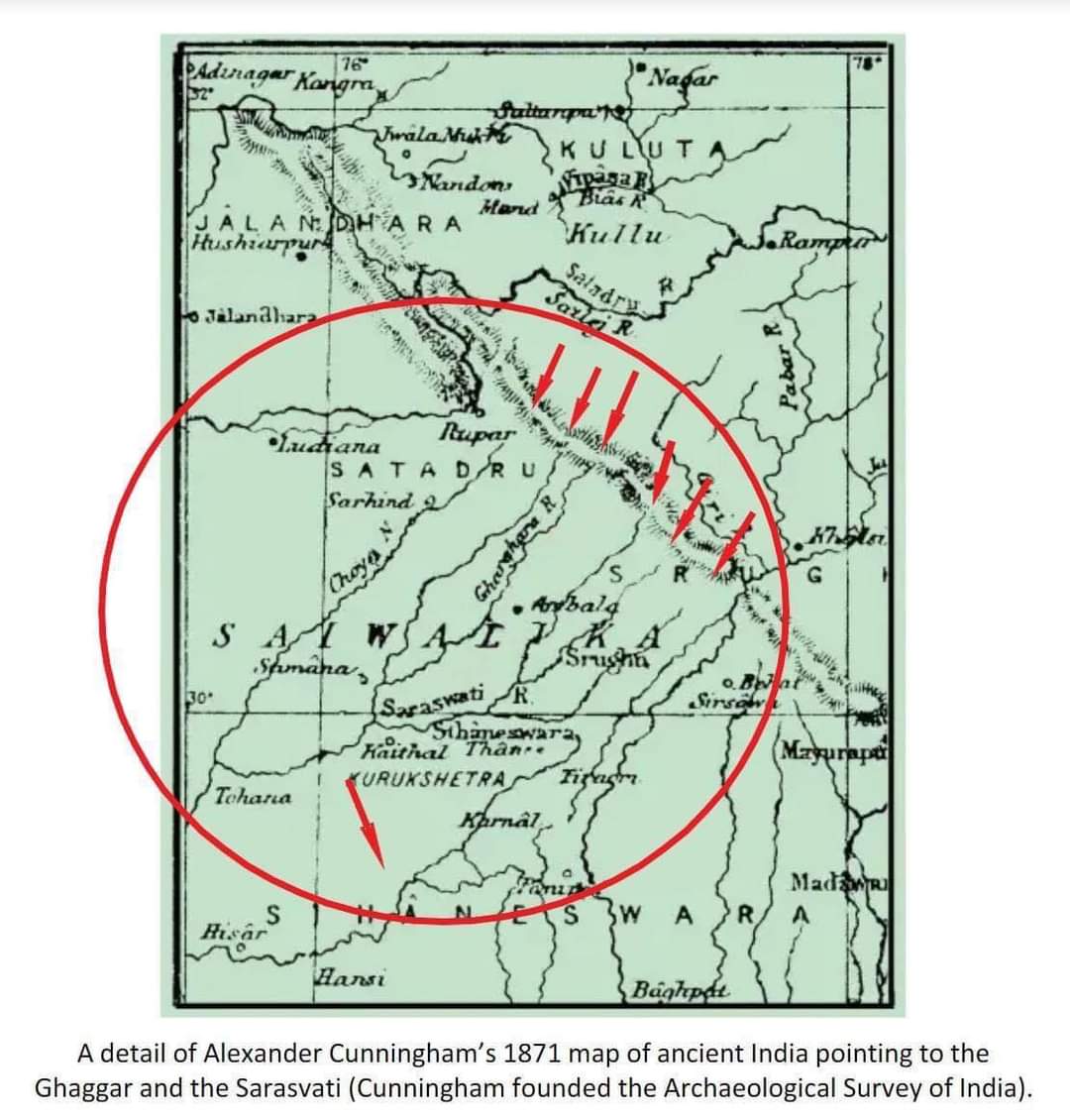
    River Sarasvati.image
    Sarasvati River,India,Satellite Image.

    According to Sri. Gupta, Remote Sensing Agency,Hyderabad,India,the Saraswathi River flowed from the Himalayan Galciers through Gujarat and joined the Arabian Sea in Gujarat.


    The river was 22 km wide!

    It flowed in Parallel to River Indus( Sindhu)

    This was found from the Satellite Images.

    And based on the melting of Himalayan Glaciers,Saraswathi River had flown between 10000 and 6000 years ago.

    Saraswati River Satellite images
    Saraswati River Satellite images

    Read this research paper in Nature.

    Punjab Rivers Satelite images
    Punjab Rivers Satelite images

    ‘The lost Saraswati River mentioned in the ancient Indian tradition is postulated to have flown independently of the Indus River into the Arabian Sea, perhaps along courses of now defunct rivers such as Ghaggar, Hakra and Nara. The persistence of such a river during the Harappan Bronze Age and the Iron Age Vedic period is strongly debated. We drilled in the Great Rann of Kachchh (Kutch), an infilled gulf of the Arabian Sea, which must have received input from the Saraswati, if active. Nd and Sr isotopic measurements suggest that a distinct source may have been present before 10 ka. Later in Holocene, under a drying climate, sediments from the Thar Desert probably choked the signature of an independent Saraswati-like river. Alternatively, without excluding a Saraswati-like secondary source, the Indus and the Thar were the dominant sources throughout the post-glacial history of the GRK. Indus-derived sediment accelerated the infilling of GRK after ~6 ka when the Indus delta started to grow. Until its complete infilling few centuries ago, freshwater input from the Indus, and perhaps from the Ghaggar-Hakra-Nara, probably sustained a productive marine environment as well as navigability toward old coastal Harappan and historic towns in the region.’

    * ka), a unit of time equal to one thousand (103) years.

    The above is an abstract of conclusions in a paper in Nature.

    Author information.

      • Nitesh Khonde

      Present address: Birbal Sahni Institute of Palaeosciences, Lucknow, 266007, India

    Affiliations

    1. Department of Geology, The M. S. University of Baroda, Vadodara, 390002, India

      • Nitesh Khonde
      • , D. M. Maurya
      • & L. S. Chamyal
    2. Physical Research Laboratory, Navrangpura, Ahmedabad, 380009, India

      • Sunil Kumar Singh
      • & Vinai K. Rai
    3. Geology and Geophysics, Woods Hole Oceanographic Institution, Woods Hole, USA

      • Liviu Giosan
      • Source of the article wanted above.

    https://www.nature.com/articles/s41598-017-05745-8

    ThecRig Veda,one of the earliest of the four Indian texts mentions Saraswathi repeatedly.

    • The Sarasvati is praised lavishly in the Rigveda as the best of all the rivers: e.g. in RV 2.41.16

    अम्बितमे नदीतमे देवितमे सरस्वती अपरास्तस्य इव स्मासि प्रशस्तिम् अम्ब नास्कृतिम्

    • Oh Mother Saraswati you are the greatest of mothers, greatest of rivers, greatest of goddesses. Even though we are not worthy, please grant us distinction

    Other verses of praise include RV 6.61.8-13, RV 7.96 and RV 10.17. In some hymns, the Indus river seems to be more important than the Sarasavati, especially in the Nadistuti sukta. In RV 8.26.18, the white flowing Sindhu ‘with golden wheels’ is the most conveying or attractive of the rivers.

    • RV 7.95.2. and other verses (e.g. RV 8.21.18) speak of the Sarasvati pouring “milk and ghee.” Rivers are often likened to cows in the Rigveda, for example in RV 3.33.1,
    Like two bright mother cows who lick their youngling,
    ( source of the Quote.

    https://en.m.wikipedia.org/wiki/Sarasvati_River

    So Rig Veda can be dated at 10,000 Years ago.

    Featured image of Dhola Vira Well. Wiki.

  • Sky Maps Star Position During Rig Veda Rama Krishna Birth

    Indian Puranas, History and The Epics are not fairy tales.

    They are facts.

    I have been verifying statements events mentioned in these texts with the help of Astronomy, etymology of word used,archeological evidence,Anthropology,Geology and tools like Carbon Dating, Atomic verification,Infra red evaluation.

    I have published posts on many events narrated in the Indian Texts.

    Now I am posting information on the appearance of the sky during,

    The Rig Vedic Period,

    Rama’s Birth,

    Krishna’s Birth.

    These maps have been arrived at running the references found in these instances through a Software designed to arrive at star positions and period..

    Rig Vedic Period Sky Map.

    There are 53 references in Rigveda as prayers offered to Aswinis at dawn. The description clearly points to the observation of the pair of stars in the Aries constellation (referred to as Aashvin or Asvini) just before sunrise as a ritual to mark the year beginning. Using Planetarium software, we find that the Winter Solstice occurred on 19 December, 7000 BC at 0735 hrs as shown in Figure 1. This is the earliest reference to Vedic calendar with year beginning at Winter Solstice, found in Rigveda (5-77-1/2; 1-46-14; 7-69-3/2). Heliacal rising of Ashwini Nakshatra (Aries) can be seen to occur on 5th January, 7000 BC, marking the year beginning (Fig. 1).

    Skymap during Ri Vedic Period.png
    Skymap during Ri Vedic Period.Fig. 1

    Pre Dawn Sky during Rig Vedic Times.

    A thousand years later, Winter Solstice no longer occurred near Aries (Asvini) due to precession. As a result, Ashwinis were no longer rising heliacally as before. They were still below the horizon at sunrise around Winter Solstice time. The Winter Solstice had moved to Revati by 6000 BC. Thus the precession of Equinoxes and Solistices was being observed by Rigvedic Scholars.

    The Sky of 19th December, 6000 BC at sunrise on the Winter Solstice day shows that Ashvini gave way to bright star Chitra (α Vir) on opposite side (Western horizon). A full Moon in Chitra Nakshatra provided a new time marker in the sky and heralded the lunar month naming system-Chaitra, Vaisakha etc. (Rigveda: 5-74-1,2 and Tait Samh. 7-4-8). See Fig. 2 –

    Winter solstice sky Ri Veda Period.jpg
    Fig.2 .The Sky of 19th December, 6000 BC at sunrise on the Winter Solstice day shows that Ashvini gave way to bright star Chitra (α Vir) on opposite side (Western horizon). A full Moon in Chitra Nakshatra provided a new time marker in the sky and heralded the lunar month naming system-Chaitra, Vaisakha etc. (Rigveda: 5-74-1,2 and Tait Samh. 7-4-8).

    Please check my post on Agstya star, Canopus Validates Sanatana Dharma.

    Rama’s Birth, Sky Map.

    Rama was born on the Navami tithi of Shukla Paksha of Chaitra masa(9th day of the increasing phase of the moon in the lunar month of Chaitra).At that time, the nakshatra was Punarvasu, and Sun, Mars, Saturn, Jupiter and Venus were in Aries, Capricorn, Libra, Cancer and Pisces respectively. Lagna was Cancer and Jupiter & Moon were shining together. — Ramayana 1.18.8,9.

    1. Sun in Aries
    2. Saturn in Libra
    3. Jupiter in Cancer
    4. Venus in Pisces
    5. Mars in Capricorn
    6. Lunar month of Chaitra
    7. 9th day after New Moon
    (Navami Tithi, Shukla Paksh)
    8. Moon near Punarvasu Nakshatra
    (Pollux star in Gemini constellation)
    9. Cancer as Lagna
    (Cancer constellation rising in the east)
    10. Jupiter above the horizon
    The observations on the left, when entered into Planetarium software gives us the above Sky Chart, which in turns gives forth the below mentioned date.

    Sri Rama Navami – 10th January 5114 BCE – Birth Day of Rama
    Observation at 12.30 p.m.

    Skymap During Krishna’s Birth.

    Lord Krishna was born around midnight. That night was the eight phase of the moon known as Ashtami Tithi. The moon was near Vrshabha, the bull, i.e the Taurus constellation that houses the star Rohini. The star Rohini is known as Aldeberan in modern astronomy. The month was Shravana, one of the 12 months in the Indian calendar.

    Shravana vada ashtami, Rohini Nakshtra, uditam Lagnam

    ( Srimad Bhagavatham, Skanda 10, Chapter 3.)

    Sky During Krishna's Birth.jpg
    Sky During Krishna’s Birth.

    Date of Krishna’s Birth By Gregorain Calendar.

    27th July, 3112 BCE .

    Couple of Points.

    1.Astronomical events repeat themselves at regular intervals.hence fixing one date is difficult.

    We are taking the last event for calculation.

    As time is Eternal and Cyclic, the events repeat themselves.

    Please read my posts on Time Non Linear for more information.

    You may check my posts under Astrophysics on Astrodating and dating of Events.

    Citations and Sources.

    Krihsna’s Birth , Skymap.Image courtesy. Sri. Narahari Achar, Memphis Univesrsity US.

    https://kalyan98.wordpress.com/2007/12/25/ramayana-era-based-on-planetarium-software/

    http://sarojbala.blogspot.in/2012/06/scientific-dating-of-ramayan-era.html

    https://bharathgyanblog.wordpress.com/