Tag: Ramayana

  • Ramayana Mahabharata Dynasties From Manu

    I have posted on Lord Rama‘s Date of birth,Travels,His Death, Krishna‘s Dwarka,Date of Ramayana, Mahabharata,Bhagavad Gita,Rig Veda,Rama’s Ancestors,Kauravas Names.

    Please find them under Hinduism/History.

    For easy reference I am providing  Flow charts from http://ancientvoice.wikidot.com on The Ikshwagu Dynasty) of Lord Rama,and Manu, based on Hindu Puranas.

    Click on the Image to enlarge.

    The Ikshvaku Dynasty.
    The Ikshvaku Dynasty.
    Dynasties since the beginning of Time.
    Dynasties since the beginning of Time.

    Source: http://ancientvoice.wikidot.com/

  • Names List of Ancient Indian Kingdoms Landmass

    The Vishnu Purana, where the Evolution of the Universe is described, also describes a Number Kingdoms, there were fifty-six .

    The other Seventeen Puranas also do for this for the description of the Universe and the Bharatavarsha is one of the Rules for being classified as a Purana.

    There is also a tradition that there were fifty-six Kingdoms in India, this is explained in the Mahabharata, where the Story of Nala and Damayanti is narrated.

    It provides  a list of fifty-six kings who attended the Swayamvara of Damayanti.

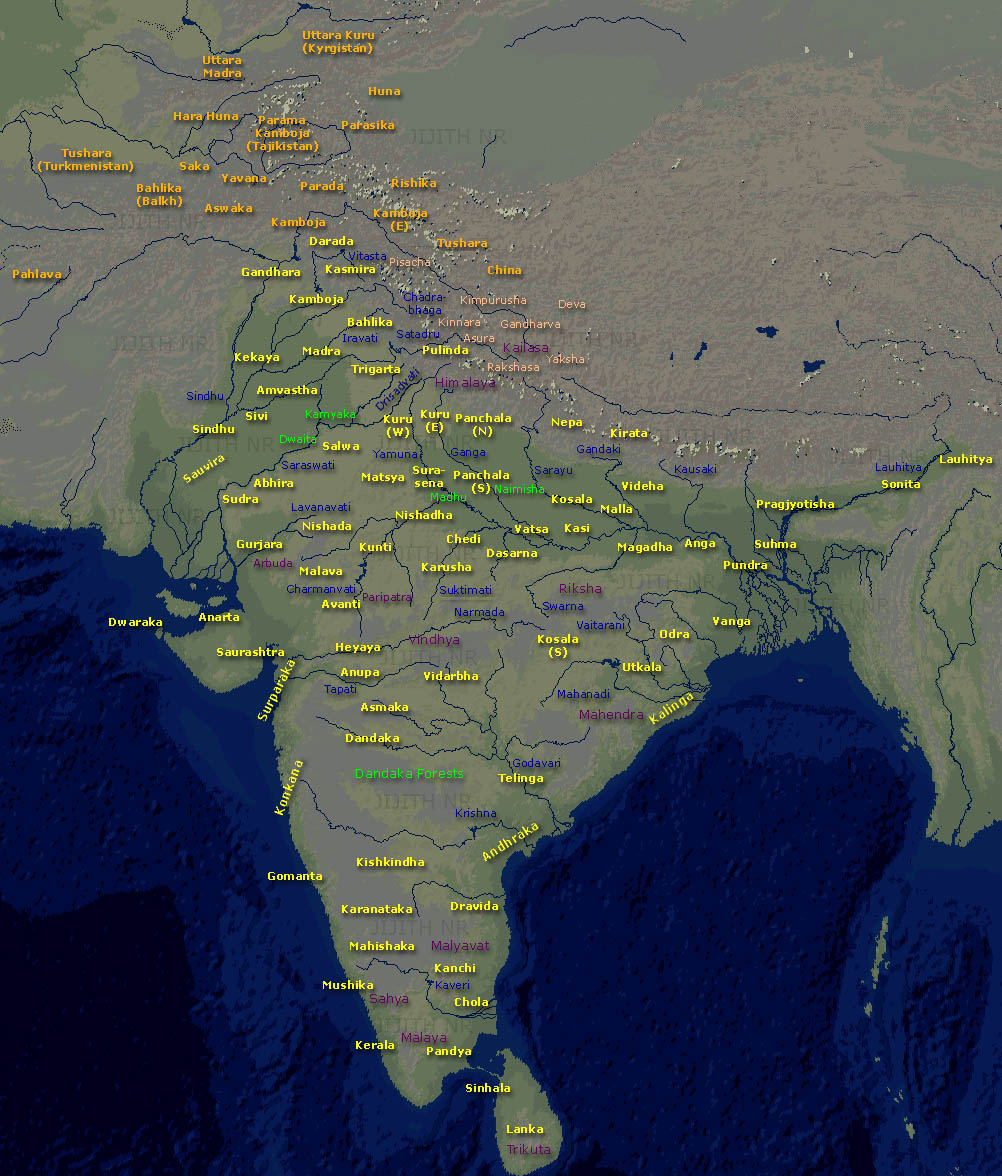
    Ancient Map, India.
    Map of ancient Indian kingdoms during epic periods Source.http://veda.wikidot.com/kingdoms-of-ancient-india

    The Ramayana also lists more or less the same number in the Ramayana for the Swayamvara of Sita.

    Tamil Classical Literature also mentions fifty-six Kingdoms.

    Now I came across information that the number of Kingdoms are not fifty-six but seventy-six,

    One may note from the Sankalpa or Resolution a Hindu chants for a function includes the Line.

    Jambo Dweepe.,Bharata Varshe, Bharatakkande’

    ‘KANDA ‘ Means Continent.

    As Kanda has already been mentioned, Varsha must be larger than this but smaller than Jambudweep.

    There is a view that Jambudvipa  means ‘beginning from Kashmir’

    The Term Jamboo means  a Tree bearing a Fruit of the same name, a type of Blackberry.

    I do not see any connection between this Blackberry and Kashmir..

    As the text goes on to describe the geographical locations, it must be indicative of a Large Mass of Earth,smaller than a Planet, bigger than a continent.

    Again the Ancients Texts mention ‘Milechas’ indicating people beyond the Bhartakanda, but not approved by the Bharatvarsha and are declared to be unfit to be called as  decent as Human Beings.

    Some subscribe to the view that the term Milecha means the early European tribes, including the Americans.

    I do not think so.

    Texts also mention about these tribes as Nomads differentiating them from those who are unfit.

    So the Jambudweep must mean(Dweepa means Continent) ,a large Island Continent, possibly Atlantis.

    Lemuria has been included in the Dravidian land Mass.

    Now I have information from a site that lists 76 Kingdoms.

    More information is welcome.

    Source Ref:

    http://ancientvoice.wikidot.com/kingdom-list

    Jamvudvipa is the name of the regions south of the Himalaya region as per ancient Indian texts. Some identifies this region with the Jammu region that lies to the immediate south of Himalaya in Kashmir. Others identify it with the whole of Indian peninsula that lied to the south of the Himalayan range and also consider Himalaya to be a mountain range that surrounds this region both to the west (the western mountain ranges in Pakistan , north (Himalaya proper) and east (eastern ranges in North-Eastern India and Myanmar) of it.

    Below is the Ancient India Map I created in 2004. It is formerly added to Wikipedia under creative common license. It is also used by many web-sites dealing with ancient India. Jamvudwipa is the Indian Peninsular region which can be seen in this map. The smaller Jamvu region is the region south of Kasmira, between the rivers Vitasta and Chandrabhaga. It is not marked in this map.

    Gandhara Kamboja Kekaya Madra Kuru-Bahlika
    Dwaraka Anarta Sindhu Sauvira Sivi
    Sudra Abhira Nishada Nishadha Matsya
    Kasmira Prakjyotisha Trigarta Kuru Salwa
    Karusha Dasarna Chedi Panchala Surasena
    Avanti Kunti Vatsa Kasi Kosala Malla
    Hehaya Saurashtra Nasikya Anupa Surparaka
    Vidarbha Dandaka Asmaka Kishkindha Karanataka
    Konkana Gomanta Mahishaka Mushika Kerala
    Lanka Vanavasika Kanchi Chola Pandya
    Sinhala Vanga Kalinga Telinga Dravida
    Mekala Utkala Odra Andhra Dakshina Kosala
    Suhma Pundra Anga Magadha Kikata
    Lauhitya Prakjyotisha Videha Kirata Yaksha
    Deva Asura Pisacha Kinnara Gandharva
    Uttarakuru Suparna Naga Kimpurusha Rakshasa
    Uraga Aratta Loha Rishika China
    Tushara Strirajya Aswaka Romana Huna
    Parasika Yavana Mleccha Darada Saka

    Please read my posts on Sankalpa, Geotagging in Hinduism,Vedic period Posts under, Hinduism, Indian Philosophy,History.Astrophysics.

  • Atheism In Ramayana Rama Jabali Discussion

    Atheism In Ramayana Rama Jabali Discussion

    Three is a thinking that Atheism and the so-called ‘Rational Thinking’ is the prerogative of the Modern Man and the early Hindu scriptures did not have these thoughts.

    Far from Truth.

    The Ramayana ‘one of the early Epics of the Hindus ,The Ramayana contains , seemingly more irrefutable arguments than the Modern  Thinkers(?).

    Other Philosophical systems like the Nyaya,Sankhya,Charvaka, do have Atheistic thoughts and they are respected and included systems of Philosophy.

    Buddhism and Jainism also fall under this category.

    That those who decried the concept of God and the worship of idols have their Statues erected and worshiped as ‘Gods’ is another story!

    1. When Lord Rama decided to  honor his father Dasaratha’s words and leave for the forest, Jabali, a Brahmin priest tries to dissuade Rama from going to the forest by questioning the authority of the Vedas, the existence of God,Truth, Theory of Rebirth,Sins.

    The arguments advanced by Jabali are very logical, though seemingly.

    That Lord Rama refutes them point by point is another matter.

    Excerpts of Jabali’s arguments and Lord Rama’s Reply

    “Rama, you are too much of a simpleton. Let not your understanding get deluded like an ordinary man’s. A man takes birth alone and alone he perishes. Therefore, he who wallows in affection for parents is insane. Discarding the kingdom at your father’s request and taking shelter in inaccessible and dangerous forests is not your duty. Return to prosperous Ayodhya this instant. That city, like an abandoned wife in a single-braid, awaits you. There pass the days enjoying the kingdom and live in supreme happiness like Indra in the world of the gods. Dasharath is no one to you. He is a distinct being and so are you. Child, you are being ruined because of your own flawed intelligence. I am extremely worried about those who, discarding concrete goals, live only for religion. For, after suffering various tortures in this world they are utterly destroyed. People perform funeral obsequies offering food to departed ancestors. Now, this is unnecessary waste of food; for who has ever heard that dead persons can eat? Those scriptures that contain prescriptions for worshipping gods, sacrifices, donations, ascesis and other rituals, have been prepared by wise men only to keep people subjugated. Therefore, Rama, comprehend that there is nothing whatsoever as dharma for the after-life. Act on what is before you and engage yourself for what is to come. Bharat is requesting you. Following the unanimous advice, accept the responsibility of the kingdom.”2

    Hearing Jabali’s words, Ramachandra, basing himself on knowledge of dharma, said:

    “Rich-in-ascesis Sir, what you have said desiring my welfare is actually improper but seems to be duty. Your advice is anti-Vedic and you are an atheist fallen from dharma. Properly I condemn my father’s appointment of you as priest. As a Buddhist deserves the same punishment as a robber, so too should an atheist be punished. Therefore, discriminating people do not even speak to those atheists who are to be avoided as driven beyond the Vedic pale.”

    Jabali meekly replied, “Rama, I am not atheist; nor am I voicing atheistic views. And it is not that there is nothing such as an after-life. Expediently, as the situation demands, I turn an atheist and after an interval become a believer. The time when it is necessary to become an atheist has come. For turning you back from the forest now I spoke thus and now, again, it is for pleasing you that I am withdrawing what I said.”

    After hearing Jabali’s words, Rama the best among virtuous and upright men spoke with a great devotion and with an undisturbed mind of his own (as follows);

    “That which, in your desire to please me, you have counselled, is impossible though it appears to be possible. It is like a forbidden food, appearing to be an agreeable one. He who is unruly, fully invested with ill-conduct, having a bad reputation and seeing differences in everything, does not gain respect from honest men. One’s conduct itself explains whether one belongs to a good family or a bad family, valiant or arrogant and chaste or unchaste. What sensible man, able to discern what is just and what is unjust, in this world, would respect me, if I am ignoble resembling as noble, bereft of honesty, impure, having no good qualities but appearing like the one having good qualities, ill-behaved but appearing as well-behaved abandoning righteousness and getting hold of unrighteousness in the guise of piety, creating confusion in the world and disregarding rules of conduct.”

    “If I behave in this manner faithlessly, to whom can I advise a prescribed conduct? How would I attain heaven? This entire world would follow its own whims, for, whatever the conduct of the kings may be, such will be the conduct of their subjects.”

    “The eternal royal governance is indeed an assemble of truth and not cruel. Hence, the kingship has the Truth as its essence. The world is established in Truth. Even sages and divine being have respected truthfulness alone. The one who speaks truth obtains the highest position in this world.”

    “People fear of a person, who speaks untruth, as one fears a snake. Truth is the highest virtue and is stated to be the origin of heaven. Truth is god and all virtues follow truth. All are rooted in truth there is nothing higher than truth.”

    “Gift sacrifice, oblation, austerities performed and the scriptural texts have the foundation in Truth. Hence, one should thoroughly surrender to truth. One rules over the world. One develops a race. One sinks into hell . One rises high to heaven (according to one’s degree of truthfulness practiced). I am true to my promise. Why should I not fulfill the command of my father, who was a devotee of truth?”

    “Neither covetousness nor forgetfulness nor pride would cause me to destroy the bond of morality. I shall honour the vow made to my father. Neither gods nor the manes will accept the offerings of those who are wanting in truth, unsteady and unstable in their minds. This is what is taught to us.”

    “I perceive this virtue i the form of truthfulness as a universal permeation of spirit. That is why, this burden, observed as a vow, has been honoured by good men. I renounce the so-called duty of a warrior, it is injustice under the name of justice, it is practised by petty cruel and covetous men of evil deeds.”

    “Sin is committed by the body after it has been conceived by the mind and falsehood is spoken with the tongue. Thus, the degrading act is of three types (with body, mind and tongue) The earth, fame, prosperity and fortune indeed woo a man of truth. They constantly oblige the truth: truth should therefore be strictly observed!”

    “The logical words, you have made it out to be good, saying ‘Do this good thing’ as uttered to me, are really unworthy. Having promised before my father about my exile to the forest, how can I fulfill Bharata’s words now, abandoning the father’s words?”

    “A firm promise has been made by me in the presence of my father, when Queen Kaikeyi too became rejoiced. I will proceed with life-journey in this manner, by accepting this dwelling in the forest, by remaining pure in body and mind, having controlled my diet, by feasting the Gods and Ancestors with pure roots, flowers and fruits, with all my five senses fully sated, without any deceit, fully devout and discriminative of what ought to be done and what ought not to be done.”

    Source:

    http://www.valmikiramayan.net/ayodhya/sarga109/ayodhya_109_prose.htm

    http://www.boloji.com/index.cfm?md=Content&sd=Articles&ArticleID=1387#sthash.Ejrjt8j3.dpuf

  • Lest We Forget

    Indians,

    India.
    India.

    We gave The World,

    The Bhagavad Gita,

    Longest Epic Mahabharata,

    Ideal Man in Ramayana,

    The Vedas, the fountainhead of Knowledge,

    Sixty Four Arts,

    The Art Of Dancing Bharatanatyam,

    Music in Mathematical Progression,Carnatic Music,

    Surgical Treatise,  Susruta

    Varahamihiram, Science of Medicine ,

    ”0′

    “Infinity’

    The Science of Logic, Tharka,

    Sanskrit, the most complete Language, compatible with modern Software coding.

    Grammar of Panini,

    Kalidasa,

    Astronomy, Arya Bhatta,

    Ancient temples of 2000 yeas with advanced Architectural Concepts.

    Yoga of Patanjali,

    More than 23 languages,

    Over 1300 dialects,

    We never invaded,

    Nor did we enslave Nations,

    Do not be misled by  The West into thinking that you are rubbish.

    The ills like jokers like Politicians,Corruption,a Phase.

    Be proud ,active  and honest.

  • Ravana’s Grand Father Pulasthya Statue Found.

    Sage Pulastyas Statue,
    The place where the statue is found was known as
    Pulastipura in olden times.
    This information can be found in the official Ramayana site of Srilanka.
    In contrast, there is no official effort by India
    to chronicle the historic sites connected with Ramayana in India. Source: wiki

    I blogged on the fact that Ravana was real and he existed.

    I had provided facts to support my statement.

    Now it transpires that the Statue of  Sage Pulasthya, Grandfather of Ravana seems to have been found in SriLanka.

    Story:


    The Srilankan site says that
    “The Central Government of India appointed a committee of 14 historians
    to identify the authenticity of Ramayana
    but was unable to find any historical or archaeological evidence in India.
    However, Sri Lanka can prove the validity of Ramayana
    with available archaeological and historical evidences.”
    That puts in perspective the kind of apathy of the Indian Government
    in matters related to Hinduism,
    inspite of the voluminous literature and traditions
    related to the places trailed by Rama.
    Both Rama and Krishna had walked
    throughout the length and breadth of India
    thereby creating an everlasting memory to the people of various parts of India.
    That memory continues to live even today.
    In this context, it is a welcome development
    that experts from various branches of science have come together
    to unravel the past prior to 2000 BC. (Read previous post).

    In this post I wish to say something I know of sage Pulastya.
    Pualstya’s name appears in different places.
    There are astrological Siddhanthas attributed to Pulaha in some texts and Pulastya in some.
    As astrological-  astronomical Sidhantha called Paulisa siddhantha
    was authored Pulasthya,
    which was compiled as one of 5 siddhanthas of
    “Pancha Siddhanthika” of Varahamihira.
    The authorship of this is attributed to sage Pulaha by some
    and to Pulasthya by others making us think
    that both are one and the same.
    But  Pulasthya and Pulaha are mentioned

    as separate entities in Mahabharatha.
    Source:
    Related: