Tag: Prophet in Vedas

  • Muhammad In Vedas Non Sense Proof Vedic Text

    Muhammad In Vedas Non Sense Proof Vedic Text

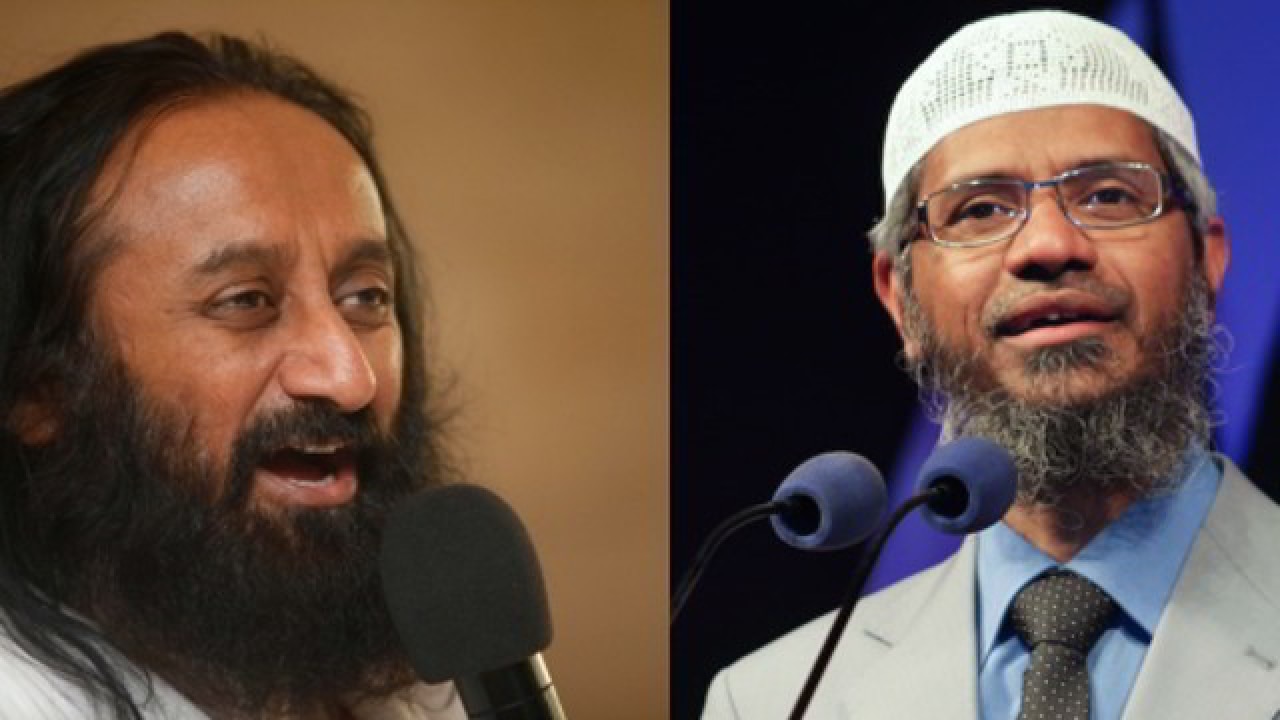
    Zakir Naik in his discussion with Sri Sri Ravishankar of The Art of Living, in Television, said that the Right Veda mentions Muhammad. And this was picked up by Islamic sites and Secular Indians who try to to justify everything that insults Sanatan Dharma went overdrive and have posted information on the web, justifying Zakir Naik.

    Naik is a pseudo Hindu scholar and quotes non existent verses and chapters in Vedas. There are many like him. They assume that people would be so awestruck that they will not check the referred source. His knowledge of Hinduism is so great that he clubs Vedas and Purans together! To add to his scholarship he peppers his talks with his reference to Smriti and says they lack the authority of Vedas, which is is true. Because of this selective facts he gains credibility.

    Convinced of his scholarship, many a site went on stating that Muhammad is mentioned in Sama Veda, Atharva Veda!

    Vedas contain only prayers and no history as it is found in Puran. We infer information about persons or events only when the circumstances when a Mantra is revealed or when or how a Ritual is performed.

    I am providing such great Findings and the actual text of the referred Mantras. Translation is also provided. Please visit the links which are provided as source for Mantra Text .

    I will write more on other points which state that Islam is found in Hinduism.

    The main points mentioned in the Kuntap Suktas i.e. in Atharvaveda book 20 Hymn 127 verses 1-13 are:Mantra 1
    He is Narashansah or the praised one (Muhammad). He is Kaurama: the prince of peace or the emigrant, who is safe, even amongst a host of 60,090 enemies.

    Mantra 2
    He is a camel-riding Rishi, whose chariot touches the heaven.

    Mantra 3
    He is Mamah Rishi who is given a hundred gold coins, ten chaplets (necklaces), three hundred good steeds and ten thousand cows.

    Mantra 4
    Vachyesv rebh. ‘Oh! ye who glorifies’…

    The original and Griffith translation of the Sukta below. This one, in reality, glorifies the rule of a king Kaurama.

    20.127
    इदं जना उप श्रुत नराशंस स्तविष्यते ।
    षष्टिं सहस्रा नवतिं च कौरम आ रुशमेषु दद्महे ॥१॥
    उष्ट्रा यस्य प्रवाहणो वधूमन्तो द्विर्दश ।
    वर्ष्मा रथस्य नि जिहीडते दिव ईषमाणा उपस्पृशः ॥२॥
    एष इषाय मामहे शतं निष्कान् दश स्रजः ।
    त्रीणि शतान्यर्वतां सहस्रा दश गोनाम् ॥३॥
    वच्यस्व रेभ वच्यस्व वृक्षे न पक्वे शकुनः ।
    नष्टे जिह्वा चर्चरीति क्षुरो न भुरिजोरिव ॥४॥
    प्र रेभासो मनीषा वृषा गाव इवेरते ।
    अमोतपुत्रका एषाममोत गा इवासते ॥५॥
    प्र रेभ धीं भरस्व गोविदं वसुविदम् ।
    देवत्रेमां वाचं स्रीणीहीषुर्नावीरस्तारम् ॥६॥
    राज्ञो विश्वजनीनस्य यो देवोमर्त्यामति ।
    वैश्वानरस्य सुष्टुतिमा सुनोता परिक्षितः ॥७॥
    परिछिन्नः क्षेममकरोत्तम आसनमाचरन् ।
    कुलायन् कृण्वन् कौरव्यः पतिर्वदति जायया ॥८॥
    कतरत्त आ हराणि दधि मन्थां परि श्रुतम् ।
    जायाः पतिं वि पृच्छति राष्ट्रे राज्ञः परिक्षितः ॥९॥
    अभीवस्वः प्र जिहीते यवः पक्वः पथो बिलम् ।
    जनः स भद्रमेधति राष्ट्रे राज्ञः परिक्षितः ॥१०॥
    इन्द्रः कारुमबूबुधदुत्तिष्ठ वि चरा जनम् ।
    ममेदुग्रस्य चर्कृधि सर्व इत्ते पृणादरिः ॥११॥
    इह गावः प्र जायध्वमिहाश्वा इह पूरुषाः ।
    इहो सहस्रदक्षिणोपि पूषा नि षीदति ॥१२॥
    नेमा इन्द्र गावो रिषन् मो आसां गोप रीरिषत्।
    मासाममित्रयुर्जन इन्द्र मा स्तेन ईशत ॥१३॥
    उप नो न रमसि सूक्तेन वचसा वयं भद्रेण वचसा वयम् ।
    वनादधिध्वनो गिरो न रिष्येम कदा चन ॥१४॥

    1Listen to this, ye men, a laud of glorious bounty shall be sung.
    Thousands sixty, and ninety we, O Kaurama, among the Rusamas have received.
    2Camels twice-ten that draw the car, with females by their side, he gave.
    Fain would the chariot’s top bow down escaping from the stroke of heaven.
    3A hundred chains of gold, ten wreaths, upon thee Rishi he bestowed,
    And thrice-a-hundred mettled steeds, ten-times-a-thousand cows he gave.
    4Glut thee, O Singer, glut thee like a bird on a ripe-fruited tree.
    Thy lips and tongue move swiftly like the sharp blades of a pair of shears.
    5Quickly and willingly like kine forth come the singers and their hymns:
    Their little maidens are at home, at home they wait upon the cows.
    6O Singer, bring thou forth the hymn that findeth cattle, findeth wealth.
    Even as an archer aims his shaft address this prayer unto the Gods.
    7List to Parikshit’s eulogy, the sovran whom all people love,
    The King who ruleth over all, excelling mortals as a God.
    8’Mounting his throne, Parikshit, best of all, hath given us peace and rest,’
    Saith a Kauravya to his wife as he is ordering his house.
    9’Which shall I set before thee, curds, gruel of milk, or barley-brew?’
    Thus the wife asks her husband in the realm which King Parikshit rules.
    10Up as it were to heavenly light springs the ripe corn above the cleft.
    Happily thrive the people in the land where King Parikshit reigns.
    11Indra hath waked the bard and said, Rise, wander singing here and there.
    Praise me, the strong: each pious man will give thee riches in return,
    12Here, cows! increase and multiply, here ye, O horses, here, O men.
    Here, with a thousand rich rewards, doth Pūshan also seat himself.
    13O Indra, let these cows be safe, their master free from injury.
    Let not the hostile-hearted or the robber have control of them.
    14Oft and again we glorify the hero with our hymn of praise, with prayer, with our auspicious prayer.
    Take pleasure in the songs we sing: let evil never fall on us.

    Reference and citations. https://www.google.com/amp/s/cbkwgl.wordpress.com/2018/06/25/kunthap-sukta-atharva-veda/amp/

    Kuntap Sukt are sections in the twentieth chapter of the Atharva Veda. These are read every year in big assemblies in prayers and where sacrifices are offered. Seventeen leading pandits assemble annually to recite these mantras (verses) with great devotion. Kuntap Sukt are mentioned in several most ancient Hindu books – Aitreya Brahmana, Kaushitki Brahmana, Gopath Brahmana, Shankhayana Shraut Sutar, Ashvlayana Shraut Sutar, and Vaitan Sutar.

    The word Kuntap means to consume sin and misery, and it is composed from Kuh (sin and misery) and tap (to consume). The word Kuntap also means the ‘hidden glands in the abdomen,’ inferring the true meaning to be revealed only to those who are able to develop sufficient insight. As a comparison, Makkah (Mecca) is called the mother of towns (Umm al Qura) or the navel of the earth. Dr. Vidyarthi shows that the word Kuntap is derived from Bakkah (Makkah). In the analysis of Sanskrit and Arabic words having the same meaning such as in the preceding Table, the word ‘b’ in Arabic is used as ‘p’ in Sanskrit (in our times, one example is that of soft drink Pepsi; it is written and pronounced as Bebsi in the Arab world). A certain ‘t’ in Arabic becomes silent and pronounced as h depending on its position in that word (see Table 3, below). For example, ‘tun’ in Medinatun is replaced by h when pronounced (both t and n are dropped). Further, many Sanskrit words having parallel in Arabic are written backwards (see Table 2, above). Thus one can see the similarity between the word Kuntap and Bakkah (each containing letters k, n, t, p). Dr. Vidyarthi further demonstrates from the context of prophecies that Kuntap in fact refers to Ka’bah and Makkah (Mecca). Interestingly, the words Bakkah and Ka’bah use the same root words.’https://saifur.tripod.com/kuntap.html

  • Kaaba Siva Temple Sri Sri Ravishankar Zakir Naik My Rebuttal Series

    Kaaba Siva Temple Sri Sri Ravishankar Zakir Naik My Rebuttal Series

    Shiva Linga in Kaaba controversy does not seem to leave me ever since I wrote on ‘Kaaba Shiva Temple, 786 is flipped OM, the sacred symbol of Hindus, Vedic practices in Islam, Siva Sthuthi by Prophet’s Uncle, History of Pre Islamic Arabia, Sapthapadhi practices in Arabia, Zam zam water Ganga Connection, Arabia was a part of Vikramaditya’s Kingdom, Mannat idol, which was reported to have survived  (among some Idols) Prophet Muhammad’s Destruction of 360 Idols in Kaaba, was the main reason why Ghazni Muhammad’ s invasion of Somnaath temple Eighteen Times because he believed the idol of Mannat was in Somnath Temple.

    Though I had written the articles quite sometime back, comments are still being received . Some of them in Facebook .Though some comments are very constructive, some are offensive and even abusive.This is not unique.It is not limited to these articles alone.Most of my articles, especially relating to presence of Sanatan Dharma in ancient world Cultures receive the same treatment. These articles are written with references to authentic sources/ links.Most of the comments express incredibility about the facts presented and call my articles being pro Hinduism and without any evidence.Those who post the comments do not bother to check the information provided in the article and related information/articles presented .

    This approach is not limited to my articles alone.Any information that highlights the antiquity of Sanatan Dharma and it’s influence on other cultures:how Tamil culture has been a forerunner of many a cultures.

    I recently came across an article in a reputed website which publishes articles purported to be researched and with authentic information .It is http://www.jstor.org. I have provided the link of this site towards the close of this article by way of link to the information I have provided in this article.

    For my articles on Kaaba being a Shiva temple, in Pre Islamic Period,and my references about 300 Idols being destroyed by Prophet.i had also written that one of the idols that survived, Mannat was believed to have been spirited away to India , that it was housed in the Somnath Temple and that was the reason why Ghazni Muhammad invaded and looted Somnath Temple in Gujarat.

    Instead of checking out facts, comments are being made that it is my fantasy.There was a mention that Kaaba was not Hindu temple but was A Pagan Temple. They should have checked what or which was the forerunner of Pagan Worship.

    Varuna and Maitra are the sons of Aththi and Kasyapa. So also Surya,the SunGod. Worship of Surya is found throughout the world,with the attributes described in Hinduism. Mitra Varuna is worshiped in the Middle east, Italy and throughout Europe. And the Mayas,Incas,Mittanis,Akkadians,Sumerians and Egyptians were Sun worshippers.

    https://ramanisblog.in/2017/04/20/surya-sun-god-mitra-worshipped-ancient-rome-pope-baptised-with-varuna/

    This attitude can be found everywhere where Hinduism is involved. In JSTOR site I came across information in an article found in book ‘ Outrage,The Rise of Religious Offence in contemporary South Asia’.The article was titled “Affective Digital Images: Shiva in the Kaaba and the Smartphone Revolution.” 

    From the title one would think that the article would be a researched article.

    But what it does is to subtly inform the readers that the whole issue of Kaaba,Shiva temple is a figment of imagination by ‘Nationalists’ and that it has no basis. But it does it in such a way it can always deny it did not mean it! Without going in to the evidence, it sweeps them aside and takes the statement of Zakir Naik, the psudeo Hindu Scriptures Authority and an Islamic Preacher that Muhammad was mentioned in Vedas. Not only that, it draws Sri Sri Ravishankar of The Art of Living into the controversy by saying that he had written a book on Kaaba being A Shiva Temple without any evidence and that he had admitted it in a Television Debate with Zakir Naik.And Sri Sri Ravishankar had not published his book after first print.

    I intend refuting all points raised in the article that cleverly evades the issue of Kaaba, Shiva Temple in Mecca and without checking evidence dismisses facts and in the process discredits Hinduism. I shall show that

    • Zakir Naik’ s assertion that Muhammad is mentioned in Vedas is totally wrong and it has no basis.
    • The Tamil and Sanatan Culture was present in Pre Islamic Arabia.
    • Muhammad’s ancestors were custodians of a temple where Hindu idols were kept.
    • Muhammad’s Uncle wrote A Siva Stuthi.
    • That Pre Islamic Arabia had a rich culture.
    • 786 is Flipped OM, The sacred Symbol of Hinduism
    • How Sapthapadhi and other Hindu practices are followed by Islam
    • There is little evidence of Prophet in the contemporary literature of His period save in Islamic texts.

    Zakir Naik tried to distort Sri Sri Ravi Shankar’s message: Art Of Living foundation https://www.dnaindia.com/india/report-zakir-naik-tried-to-distort-sri-sri-ravi-shankar-s-message-art-of-living-foundation-2232560

    Founder of the Art of Living movement, Sri Sri Ravi Shankar has been one of India’s highest-profile gurus since the early 1990s. In Hinduism and Islam: The Common Thread (2002), Sri Sri (as many of his followers fondly call him) drew heavily on Knapp to argue that, rather than fighting one another, India’s Hindus and Muslims must acknowl edge the many religious traits that unite them. Though Sri Sri was less explicit than Oak, Venugopalacharya and Knapp in asserting the Kaaba’s past as a Shiva temple, his attention to simile was nonetheless suggestive:

    Though Islam prohibits idol worship, Muslims revere the black stone in Kaaba which is held sacred and holy. The black stone in the Kaaba is called Hajre Aswad from the Sanskrit word Sanghey Ashweta (non-white stone). The Shivalinga is also called Sanghey Ashweta… Another holy tradition at the Kaaba is that just as every Shiva temple has a sacred water spring that represents the holy river Ganga, there is a Zam Zam spring near the Kaaba (Shankar 2002, location 196-7 on Kindle).

    Sri Sri Ravi Shankar was about to complete this book when the Godhra incident precipitated large-scale Hindu-Muslim riots in Gujarat in 2002. Believing his book manuscript to be of potential help in preventing further escalation, Sri Sri decided to speed up publication (Ved 2002) without double-checking his sources. For the same reason, he also made public appearances in which he made his conviction about the Kaaba’s Shaivite past more explicit. Some of the talks were videotaped and uploaded on the internet. This was not to the liking of his Muslim counterpart, the high-pro file televangelist Zakir Naik. In a public debate in Bangalore, televised for Naik’s Peace TV channel in 2006, Naik made Sri Sri Ravi Shankar admit his mistake of relying on flimsy sources. According to a transcript, this is what Sri Sri told Zakir Naik and his followers in front of the television cameras:

    I know there are some mistakes in that book… [T]his Book was printed in an emergency, in urgency, when there was riots in Gujarat. I wanted this book to immediately go. I did not go to big scholars because I do not know much about Qur’an. I myself not a big scholar but the intention he caught behind that is to bring people together (Punj n.d.; grammar and synthax as in the transcription).

    Though Naik refrained from initiating legal proceedings, Sri Sri Ravi Shankar resolved not to issue a second edition of the book, though Ama zon still provides electronic versions for Kindle.

    print were now made available to a new generation. Some of Oak’s new readers were so enthralled by his arguments that they began to quote him extensively in online discussions that united Indian computer users with diaspora Indians across the world. However, the loop I am tracing is not yet complete. Equally important were the contributions of Stephen Knapp and Sri Sri Ravi Shankar.

    From India to the US and back

    Born in Massachusetts, Stephen Knapp read the Bhagavad Gita as a young man. He has spent most of his time since then spreading the gospels of Krishna consciousness and Vedic pre-eminence. Author of at least 28 books, his Proof of Vedic Culture’s Global Existence (2000) expands Oak’s overall argument. This is what he says about the Kaaba:

    So, he [Prophet Mohammed] destroyed all 360 images in the Kaba and kept only Allah, along with the Shiva linga, which has become known as the Ashwet, or black stone (Knapp 2000, 34).

    A few pages on, he is less assertive but nonetheless suggestive:

    It is also said that the Black Stone (Sangay Aswad) is originally a representation of Shiva, Mahadeva, in the form of a Shiva lingam. Shiva is also known as Makkeshwar, to which the name Makka or Mecca refers. This linga stone was retained by Mohammed as a formless symbol of the Divinity, although its pedestal has been lost. … It is an ovoid shape, about 11 inches wide and 15 inches high. This is the typical shape and color similar to the black Shiva-lingas that are popular in India today (Knapp 2000, 147).

    Though Knapp is less detailed than Oak and argues with less certainty, he acknowledges the inspiration from Oak in the preface. He also gives credit to a book titled World-Wide Hinduculture and Vaishnava Bhakti (1997) by one Dr S. Venugopalacharya. Though Knapp’s book is with out formal references and footnotes, it does have a bibliography titled ‘references’ at the end along with an index and a Sanskrit glossary. Com bined with its fluent and self-assured style of writing, this can easily make it pass as research to an academically untrained reader. One of them was Sri Sri Ravi Shankar, who contributed to popularise the nar rative about the alleged Shaivite past of the Kaaba, though he later was to regret this move.  Citation. Frøystad, Kathinka. “Affective Digital Images: Shiva in the Kaaba and the Smartphone Revolution.” Outrage: The Rise of Religious Offence in Contemporary South Asia, edited by Kathinka Frøystad et al., UCL Press, London, 2019, pp. 123–148. JSTOR, www.jstor.org/stable/j.ctvh1dx8q.12. Accessed 8 July 2021.