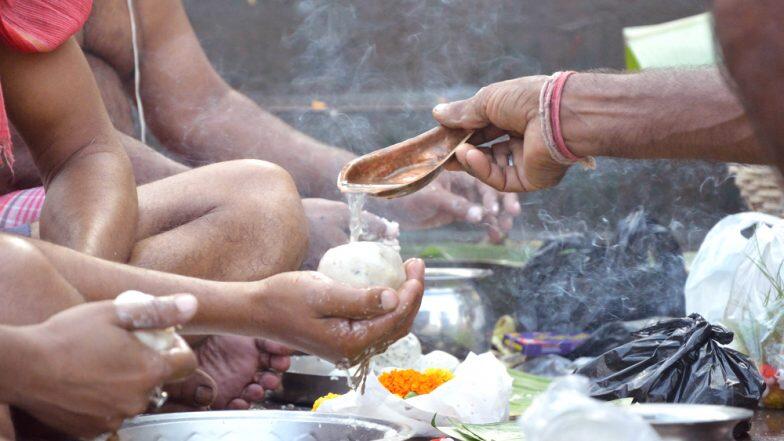
Tag: Pitru Paksha

  • Sraddha Rules How Face,Sit,Perform Homa,For Whom How Many Apasthamba Sutra

    Sraddha Rules How Face,Sit,Perform Homa,For Whom How Many Apasthamba Sutra

    I have written on the Basic Samskaras,forty duties,to be performed by three varnas,Brahmana, Kshatriya and Vaisya .

    I have written on individual Samskaras,Garbhadhana,Pumsavana,Punyahavaasana,Namakarana and many more.

    I have also described details for Sraddha,the Oblations to be performed for ancestors.

    These rules,being Smritis,have variations in practice.

    Those who are in Dakshina Para,south of Vindhyas follow the rules set by Sage Apasthamba.

    Even in the south,there are people who follow other Sutras.

    This is due to the Vedas Shaka assigned to them.

    The Sakas one has to follow can be found in the Abhivadan Mantra,that is ‘Abhivaadaye….aham asmibho’

    There seems to be some doubts on basic procedures to be followed in performing Sraddha.

    The authority is the Smriti on these issues.

    On How

    1. To sit,
    2. Which direction to face at various point of time during Sraddha,
    3. Light fire for homa,
    4. How many ahutis,
    5. For whom…

    These are all set out by Sage Apasthamba in Apasthamba Gruhya Sutra.

    Those who follow Apasthamba sutra are to follow this.

    I am providing the procedure from Apasthamba Gruhya Sutra.

    Praśna 1, Section 1

    1. Now (follow) the ceremonies (the knowledge of) which is derived from practice (and not from the Śruti).

    2. They should be performed during the northern course of the sun, on days of the first fortnight (of the month), on auspicious days,

    3. With the sacrificial cord suspended over (the sacrificer’s) left shoulder.

    4. (The rites should be performed) from left to right.

    5. The beginning should be made on the east side or on the north side,

    6. And also the end.

    7. Ceremonies belonging to the Fathers (are performed) in the second fortnight (of the month),

    8. With the sacrificial cord suspended over the right shoulder,

    9. From right to left,

    10. Ending in the south.

    11. Ceremonies occasioned by special occurrences (are performed) according as their occasions demand.

    12. Having set the fire in a blaze, he strews eastward-pointed Darbha grass around it,

    13. Or eastward-pointed and northward-pointed (grass);

    14. Southward-pointed at sacrifices to the Fathers,

    15. Or southward-pointed and eastward-pointed.

    16. To the north of the fire he strews Darbha grass and (on that) he places the vessels (required for sacrifice) upside-down, two by two, if referring to ceremonies directed to the gods,

    17. All at once, if to men,

    18. One by one, if to the Fathers.

    19.The preparation of the (blades used as) ‘purifiers,’ the measure of their length, the preparation of the Prokṣaṇī water, and the sprinkling of the vessels are the same here as at the sacrifices of the new and full moon, (but are performed) in silence.

    20.To the west of the fire he pours water into a vessel over which he has laid (two grass blades called) purifiers, purifies (the water) three times with two northward-pointed purifiers, holds it on a level with his nose and mouth, places it to the north of the fire on Darbha grass, and covers it with Darbha grass.

    21. On the south side he causes a Brāhmaṇa to sit down on Darbha grass.

    22. He melts the Ājya, pours it, to the west of the fire, into the Ājya-pot, over which he has laid two purifiers, draws coals (out of the sacrificial fire) towards the mirth, puts (the Ājya) on them, throws light on it by means of a burning (grass-blade), throws two Darbha points into it, moves a firebrand round it three times, takes it from the fire towards the north, sweeps the coals back (into the fire), purifies (the Ājya) three times with two northward-pointed purifiers, moving them backward and forward, and throws the purifiers into the fire.

    Praśna 1, Section 2

    1. He warms at the fire the implement with which he sacrifices, wipes it off with Darbha blades, warms it again, sprinkles it (with water), puts it down, touches the Darbha blades with water, and throws them into the fire.

    2.As paridhis (or pieces of wood laid round the fire) yoke-pins are used at the marriage, the Upanayana, the Samāvartana, the parting of the (wife’s) hair, the tonsure of the child’s hair, the cutting of the beard, and at expiatory ceremonies.

    3. He sprinkles water round the fire, on the south side from west to east with (the words), ‘Aditi, give thy consent!’ on the west side from south to north with ‘Anumati, give thy consent!’ on the north side from west to east with ‘Sarasvatī [sic], give thy consent!’ all around with ‘God Sāvitrī, give thy impulse!’

    4. At ceremonies belonging to the Fathers (water is sprinkled) only all round (the fire), silently.

    5. Having put a piece of wood on the fire, he offers the two Āghāra oblations as at the sacrifices of the new and full moon, silently.

    6. Then he offers the two Ājyabhāga oblations, over the easterly part of the northerly part (of the fire) with (the words), ‘To Agni Svāhā!’ over the easterly part of the southerly part (another oblation) exactly like the preceding one, with (the words), ‘To Soma Svāhā!’

    7. Having offered the chief oblations (belonging to each sacrifice) according to prescription, he adds the following oblations, viz. the Jaya, Abhyātāna, Rāṣṭrabhṛt oblations, the oblation to Prajāpati, the Vyāhṛtis one by one, the oblation to (Agni) Sviṣṭakṛt with (the following formula), ‘What I have done too much in this ceremony, or what I have done here too little, all that may Agni Sviṣṭakṛt, he who knows, make well sacrificed and well offered. Svāhā!’

    8. The sprinkling (of water) round (the fire is repeated) as above; the Mantras are altered so as to say, ‘Thou hast given thy consent,’ ‘Thou hast given thy impulse.’

    9. The designation ‘Pākayajña’ is used of ceremonies connected with worldly life.

    10.There the ritual based on the Brāhmaṇa (holds good),

    Source.

    https://www.wisdomlib.org/hinduism/book/āpastamba-gṛhya-sūtra/d/doc116791.html

  • Mahalaya Amavasya Amavasya Sankalpam Text With Seasons Thithis

    Mahalaya Amavasya Amavasya Sankalpam Text With Seasons Thithis

    Sankalpa,according to Hinduism,is Right Determination.

    Any act,auspicious or otherwise is to be preceded by Sankalpa.

    While Abhivadana Mantra is Geotagging the individual,Sankalpa is Event specific,where the Time of the occasion,location where it is performed is pinpointed.

    Year,Season,Month,Thithi(phases of the Moon),Nakshatra(Star),Day,the Gotra,the founder of the Family are mentioned.

    I am providing the Sankalpa for Amavasya .

    For Grahana suitable changes as in Soorya/Chandra Grahana Punyakaale may be made along with month,day,Thithi,Nakshatra ,Ayana,Year may be made.

    I am providing names of seasons and Thithis

    Year,month,day,Nakshatra may be found in daily calendar.

    Ayana are.

    Dakshinayana and Uttarayana.

    Uttarayan begins from the day of Makar sankranti. Days are longer and nights are shorter during Uttarayan. This period involves pilgrimages and festivals. The period of Uttarayan collides with the Paush Magh month. Uttarayan is known to be the period of Devas. Yagyas, donations, charities, austerities, marriages, mundan etc. are considered to be auspicious during this period.

    Dakshinayan

    Dakshinayan begins from 21/22 June. The sun travels from Uttarayan to Dakshinayan on 21st June. According to religious beliefs, Dakshinayan is the night of Kal Devas. Nights and longer and days are shorter during Dakshinayan. During Dakshinayan, Sun travels with an inclination toward the southern direction.

    Dakshinayan is the period associated with fasts. Many kinds of auspicious works are prohibited during Dakshinayan. This period is auspicious for Tamsik activities. Dakshinayan is a symbol of lust and desire. Therefore, fasts, yagyas, worship and other religious activities cure diseases and sorrows.

    For inauspicious occasions, Lord Vishna as Govinda is invoked,while for auspicious occasions ,Shiva as Parameshwara is invoked by those who worship Shiva and Narayana by those who worship Lord Vishnu.

    As in,

    Sree Parameshwara Prretgyartham,

    Sree Narayana Preethyartham.

    For Mahalaya paksha,the same format is to followed with changes for month/Thithi/Nakshatra/Year/Season/Ayana(movement of Sun to Tropic of Cancer and Capricorn).

    And chant Mahalaya Punyakaale…..Thithi,Vara etc.

    nama samvathsare ,utharayane/dakshinayane , rithou(season),  mase(month),   pakshe(phases of Moon), adhya Amavasyam     punya thidhou , …..vasara(day)yukthayam,  nakshatra (Star)yukthayam, shubhayoga, shubhaKarana evam guna viseshena, visishtayam asyam Amavasyam    punya thidhou, amavasya  punyakale, darsa sradham , thilatharpana roopena adhya karishye
    Seasons.


    1. Vasantha Ruthu – Spring season
    2. Greeshma Ruthu – Summer season
    3. Varsha Ruthu – Rainy/Monsoon season
    4. Sharad Ruthu – Early Autumn
    5. Hemantha Ruthu – Winter season
    6. Sishira Ruthu – Late Autumn


    Thithis.

    Sl.No Krishna paksha
    (dark fortnight)
    Shukla paksha
    (bright fortnight)
    Deity and properties[citation needed]
    1 Prathama Prathama The presiding deity of the first lunar day is Agni and it is good for all types of auspicious and religious ceremonies.
    2 Dwitiya Dwitiya Vidhatr or Bramha rules this lunar day and is good for the laying of foundations for buildings and other things of a permanent nature.
    3 Tritiya Tritiya Gauri is the lord of this day and is good for the cuttings of one’s hair and nails and shaving.
    4 Chaturthi Chaturthi Yama/Ganapati is lord of the 4th lunar day, which is good for the destruction of one’s enemies, the removal of obstacles, and acts of combat.
    5 Panchami Panchami The Naaga or Serpents rule this day, which is favourable for administering medicine, the purging of poisons, and surgery.
    6 Shashthi Shashthi Karttikeya presides over this day and is favourable for coronations, meeting new friends, festivities, and enjoyment.
    7 Saptami Saptami The 7th lunar day is ruled by Surya; one may begin a journey, buy conveyances, and deal with other such things of a movable nature.
    8 Ashtami Ashtami The Rudra rule this day, which is good for taking up arms, building of one’s defenses, and fortification.
    9 Navami Navami The Ambikaa rules this day, which is suitable for killing enemies, acts of destruction, and violence. Inauspicious for ceremonies and journeys.
    10 Dasami Dashami The day is ruled by Dharmaraja and is auspicious for acts of virtue, religious functions, spiritual practices, and other pious activities.
    11 Ekadasi Ekadashi Rudra rule this day; fasting, devotional activities, and remembrance of the Supreme Lord are very favourable. This day has special religious significance in Hinduism and Jainism—usually observed by fasting.
    12 Dvadasi Dwadashi The Vishnu or Aditya rules this day, which is auspicious for religious ceremonies, the lighting of the sacred fire, and the performance of one’s duties.
    13 Trayodasi Thrayodashi The day is ruled by Cupid and is good for forming friendships, sensual pleasures, and festivities.
    14 Chaturdashi Chaturdashi Kali rules this day, suitable for administering poison and calling of elementals and spirits.
    15 Amavasya
    (new moon)
    Purnima or Paurnami
    (full moon)
    The Pitru-devas rule the New Moon, suitable for the propitiation of the Manes and performance of austerities. Purnima is ruled by Moon and is suitable for merry making and fire sacrifice.
  • Pitrus Presiding Deties Sraddha

    Details of Pitrus present and the Deities of Sraddha.


    1 Pururav-Aardrav and Dhurilochan

    Pururav-Aardrav and Dhurilochan are deities of ancestors’ souls. They are referenced in the ritual of Shraddha.

    1.2. Vasu-Rudra-Aditya

    1.‘Shraddha is associated with the benevolent deities Vasu, Rudra and Aditya of the ancestors’ souls. The mantras chanted during the Shraddha and the rites performed enables one to connect to these deities.’ (6)

    2. The deceased person for whom the ritual of Shraddha is being performed, is considered as a follower of Vasu, his parents are considered as followers of Rudra and his grand parents are considered as followers of Aditya. Therefore during Shraddha, the names of father, grandfather and great grandfather (or mother, grandmother and great grandmother) are pronounced as representatives of Vasu-Rudra-Aditya respectively.


    Presiding Deity of
    the departed ancestors
    Associated mission
    Vasu Desire
    Rudra Dissolution
    Aditya Action

    During the ritual of Shraddha the Vishvedevs called Pururav-Ardrav and Dhurilochan are also invoked. Vishvedev means the ‘group of Deities which represents the Deities during a sacrificial fire’.


    Pitrus, Ancestoes present during Mahalaya Sraddha.


    . Father, grandfather, great grandfather (Pitrutrayi) 10. Maternal uncle
    2. Mother, grandmother and great grandmother (matrutrayi) 11. Brother
    3. Step mother 12. Father’s sisters
    4. Mother’s father, grandfather and great grandmother (matamahatrayi) 13. Mother’s sisters
    5. Mother’s mother, grandmother and great grandmother 14. Sisters
    6. Wife 15. Father-in-law
    7. Sons 16. Other relatives
    8. Daughters 17. Guru (if the Guru-disciple relationship exists)
    9. Paternal cousins 18. Disciple (if the Guru-disciple relationship exists)

    http://kramans.blogspot.in/2012/01/shraddha.html

  • Types of Sraddha One Hundred Sixteen

    I have posted a few articles on Sraddha,Rites for the departed , including text of Mantras ans Mahalaya Paksha Procedure.


    I shall be posting a series of articles in detail on various aspects of Sraddha.


    Here are the types of Sraddha to be performed.


    They are one hundred sixteen in number.


    Sraddha the ceremony performed for the ancestors is of different types.

    Stricly speaking Sraddha has to be performed daily.

    Definition of Sraddha.

    देशे काले च पात्रे च श्रद्धया विधिना च यत् ।
    पितृनुद्दिश्य विप्रेभ्यो दत्तं श्राद्धमुदाहृत् ।। – ब्रह्मपुराण

    Meaning: The offerings (food etc.) made to the Brahmin (priests) with the intension being received by the deceased ancestors, after taking into account the aptness of country, time period and place and with complete faith and abiding by all the rules is known as Shraddha.
    C: Associated words

    Shraddhattva Pinda, Pitru Puja (ritualistic worship of deceased ancestors), Pitru Yagna (sacrificial fires performed for deceased ancestors).


    Hindu Dharma does not give any chance to anyone to say that the shraddha was not performed due to non-feasibility in a particular period!

    Normally every year Shraddha should be performed on the date of death of the person (as per the Hindu calendar and not as per the English calendar.) If the date is not known and only the month is known, then in that case the shraddha can be performed on the no moon night of that month.

    If both, the date as well as the month is unknown then the shraddha can be performed on the no moon night of the Hindu calendar month of Magh or Margashirsha.

    If the definite date of death is not known then the shraddha can be performed on the date when the news of the death was received.

    Shraddha for deceased ancestors’ souls should be performed everyday and it can be achieved just by offering water (tarpan) to them.

    If it is impossible to perform Shraddha daily, then Darsha Shraddha should be performed.  Darsha means no moon night. Therefore Darsha Shraddha is t is performed on every New Moon.

    If it is not possible to perform Darsha Shraddha every month, one should at least perform it on the no moon night of Hindu calendar months of Chaitra, Bhadrapad and Ashwin months.

    If it is not possible even to perform Darsha Shraddha on no moon nights of Chaitra, Bhadrapad and Ashwin, then at least the ritual of Mahalaya should be performed in the Pitru fortnight of the month of Bhadrapad. If this too is impossible thenShraddha should be performed on the no moon night of the month of Bhadrapad (sarva pitri amavasya) .


    Types of Sraddha.


    Matsya Puran mentions ‘नित्यं नैमित्तिकं काम्यं त्रिविध श्राद्ध मुख्यते ।’, meaning, primarily there are three types ofShraddha – one performed daily, periodically and with purpose (Kamya). In addition to these, Yamasmruti definesNandi Shraddha and Parvan Shraddha as additional main types.

    Daily Shraddha

    The ritual of Shraddha performed daily is known as Daily Shraddha. This Shraddha can be performed just by offering water or sesame seeds to deceased ancestors.

    Periodic Shraddha

    The shraddha performed for deceased ancestors with a single objective and other such types fall under periodic Shraddha.

    Purpose oriented (Kamya) Shraddha

    Shraddha performed for achieving a specific objective is termed as purpose oriented (Kamya)Shraddha.

    From the point of view of deriving fruitful result, if the Shraddha is performed on a specific day, date (as per Hindu calendar) and taking into consideration the position of stars (nakshatra), then the desired result is achieved.

    The details.


     Day and the derived result of the Shraddha

    Date (as per Hindu calendar) and the derived result of the Shraddha

    Date of performingShraddha Result derived from the Shraddha
    First day in Hindu Lunar fortnight Gaining a good fowl and being able to give birth to a healthy baby boy.
    Second day in Hindu Lunar fortnight Conceiving a baby girl.
    Third day in Hindu Lunar fortnight Acquiring a horse, acquiring fame
    Fourth day in Hindu Lunar fortnight Acquiring a lot of inferior animals
    Fifth day in Hindu Lunar fortnight Having a lot of good looking male children
    Sixth day in Hindu Lunar fortnight Conceiving bright male child, getting success in gambling.
    Seventh day in Hindu Lunar fortnight Acquiring a farm or land
    Eighth day in Hindu Lunar fortnight Obtaining success in business
    Ninth day in Hindu Lunar fortnight Acquiring animals like horses
    Tenth day in Hindu Lunar fortnight Expansion of cattle, acquiring animals with two humps
    Eleventh day in Hindu Lunar fortnight Acquiring utensils, clothes and a scholar male child.
    Twelfth day in Hindu Lunar fortnight Acquiring gold, silver etc.
    Thirteenth day in Hindu Lunar fortnight Gaining superiority within the community
    Fourteenth day in Hindu Lunar fortnight The persons, who have died due to the stroke of a weapon or on a battlefield, get momentum to attain a higher sub-plane. Gaining good citizens.
    Full moon / no moon night Fulfillment of all wishes

    Note 1: Except full moon night, all other dates that belong to the dark fortnight and corresponding dates in dark fortnight of the month of Bhadrapad, bestow special benefit.

    1. Bhimashtami Shraddha: If one is not able to conceive or is facing problems of abortion, then for the well being of the fetus, Shraddha is performed or offering of water is made to Bhishmacharya, on the eighth day of the bright fortnight (Bhimashtami) in the Hindu calendar month of Magh.

    3. Position of stars and the derived result of the Shraddha


    Position of star while performing Shraddha Result derived from the Shraddha
    Kruttika Acquiring a heavenly abode for oneself and ones son.
    Rohini Conceiving male child
    Mruga Acquiring radiance of Brahman (Brahmatej)
    Aardra Providing momentum to the soul of an evildoer, action transformed into supernatural power.
    Punarvasu Obtaining wealth or land
    Pushya Improvement in strength
    Ashlesha Conceiving a male child with brave character, fulfillment of a wish
    Magha Gaining superiority within the community, a long married life
    Purva Good luck, conceiving a male child, elimination of sin
    Uttara Good luck, conceiving a male child, elimination of sin
    Hasta Fulfillment of a wish, gaining superiority within the community
    Chitra Conceiving a handsome male child, conceiving ample male children
    Swati Earning profit in business, earning success.
    Vishakha Conceiving ample male children, acquiring gold
    Anuradha Acquiring a kingdom (attaining position of minister etc), acquiring friends
    Jyeshtha Acquiring superiority, authority, wealth and self-confidence, acquiring a kingdom
    Mula Obtaining good health, acquiring a farm or land
    Purvashadha Achieving good fame, successful journey up to the sea limit
    Uttarashada Getting relieved from grievances, fulfillment of all wishes, achieving good hearing ability
    Shravan Achieving best progress in subtle plane, superiority
    Ghanishtha Acquiring kingdom (attaining position of minister etc), fulfillment of all wishes
    Shavataraka Achieving supernatural powers in medical practice, acquiring metal other than gold and silver.
    Purvabhadrapada Acquiring a flock of sheep or lamb, acquiring metal other than gold and silver.
    Uttarabhadrapada Acquiring cattle, acquiring sanctified and good premises
    Revati Acquiring utensils and clothes, acquiring cattle
    Ashwini Acquiring horses
    Bharni Acquiring a long life

    Note 1: When an evildoer dies and Shraddha is performed for him at the time of Aadra star, for imparting momentum to its soul, the desired benefit can be derived.

    Special note: In the table given in point 2 and 3, multiple benefits are indicated for a single date or star position. These are specified based on references obtained from different books.

    2. Nandi Shraddha

    The ritual of Shraddha performed during the start of any joyous ceremony and performance of any of the 16 religious rites, and recitation of specific mantras for success of the ceremony is called NandiShraddha. In this ritual Satyavasu (or kratudaksha) are the vishve deities and the father-grandfather-great grandfather, mother-grandmother (mother’s mother) – great grandmother (mother’s grandmother) and mother- grandmother (mother’s mother-in-law)-great grandmother (mother-in-law of mother’s mother-in-law) are invoked.

    3.. Karmanga Shraddha: This Shraddha is performed during the religious ritual of Garbhadhan.

    4. Vruddhi Shraddha: Shraddha performed at the time of birth of a baby.

    5.Parvan Shraddha

    The Pindapitruyagna (sacrificial fires related to deceased ancestors) mentioned in the Shrout lineage is to be performed by a Sagnik (one who performs the ritual of Agnihotra). Alternative to this is the Parvan Shraddha mentioned in the Gruhya sutras. Once the deceased ancestors get listed as Parvans, then this shraddha is performed for them. (Detailed information on Parvan is presented under the heading ‘Terminology of Shraddha’ and in point ‘3 B’ of volume 2.) Ekparvan (single Parvan), dviparvan (doubleParvan), triparvan (triple Parvan) are the three varieties of this shraddha. Mahalay Shraddha and Tirtha Shraddha are the types of Parvan Shraddha.

    6. Mahalay Shraddha (fortnightly): It is a Parvan Shraddha performed starting from the eleventh day of dark fortnight of Bhadrapad (Hindu calendar month) till the no moon night.

    7.. Tirtha Shraddha: The ritual of shraddha performed at Holy places like Prayag or at the banks of a sacred river is termed as Tirtha Shraddha. While performing Tirtha Shraddha, all the Parvans of Mahalay are invoked.

    .Other types

    Apart from the main types mentioned above there are 96 types of Shraddha namely, 12 no moon nights, 4 eras, 14manvantars, 12 sankrants, 12 vaidhruti, 12 vyatipat, 15 mahalays, 5 first, 5 ashtak and 5 anvashtake. (Detailed information about these is present in the books related to science of Dharma.)

    Brief information about few of the other types of Shraddha

    8. Goshthi Shraddha

    The Shraddha performed by the group of priests (Brahmins) and scholars at a holy place with the intention that, ‘Deceased ancestors’ souls should get satisfied and let happiness and prosperity preside’, or while discussing the topic of Shraddha, if one gets inspired all of a sudden and performsShraddha, then such Shraddha is termed as Goshthi Shraddha.

    9.Shuddhi Shraddha

    Offering food to priests (Brahmins) for acquiring purity is called as Shuddhi Shraddha. This is the ‘undergoing of punishment’ part of Shraddha.

    10.Pushti Shraddha

    Shraddha performed for increasing physical strength and prosperity is called as Pushti Shraddha.

    11. Ghruta Shraddha (Yatra Shraddha)

    Shraddha performed using ghee (clarified butter), in remembrance of deceased ancestors, before embarking on a journey to holy places with the objective of completing the journey without any obstacles is called Ghruta Shraddha.

    12. Dadhi Shraddha

    Shraddha performed after returning from a journey to holy places is termed as Dadhi Shraddha.

    13. Ashtaka Shraddha

    Shraddha performed on 8th day of the bright fortnight of the Hindu calendar mont. Ashtaka means the 8th day of bright fortnight of any Hindu calendar month. During the era of Vedas, the Ashtaka Shraddha used to be performed specifically on the 8th day of bright fortnight of Margashirsha, Poush, Magh and Falgun months. It was a practice to offer vegetables, meat, bondas, sesame seeds, honey, rice kheer, fruits and underground vegetables to deceased ancestors. Vishvedev, Fire (Agni), Sun, Prajapati, Ratri, Stars (nakshatra), season (rutu) etc. were considered as deities of Shraddha.

    14.Daivik Shraddha

    Shraddha performed with the objective of obtaining the grace of God is termed as Daivik Shraddha.

    15.. Hiranya Shraddha

    This Shraddha is performed without offering food and only by offering money (dakshina) to the priests (Brahmins). If food is in scarcity, then gold, equivalent to four times the cost of the food grains, should be offered.

    16. Hasta Shraddha

    Shraddha performed by offering food to the priests (Brahmins) designated for Shraddha. If cooked food is not available then the Shraddha is performed by offering money or dry food grains. (7)

    17. Aatma Shraddha

    Those people who do not have children or whose children are atheists, they should perform Shraddhafor themselves when they are alive. The rites for such Shraddha are explained in the science of spirituality.

    Even though various types of Shraddha are mentioned above, based on the calendar days, theShraddha performed for a dead person from the first day to the eleventh day, monthly shraddha,Sapindikaran Shraddha, Shraddha performed on one-year completion, Shraddha performed every year from the second year and Mahalay Shraddha are the only ones that are commonly practiced.


    Citation.

    http://kramans.blogspot.in/2012/01/shraddha.html

  • No Pitru Paksha for Sri Vaishnavas?

    A close friend of mine, a Sri Vaishnava told me that he does not perform the Mahalaya Paksha Tharpana.

    He informed me that , as an Iyengar belonging to Thengalai Sampradya, he does not do it as it is prohibited by Ramanucharya.

    He told me that the other sect of Iyengars in Tamil Nadu, Vadagalai Iyengars perform the Pitru Paksha Tharpana.

    As I am unable to find any authentic source on this, I am posting my views.

    Those who know the subject well may quote with source.

    In Hinduism there are two paths in terms of Lifestyle.

    One is called Pravritti Marga and another Nivrutti Marga.

    Pravrutti Marga is the leading of our daily lives , as normally do, by going after the sense objects.

    Nivrutti Marga is renunciation of the sense objects.

    Hinduism teaches how to live,taking into account the limitations and the frailties of Human Life including the desire to go after sensory objects for pleasure.

    So Hinduism has devised the four stages of Life.

    Brahmacharya, the young Celibate.

    Gruhastha when one gets married begets children and goes about Life.

    Vanaprastha,when one, after the son becomes capable managing the Family leaving the Family, either with or without wife to seek Reality either in the Forest or staying at Home in a detached way.

    My friend quoted Visishtadvaita to support his view that one need not perform the Karmas,excepting Sandhyavanadan and Amavasya Tharpana as Sri Vaishnavism gives priority to surrender to Lord Vishnu and once one surrenders himself to God, one need not, should not perform Karma , including Pitru Paksha Tharpana.

    He quoted the Sloka form the Bhagavad Gita, this is also called the Karna Mantra,,

    Sarva Dharma Parijyasya Maameka Charanam Vraja,

    Aham Thva Sarva Paapepyp0Mokshayisyami Maa sucha. Chapter 18

    Leave all actions, and surrender only to Me.

    I shall absolve you of all your sins and grant you Moksha’

    I think my friend does not seem to have understood Krishna and this sloka is often misunderstood.

    What Krishna says is that He shall grant Moksha and one need not perform any action(Karma)  if one surrenders to Krishna.

    The surrender , Krishna means a surrender  is not a lip service but one of total Surrender,mind ,words and deeds.

    By merely saying one has surrendered to Krishna does not mean total surrender.

    Draupadi who wass a cousin of Krishna and an ardent devotee had to throw her arms up and pray Lord Krishna when Dhuchashana was stripping her.

    Krishna did not pay heed to her earlier entreaties to save her when she held her hands to her saree: only when, she ,devoid of Ego , called out, leaving her hands off the saree, did Krishna rescue her modesty.

    Such a devotion is very difficult to come by.

    It needs years of practice ,Abhyasa and determination(vairagya)

    This, I think we do not, posses at least I do not.

    So the statement , presumably said by Ramanucharya, that one need not perform Karmas if one surrenders to Vishnu, is meant for evolved souls;such loved souls like Ramadasas,Ramakrishna Paramahamsa may and can follow this as they had lost Dehatma Buddhi, the attachment to Body.

    We can not compare ourselves to these souls.

    Again, while talking about Renunciation, Krishna says  in the Bhagavad Gita, those who call the,selves Sanyasis , while their Minds are after sense objects, may appear so outwardly. are only Aashaadaboothis(hypocrites)

    The determination to relinquish the fruits of action even at the mental level while performing the action is called renunciation.

    With such a mindset one can even be in family Life, like Janaka, father of Sita.

    Therefore the non-performance of Pitru Pksha , quoting some Acharya is contrary to Vedas and as such is incorrect as Pitru Yagnya is one of the most important and mandatory Yagnya for every one.