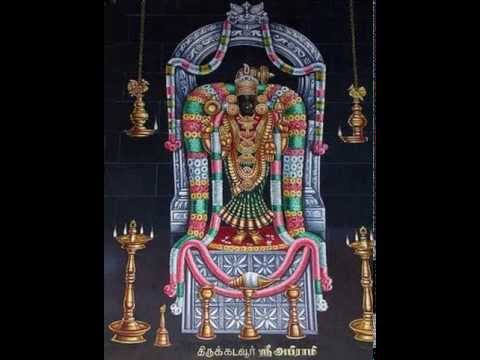
Tamil calls Him ‘Kadavul’, one who is beyond the Mind.
You can not hold the Ocean in your palms.
How does one explain hunger, Pleasure, or Pain?
They have to be felt.
Many who have experienced the ecstasy of God have attempted to explain it.
The fact is those who explain it in detail have not seen or experienced God,
Those who have experienced can not explain..
‘kandavar Vindilar,
Vindavar Kandilai'(Tamil)
But some great souls have attempted to try.
Ramakrishna Parahamsa was one.
He was seen as a Lunatic, when He was in Ecstasy!
Similar descriptions of god may be found in Tamil.
Abhirami Bhattar was one such.
He was One who had seen Her, Abhirami of Thirukkadavur.
I shall write on him and his poem Abirami Andhadai in detail
The poem is in a special format, Andhadi, where the last word, letter of the preceding verse is the first word or the letter of the succeeding verse, mostly the former.
The last verse shall end with a word that would be the first word of the Andhadi(Beginning of the End)
விரும்பித் தொழும் அடியார் விழிநீர் மல்கி, மெய் புளகம்
அரும்பித் ததும்பிய ஆனந்தம் ஆகி, அறிவு இழந்து
கரும்பின் களித்து, மொழி தடுமாறி, முன் சொன்ன எல்லாம்
தரும் பித்தர் ஆவர் என்றால் அபிராமி சமயம் நன்றே.
அபிராமி அம்மையைப் பக்தியோடு விரும்பித்தொழும் அடியவர்களின் கண்களில் நீரானது பெருகி, மெய்சிலிர்த்து, ஆனந்தம் ததும்பி, அறிவு மறந்து, வண்டைப் போல் களித்து, மொழி தடுமாறி, முன்பு சொல்லிய பித்தரைப் போல் ஆவார்கள் என்றால், அப்பேரானந்தத்திற்கு மூலமான அம்பிகையின் சமயமே மிகச்சிறந்ததாகும்..
Tamil Poem explanation by Poet laureate Kannadasan
‘Tears stream down from the eyes,
Loses identity, with goose-pimples,
Overflowing with ecstasy , loses Mind,Discrimination,
Language falters, words get jumbled,
All this for those who immerse themselves in Abhirami and if this be the fruit of Her , it is the Best Religion to follow’
Well, that’s it.
As English translations are not available on the web, I have tried translating.
Definitely does not convey what Abhirami Bhattar intended.
I have tried.
Please check for a translation and enjoy the experience.
The general information about the Siddhas are very limited.
Even here, there is a misconception that the Siddhas are Tamils and their presence is limited to Tamil Nadu.
When Siddhas can transcend Time and Space, a Country is nothing for them.
There are Siddha sites in Karnataka, that too near Bangalore.
Siddhara Betta, Siddhas’ Hills, near Bangalore
There are prehistoric sites.
On one of the hills surrounding Siddhaloka is a massive pattern (about 30 metres, or 90 feet high) etched naturally on the rocks. If you observe carefully, it appears as a picture of the goddess Durga or Shakti, mounted on a lion, crown on head, arm raised with sword in hand.
‘
Siddhaloka is described as the world inhabited by Siddhas, the Perfected Ones. An Ashram (hermitage) of this name is situated about 40 km from Bangalore in Southern India. This is the seat of the Siddha Yoga Dham, a registered charitable institution whose spiritual head is Param Poojya (His Holiness) Swami Chetanananda Saraswati, who belongs to the ancient lineage of Siddha Gurus.
Siddhaloka is a place full of splendour and serenity. The ashram is surrounded by hills and forests, with a breathtaking view, and is in the heart of rural Karnataka. The place is blessed by Siddhas and is an ocean of Siddha Shakti (divine power). There is no pollution of any form. One is inspired to remain indrawn and experience the natural meditative state..
The cave derives its name from the peculiar picture-script found on its walls, which have been estimated by experts to date back to prehistoric times. The script is referred to as Shankha or ‘Conch-shell’ script. The actual height of the picture shown here is about four metres…
Siddhara Betta, Siddhars Mountain.
Siddhara Betta, around 12 Kms away from Koratagere in Tumkur district,
Tumkur can be reached by Train, Buses from Bangalore.
Airport.Bangalore.
From here, we climbed back on to the path where visitors walked and soon we were back in contact with the people moving all over the place. We then, moving ahead, reached the spot which is the destination of tourists and religious seekers. This is the main location of the Siddheshwara Temple and the healing waters. This also had entrance to large number of caves in which many yogis did their sadhana for years together. We were told to take a guide with us or there was a possibility of missing important places or literally getting lost in the caves. What is told to be caves is nothing but the spaces between these incredibly huge rocks but as one proceeds deeper into the space it gets darker and there was multiple twists and turns that one could keep wandering. We did not know whom to ask but as we moved ahead a man came walking along with us and spoke in Kannada stating that he would show us around. i was told earlier before coming to this place that a guide is a must to navigate in these caves or one could get lost or one could miss out the main spots needed to be seen. They charge between Rs.100/- and 200/-
The entrance to the holy temple and caves had crystal clear water flowing as though it was meant to wash the feet of those who went it. The water on this hill is very pure and is known for its medicinal properties full of healthy vital natural elements in it and also spiritually vibrant. The guide took us first to a dark space filled with lot of people and there seemed to be an arati going on. Reaching close to it, we found that this was the temple. There were no electric lights and the only visibility was a gas lamp lit in front of the big Shiva Linga. People made different offerings here and the priest was doing arati and puja for the devotees. In front of the Shiva Linga was a small natural water tank in stones which was filled with the holy waters. The guide told us that the Siddhas used water from here for worship. There were few very ancient idols also there, the most prominent being Lord Ganesha’s. Then, the guide took us through a narrow dark passage. We had carried our torches and that came very handy here along with the torch of the guide. Everything from here was dark inside. He moved through various narrow spaces that needed climbing, sliding, crawling on knees, have steep navigations that required careful and slow maneuvering. He helped us navigate through these spaces, sometimes himself demonstrating techniques on foot placement and shifting body weight to narrow down into steep rock spaces. By now it was evident that there is no way one can come here without a guide for there are so many passages that one can literally get lost. We were the only four of us (physically) in that location at that time.
He stopped at certain locations to show us the well-known spots that some Siddhas did their tapas for years. He also showed us a space where there was a natural stream of water filled in a space from where the Yogis drew and used water. He then took us to one remote cave around which a wall was built with a door and two windows and it looked like a room, but it was actually the entrance to a cave, where even today a Siddha lives. The door was locked and outside was carved “Marul Siddheshwar Mutt” which means ashram. There was another such kind of cave with a door a little ahead. i asked the guide where was the Yogi and he said that during the day he goes away some unknown place during the day because of the disturbance of people there flocking for favours and comes back only in the night to meditate there. Moving further, he showed us more spaces and seats of Yogis. He added that even meditators come and sometimes use this place for their meditation. We asked if anyone can sit to which he said anyone can, but rarely does anyone use it.
Unlike other Faiths, Hinduism does not bring all those who realized Godhead or self-realization under one name, Mystic.
There are Siddhas, Rishis of Different kinds,Munis,Guru,Yogins, Savikalpa and Nirvakalpa,Saints, Sages.
Though there is this common factor of having realized God/Self, there is a minute difference among them.
Please read m posts on Rishis, different kinds.
Siddhas are realized souls, do not die and live eternally.
Yogis reach the State of samadhi.
This is of two kinds.
Savikalpa where the realized soul is seemingly active here.
In Nirvakalpa everything is renounced.
We have yet another classification.
Avadhuta.
An Avadhuta.
Avadhoota (अवधूत avadhūta) is a Sanskrit term from some Indian religions referring to a type of mystic or saint who is beyond egoic-consciousness, duality and common worldly concerns and acts without consideration for standard social etiquette.
Also spelled as Avdhoot, such personalities “roam free like a child upon the face of the Earth”.
An Avadhoota does not identify with their mind or body or ‘names and forms’ (Sanskrit: namarupa).
Such a person is held to be pure ‘consciousness’ (Sanskrit: caitanya) in human form.
Avadhoota play a significant role in the history, origins and rejuvenations of a number of Dharmic Traditions such
hand path (Sanskrit: Dakshinamarga) traditions and left and right channels (otherwise known as the outer channels) of the energetic body, though an
Avadhut may or may not continue such dichotomous rites of the āstika or nāstikaDarśana for they are free from sectarian ritual observance and
affiliation.
Feuerstein (1991: p. 105) frames how the term ‘Avadhoota’ came to be associated with the mad or eccentric holiness or ‘crazy wisdom‘ of some antinomianparamahamsa who were often ‘skyclad’ or ‘naked’ (Sanskrit: digambara):
“The appellation “Avadhoota,” more than any other, came to be associated with the apparently crazy modes of behaviour of some paramahamsas, who dramatize the reversal of social norms, a behaviour characteristic of their spontaneous lifestyle. Their frequent nakedness is perhaps the most symbolic expression of this reversal.”
Sacrifice.
Chandraet al.. (1902: p. 20) equates the ‘chodpa‘ (Tibetan: གཅོད་པ, Wylie: chod pa) as a type of Avadhoota:
“ཀུ་སུ་ལུ་པ ku-su-lu-pa is a word of Tantrik mysticism, its proper Tibetan equivalent being གཅོད་པ, the art of exorcism. The mystic Tantrik rites of the Avadhauts, called Avadhūtipa in Tibet, exist in India.”
The rites of chod differ between lineages but essentially there is an offering of their body as food, a blessing to demons and other entities to whom this kind of offering may be of benefit. This leitmotif and sadhana is common to another denizen of the charnel ground, Dattatreya the Avadhoota, to whom has been attributed the esteemed nondual medieval song, the Avadhoota Gita. Dattatreya was a founding adi guru of the Aghor tradition according to Barrett (2008: p. 33):
“…Lord Dattatreya, an antinomian form of Shiva closely associated with the cremation ground, who appeared to Baba Kina Ram atop Girnar Mountain in Gujarat. Considered to be the adi guru (ancient spiritual teacher) and founding deity of Aghor, Lord Dattatreya offered his own flesh to the young ascetic as prasād (a kind of blessing), conferring upon him the power of clairvoyance and establishing a guru-disciple relationship between them.”
Mahānirvāṇatantraṃ
Woodroffe, in his translation of the Mahānirvāṇatantraṃ from the original Sanskrit into English under his nom-de-plume of Arthur Avalon, may be the opening discourse of the archetype of “Avadhoota” to the English reading public, as none of the Avadhoota upanishads were translated amongst the collections of minor upanishads such as the Thirty Minor Upanishads (Aiyar: 1914).The pen-name is play on the magical realm of Avalon and the young later-to-be, King Arthur, within the story-cycle of tales known generally as King Arthur and the Knights of the Round Table; specifically according to Taylor (2001: p. 148), Woodroffe chose the name from the noted incomplete magnum opus, the painting ‘Arthur’s Sleep in Avalon‘ by Burne-Jones.[9] Moreover, Taylor (2001: p. 148) conveys the salience of this magical literary identity and contextualizes by making reference towestern esotericism, Holy grail, quest, occult secrets, initiations and the Theosophists:
“This is quite important to know, for here we have a writer on an Indian esoteric system taking a name imbued with western esotericism. The name at any rate seems to hint at initiations and the possession of occult secrets. The Arthurian legends are bound up with the story of the Holy Grail and its quest. This was a symbol of esoteric wisdom, especially to Theosophists who appropriated the legend. Anyone who named himself after King Arthur or the mystic isle of Avalon would be thought to be identifying himself with occultism, in Theosophists’ eyes.
How to identify an Avadhuta,
The book of Brahmanirvantantra describes how to identify the avadhuts of the following types:
BramhAvadhoota : An avadhut from birth, who appears in any class of society. Completely indifferent to the world or worldly matters.
ShaivAvadhoota : Avadhuts who have taken to the renounced order of life (sannyas), often with unkempt long hair (jata), or who dress in the manner of Shaivites and spend almost all of their time in trance (samādhi), or meditation.
VirAvadhoota : This person looks like a sadhu who has put red colored sandal paste on his body and wears saffron clothes. His hair are very well grown and are normally furling in the wind. They wear in their neck a Rudrakshamala or a string with bones. They hold a wooden stick (danda) in their hand and additionally they always have an axe (parashu) or a damaru (small drum) with them.
KulAvadhoota : These people are supposed to have taken initiation from the Kaulasampradaya. It is very difficult to recognize these people as they do not wear any signs outside which can identify them from others. The speciality of these people is that they remain and live like usual people do. They can show themselves in the form of Kings or a family man.
The avadhoota represents the pinnacle of spiritual evolution; none is superior to him. Avadhoota means “one who is immortal” (akshara), and who has totally discarded worldly ties. He is verily Brahman himself. He realizes himself to be pure intelligence. He is unmindful of the six infirmities of human birth, namely: sorrow, delusion, old age, death, hunger and thirst. He has shaken off all bondage of the experimental world, and moves about freely like a child, a madman or one possessed by spirits.
He may be with or without clothes. He does not wear any distinct emblem of any order. He has no desire to sleep, beg or bathe. He views his body as a corpse and subsists on food which comes to him from all classes. He does not interpret the shastras or the Vedas. For him nothing is righteous or unrighteous, holy or unholy.
He is free of karma. The karmas of this life and past lives are all burnt away, and due to the absence of kartritva (doership) and bhoktritva (desire for enjoyment), no future karmas are created. Only the prarabdha (unalterable) karmas which have already begun to operate will affect his body, helping to sustain it, but his mind will remain unaffected. He will live in this world until the prarabdha karmas are worked out, after which his body will fall off. Then he is said to attain videhamukti (state beyond body consciousness).
Such a liberated soul never returns to the embodied state. He is not born again; he is immortal. He has achieved the final aim of taking birth in this world.”
Bhad-avadhuta Upanisad, thus: “The Avadhuta is so called because he is immortal ; he is the greatest ; he has discarded worldly ties ; and he is indicated in the meaning of the sentence “Thou art That,”
You must be logged in to post a comment.