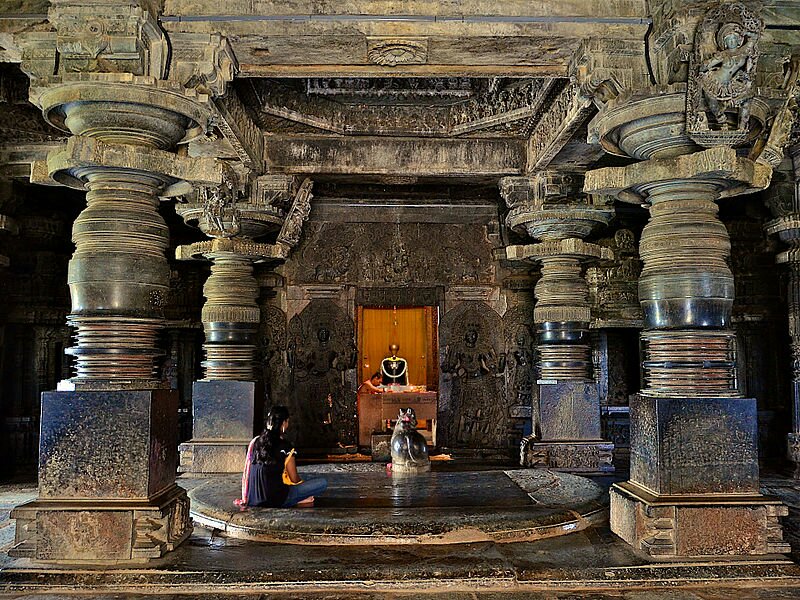
Tag: Moolavar

  • Moolavar And Utsavar Idols In Pre Islamic Worship,Wathan, Sanam

    Moolavar And Utsavar Idols In Pre Islamic Worship,Wathan, Sanam

    When we follow the evolution of thought in Religions,one can see a gradual development of Spirituality.

    Man first feared Nature and worshipped it’s different aspects.

    He assigned them super human powers.

    He was scared of Fire,Water,Rains, Thunderbolt, Earthquakes.

    He feared them ,appeased them and sought relief.

    There were as many Gods as one feared.

    On the other hand,when he found benevolent things in Nature,he included them also in the list of God’s.

    The practice of worshipping many Gods is called Polytheism.

    Hinduism has one essential difference while moving on from Polytheism.

    One would find that One God is praised,while others are relegated to secondary or tertiary places in worship.

    Thus we find Shiva worshipped as the Supreme Deity and other Deities pushed to secondary places.

    The same with Vishnu,Brahma,Agni,Vaayu,Devi,Agni and others.

    This practice of praising one God and pushing others back is called Henotheism.

    Hinduism ultimately reached Monism,Non Dualism and Qualified Non Dualism,

    But this article is on Polytheism.

    Here many Gods are worshipped.

    Though the Vedas do not advocate Idol worship ,Temple worship, they are followed nevertheless.

    This practice was regulated by the Agamas,that is worship in Temples.

    The Agamas ,which rose later to the Vedas lay down rules for building temples and methods of worship in Temples.

    For details on Agamas,why many Gods in Hinduism,please read my articles on the same names.
    In temple worship,one finds Presiding Deity, Moolavar and another Deity for taking out during auspicious occasions.

    Thaayar,Varadaraja perumal,Kanchipuram.Moolavar and Utsavar.image
    Thaayar,Varadaraja perumal,Kanchipuram.Moolavar and Utsavar

    All poojas are performed first to the Presiding Deity Moolavar and then to the Utsavar.

    This concept is unique to Hinduism.

    While checking up the history of Pre Islamic Polytheism and method of worship, one finds that the Pre Islamic Deities were worshipped in the same way as that of Hindus in Temples,that is they had Moolavar and Utsavar.

    Yet another proof of Hinduism being the forerunner of Pre Islamic Religion.

    ‘The pre-Islamic Arab religion was polytheistic, venerating many deities and spirits through statues, baetylus and natural phenomena. According to the Book of Idols, there are two known types of statues; idols (sanam) and images (wathan). If a statue was made of wood, gold, or silver, after a human form, it would be an idol, but if the statue was made of stone, it would be an image.

    Reference and citation.

    al-Kalbi, Ibn. The Book of Idols (1952 Nabih Amin Faris translation). pp. 12–13.

  • Womb The Home Garbha Griha Temple Sanctum

    Womb The Home Garbha Griha Temple Sanctum

    One is born from a woman, ends up in Earth.

    Hinduism accords the respect these deserve.

    A woman is called Gruha Lakshmi, one who brings Prosperity to Home.

    Tamil calls her Illal, one who owns/rules the Home.

    Lord Balaji In Garbha Graha, Tirupati.jpg
    Lord Balaji In Garbha Graha, Tirupati.

    Similarly Earth is given the respect it deserves for it supports from Birth to Death.

    Earth is eulogized as Mother and there are Vedic Sukthas in praise of the Earth, Bho Suktham.

    There is Neela Suktham, Neela is considered to be the consort of Lord Vishnu.

    Such being the case, there is no wonder in Hinduism calling the Sanctum Sanctorum of a Temple as Garbha Gruha, Gharbha meaning The Womb and Gruha, the Home.

    Tamil calls The Gharbhagriha as Karuvarai, meaning ‘where the Foetus stays’

    One’s first Home is the womb.

    A Hindu temple consists of an inner sanctum, thegarbha griha or womb-chamber, where the primary idol or deity is housed along with Purusa. The garbhagriha is crowned by a tower-like Shikhara, also called the Vimana. The architecture includes an ambulatory for parikrama(circumambulation), a congregation hall, and sometimes an antechamber and porch.

    The Hindu temple architecture reflects a synthesis of arts, the ideals of dharma, beliefs, values and the way of life cherished under Hinduism. It is a link between man, deities, and the Universal Purusa in a sacred space.

    In ancient Indian texts, a temple is a place for Tirtha – pilgrimage.It is a sacred site whose ambience and design attempts to symbolically condense the ideal tenets of Hindu way of life. All the cosmic elements that create and celebrate life in Hindu pantheon, are present in a Hindu temple – from fire to water, from images of nature to deities, from the feminine to the masculine, from kama to artha, from the fleeting sounds and incense smells to Purusha – the eternal nothingness yet universality – is part of a Hindu temple architecture.

    ….

    Garbhagriha or Garbha gruha (garbha gṛha) (Sanskrit: गर्भगॄह) is the sanctum sanctorum, the innermost sanctum of a Hindu templewhere resides the murti (idol or icon) of the primary deity of the temple. Literally the word means “womb chamber”, from the Sanskritwords garbha for womb and griha for house. Only ‘priests’ (pujari) are allowed to enter this chamber.

    Although the term is often associated with Hindu temples, it is also found in Jain and Buddhist temples…

    In temples with a spire or vimana, this chamber is placed directly underneath it, and the two of them form the main vertical axis of the temple. These together may be understood to represent the axis of the world through Mount Meru. The garbha griham is usually also on the main horizontal axis of the temple which generally is an east-west axis. In those temples where there is also a cross-axis, the garbha gṛha is generally at their intersection.

    Generally the garbhagriha is a windowless and sparsely lit chamber, intentionally created thus to focus the devotee’s mind on the tangible form of the divine within it. Entrance to the garbha grha may be restricted to priests who perform the services there…

    In the Dravida style, the garbhagriha took the form of a miniature vimana with other features exclusive to southern Indian temple architecture such as the inner wall together with the outer wall creating a pradakshina around the garbhagriha. The entrance is highly decorated. The inner garbhagriha or shrine became a separate structure, more elaborately adorned over time.

    More often garbhagriha is square and sits on a plinth, its location calculated to be a point of total equilibrium and harmony as it is representative of a microcosm of the Universe. In the centre is placed the image of the deity.

    But sometimes, for the temples of feminine deities, the garbagriha is rectangular. For example in the temple of Varahi Deula in Chaurasi.

    The present structure of most of these temples is a two-storeyed vimana with a square garbhagriha and a surrounding circumambulatory path, an ardha-mandapa and a narrower maha-mandapa.

    https://en.wikipedia.org/wiki/Garbhagriha

    https://en.wikipedia.org/wiki/Hindu_temple_architecture

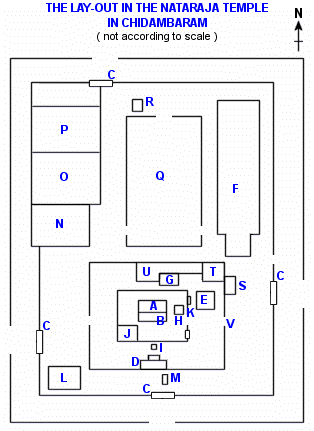
    Natarja ,  Chidambaram Plan Image Credit.  http://natarjatemplechidambaram.blogspot.in/