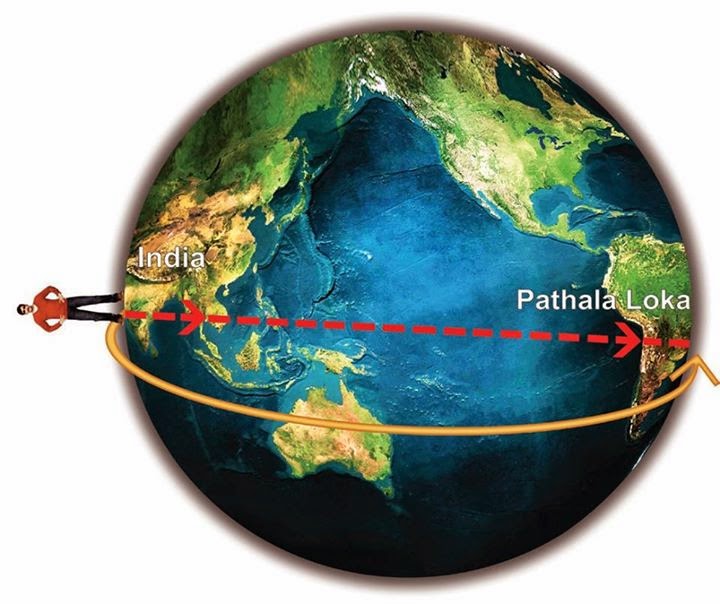
I had written on the fact that the US is the Patala Loka mentioned in the Hindu Puranas ,Ithihasas, Ramayana and Mahabharata.
And California is Kapila Aranya.
I had also written quite extensively on the Inca connection to Hinduism. specifically the Tamils and how they celebrate the Makara Sankaranthi.
Mayan temple Chichen Itza’s Sanctum is identical with the Sanctum of Chidambaram Nataraja.
In Yucatan ruins one finds the 1000 Pillared Mantap( Hall ) in Tikal,like the ones in the Hindu temples in Sout Indi.
We have Hanuman’s son Makaratwaja being worshiped in Honduras.
Rama’s ancestor Sagara,after whom the Ocean is called as Sagara, conducted an Aswamedha Yaga.
A decorated Horse is normally sent before the conclusion of the yaga.
One who stops the Horse must engage himself in a fight with the King who sent the Horse/conducts the Yaga.
Depending on the outcome of the battle, the Yaga will be concluded.
In this case, the horse wandered off and landed in the nether world and stood in front of Sage Kapila, an Avatar of Vishnu, who was meditating.
Meanwhile worried about the missing Horse, Sagara sent his 60,000 sons to search for Horse.
The located the Horse standing in front of Kapila, assumed Kapila and started harassing Him.
Kapila just opened His eyes and the 60000 sons of Sagara were turned into ashes.
Knowing this, Sagara came rushing and requested the forbearance of Kapila.
200,000 Years Old Colorado Shiva Temple.
Kapila told Sagara that his sons would attain Moksha,only after Ganges was brought from the head of Lord Shiva and the ashes were immersed in the Ganges water.
And Sagara’s descendant would achieve this after a strenuous effort.
And that was Bhagiratha.
River Bhagirathi is named after him.
And any ceacseless, undaunting effort is called Bhagiratha Prayathana.( some thing similar to Herculean Task)
The place where the sons of Sagara was turned into ashes is the Ash Island, US.
The places are now the Ash Island and Horse island US.
‘According to Jagadguru Sankaracharya all this happened in “Kapilaranya” which is exactly opposite to India in the Globe and which is currently California. Geography, of course, confirms that India and California locations are diametrically opposite to each other on the Globe. Therefore if one were to notionally pierce a needle from India on the Globe, it would hit California directly at the bottom. This also corroborates the view that the princes who dug deep into the ground from India reached California at the bottom. Also the existence of “Ash Island” and “Horse Island” next to California today lends credence to this explanation suggesting that “Ash Island” was the place where the princes were burnt to ashes and the “Horse Island” was the location where the horse was tied. Hindus popularly believe that the epic Ramayana happened at least 100,000 years ago. So, could it be that Hinduism is 100,000 years old and spread to far off locations including the geographic area, which is USA today?’
The Americas were the Patalas as described by Hinduism in the Puranas.
Yakshas are described as a Superior Benevolent beings and Kubera, God of Wealth, is their Chief.
The Rishis of India, Narada included were connected to the Mayans.
Yaxichilan Litel.Yaksha of Hinduism?
There are two architects in Hindu Puranas.
Mayasura was an ancient King of India and he was the architect of the Patala Loka.
The Mayans have a close relationship with this legend.
Mayans were great Astronomers and were the Hindus.
I shall be posting on the Astronomy connection between Mayas and the Hindus.
Yaksha Sculpture Saranath,India
And the The Nagas were also connected to the Mayans.
To the topic on hand ,
Yaxchilan pronounced: [ʝaʃtʃiˈlan] is an ancient Maya city located on the bank of the Usumacinta River in what is now the state of Chiapas, Mexico. In the Late Classic Period Yaxchilan was one of the most powerful Maya states along the course of the Usumacinta, with Piedras Negras as its major rival.(wiki)
‘Epigraphers think that the ancient name for the city was probably the same as that of its’ realm, Pa’ Chan, meaning “Cleft (or broken) Sky“.
The lintels of Yaxchilan Temples are decorated with carvings that can be connected to carvings ofYakshas in India.
In Sanskrit PaShan (पाषण) also means stone and this could be distorted as Pa’Chan.
In Ancient India, Yakshas(यक्ष) are a class of benevolent spirits or super-natural guards who are the custodians of treasures that are hidden in the earth and in the roots of trees…
Maya, who built mystical and phenomenal structures for Yakshas and Asuras (demons) was also a Yaksha and we can related him as origin of Mayan civilization, that thrived in mexico and south america.
Sila (शिला) means stone or stone-sculpture or stone plate in sanskrit.
Yaksha-Sila (यक्षशिला) are the Yaksha’s stone-lintels in Mexico and thus the name Yaxchilan (distorted version of Yaksha-Sila).
Yakshas are mentioned in Hindu, Buddhist and Jain traditions.
There is definitely an important connection between the old Vedic people and Maya-ancestors. The Mayas are actually referred to in The Mahabharata, one of the main Hindu scriptures, as a tribe having left the Indian subcontinent. There are sources who have revealed those people to be the same as the Nagas, one of the oldest Indian tribes recorded. Those Nagas seem to have been a people, later called Danavas, with a capital Nagapur. They are referred to in another main Hindu-scripture, the Ramayana, as belonging to a Naga-Maya tribe, who is said to have transmitted their culture towards Babylonia, Egypt and Greece.”
Naga is the Sanskrit word for serpent or snake.The feathered serpent represents the Mayan God Kukulcan or Quetzacoatl, a Christ/Krishna-like figure. In those days the ancient serpent religion referred to the Serpents of Wisdom. Mercury or Hermes (Narada – see further in text) – his symbol is the caduceus : two serpents entwined around a staff.
The Tamil Connection.
“The four principal groups in ancient India were the Asuras (Assyrians or Indus Valley people), Panis (Phoenicians), Yakhus or Yakshas (subjects of Kubera, god of gold and treasure a.k.a. Nagas) and Mayas. We know them today as the Dravidians (Tamils, Malayalam, etc.)
The non Indus Valley people in ancient days were exceedingly superstitious and fearful of the Mayans. The latter were excellent international shippers and traders, builders and astronomers. Their superstitious enemies thought their accomplishments had to be magic and beyond human ability. They were ultimately driven to Ceylon where they inhabited the province of Maya. Later, they went to the Americas, having been taken there by Kubera and his Yakshas.” [12] ‘Ceylon’ in those ancient times was more than likely the now sunken land to the south of India and connected geographically to the Ceylon of today, Sri Lanka. This is the ancient Tamil country of which today’s Tamil Nadu in India is but a small remnant..
This is a major key to the understanding of their ancient Sri Lankan origins which, with southern Tamil India, extended much further south, now since sunk hundreds of thousands of years ago.When speaking of their origins, the Mayans (like the Hopis) had several names for their land: Shilanka(Xilanca) – an ancient name of Ceylon (Zeilan-Ka) Shikalanka (Xicalanca) – Ceylon. In Tamil, Shikalam.A Mayan culture hero was Ishbalanka (Xbalanca) meaning in Tamil, “Shiva of Lanka” who was supposed to have made the footprint on top of Adam’s Peak in Sri Lanka; modernly, in line with the prevailing Buddhist culture, it is known as (Gautama) ‘Buddha’s footprint.’Palenque, the ancient capital of Guatamala, Palenke (Palenque) derives from the Tamil Pal-Lanka, meaning “Protectorate of Lanka.” Guatemala (the main habitat of the Mayans) may derive from Gautemala, meaning “A Subsidiary Land of Gautama Buddha.”
References and Citation.
Una Vision del Mundo, Prof. G. Zapata Alonzo, Merida, Mexico, 1994, p.71.
“Ophiucus : Astronomy , Astrology & the “Thirteenth Constellation” in Soul Cycles of the Seven Rays, Phillip Lindsay. Will the Maya Prophecy Really Happen? Gene D. Matlock.
I had posted quite a few articles on the fact that the Americas were the Patala Loka described in the Hindu Puranas.
That the Incas descended from the Tamils and celebrated Pongal ,Makara Sankaranti.
And the Mas had their roots in Sanatana Dharma.
More evidence has come to light in the form of a Mysterious Ceremonial Shrine , Yamacutah. Georgia, USA.
In Sanskrit ,
Yamacutah , Georgia.Burial Shrine.
Yama (Sanskrit: यम) or Yamarāja (यमराज) is the god of death, belonging to an early stratum of Vedic mythology. In Sanskrit, his name can be interpreted to mean “twin”.[1] In the Zend-Avesta he is called “Yima”.[2] According to the Vishnu Purana, Yama is the son of the sungodSurya[3] and of Sanjna, the daughter of Visvakarman, sometimes called “Usha”. He is the brother of the current Manu Vaivasvatha and of his older sister Yami, which H. H. Wilson indicates to mean the Yamuna river.[4] According to Harivamsa Purana her name is Daya.[5] In the Vedas, Yama is said to have been the first mortal who died. By virtue of precedence, he became the ruler of the departed,[6] called “Lord of the Pitrs”.[7] There is a one-of-a-kind temple in Srivanchiyam, Tamil Nadu, India, dedicated to Yama.
Distant some twenty yards, a great black bear was perched in the fork of a tree. As he moved his forepaws with the evident intention of descending, a ball from Clark’s deadly rifle crashed through his head. Curious to say, as was afterwards learned, that bear’s life was the first ever known to be taken at or near Yamacutah. After a “delightful supper of broiled bear ham,” as the adventurers described it, they slept by turns, through most of the night, and with the rising sun began a careful examination of their surroundings.
About seventy-five yards from the west end of the natural rock dam they discovered a curious upright statue a little over four feet high. It was made of a soft talcose rock, 13 inches square at the bottom; but the top, from the shoulders up was a fair representation of the human figure. The shoulders were rudimentary, but the head was well formed. The neck was unduly long and slender. The chin and forehead were retreating. The eyes were finely executed, and looked anxiously to the east. It stood at the center of an earth mound (17) seventeen feet in circumference and six feet high. Around it were many other mysteries which will never be fully explained. Only a few of them may be mentioned now.
Four paths, doubtless the ones the Choctaws mentioned, led, with mathematical precision, from the base of the mound to the cardinal points of the compass. Though it seemed that no other part of the forest had been trodden by human feet, these paths were as smooth and clean as a parlor floor. The scrubby cane, which seemed to have been planted by design along their margins, was as neatly trimmed as if the work had been done by a professional gardener. And here, amid those gloomy solitudes the natives believed that our God, their Great Spirit, had walked as a man walks along his homeward pathway.
The statue was found to be the center of an exact circle about one hundred and fifty yards in diameter. Its boundary was plainly marked by holes in the ground three feet apart. The holes to which the paths ran in a straight line from the center were much larger than the intervening ones; and before them, inside the circle, were what seemed to be stone altars of varying dimensions. At the end of the path running to the north was a single triangular stone; at the east were five square stones and four steps; at the west, four stones and three steps; at the south, three stones and two steps. Upon the upper surface of all the stones except that at the north the effect of fire was plainly visible and doubtless had been used for sacrificial purposes.
All the paths terminated at the altars except the one running to the east. At this the trail parted, and, uniting beyond it, continued a short distance and then, much like an ascending column of smoke, disappeared, gradually. The account given by the Choctaws was verified. On the smooth surfaces of the stones were deeply cut both three and five-pointed half moons, whose horns turned in different ways.
A good representation of the rising sun and other curious characters were deeply cut on the eastern altar.’
The basic story about the Yamacutah shrine is so phenomenal that it is probably true. However, there are many discrepancies about the details of the history being told visitors to the region today.
During the 1700s, the American Indians, who lived immediately around the Yamacutah Shrine, were not ethnic Creeks or Cherokees. They were Timucua, who originally spoke a language that originated in South America. In fact, their tribal name, Tamakoa, was the origin of the Spanish ethnic label, Timucua.
French and English speakers called the Tamakoa, the Thamacoa or Thamagua. In 1664 they lived upstream on the Altamaha River from the short-lived French colony of Fort Caroline. They spoke a similar language of several provinces in northeastern Florida, all of whom the Spanish called Timucua.
‘The word, Yamacutah, was probably from the lost Apalache language. It was a Creek dialect, but not quite the same as the four surviving Creek languages. Whatever the case, Yamacutah does not mean “Tumbling Shoals in Creek” as stated by numerous local sources in Jackson County. The words for that phrase are entirely different in the three Creek languages used today: Mvskoke, Kvce, Koasati and Miccosukee.
A hint of the meaning of Yamacutah comes from numerous 18th century maps. They show an ethnic group named the Katvpa (Katawpa ~ Catawba) living in the region immediately west of Yamacutah. Apparently, there were once many more Katvpa living in Georgia than in the branch that gave rise to the Catawba Indians. The Katvpa were Muskogeans. Their name means “Place of the Crown” in Itstate Creek and Itza Maya. Apparently, their vassals were Siouans in South Carolina.
In contemporary Creek languages, “Yama” can mean a tribe that once lived on the Mobile River in Alabama, or the adjective, “gentle.” Yamacutah could be the Anglicization of Yamakvtv, which means either “Gentle Crown” or “Yama Crown.” The site’s name is just one of its many mysteries..
Yama Came and disappeared.
On the carved stones were the strange letters of an unknown language, plus many abstract symbols. The most prominent symbols were of a sunrise and various combinations of crescent moons. At each cardinal direct were a different combination of carved rectangular stones, covered with writing and symbols.
Creek families living near the shrine told visitors that this place was the most sacred location in all North America. It was here that God had appeared one day. By God the Creek families really meant the sun god, whose description closely matched the invisible Creator, Yaweh (YHWH), of the ancient Hebrews. For a period of time he taught the ancestors of the Creeks mathematics, astronomy, surveying and how to maintain a perfectly accurate calendar.
Then one day, the extraterrestrial visitor disappeared before their eyes. Where he last stood was now a small conical mound, on top of which was a white stone statue of a man looking up to the stars. It was surrounded by a complex shrine that marked the locations of planets and distant galaxies in the sky, plus the days and months of the solar calendar that he introduced. It began on the Summer Solstice, contained leap days and was equally as accurate as the one we use today.
The connection between the Mayan Civilization is reconfirmed when one studies the Building of the Chichen Itza and the Temples of Tamil Nadu in general and Chidambaram Temple of Lord Natarja, a form of Lord Shiva, in particular.
The general principle of building the temple is identical.
The sacred room in a Mayan Pyramid is called Chilambalam.
The sanctum of Shiva is called Amablam in Tamil,Chitrambalam in Tamil means a smaller temple.
And at the end of reciting Shiva’s Tamil Hymns from Thevaram, Thiruvasagam the word .Thiru Chitrambalam’ is recited to indicate that the Mantras are concluded.
Chichitzen Itza pyramid has the same plot as a South Indian temple vimana. Both are based on a grid consisting of 8 × 8 squares.
In Vasati such a square grid is called Manduka Mandala, the frog mandala. The centre is formed by a square made of four squares, which corresponds to the Brahmasthana, the place of Brahma. At this location the divine energy is so strong that it is not suitable for people to live there.
Chidambaram temple Gopuram, Tamil Nadu,India.
Both in the Vasati temples and in the Maya pyramids the most sacred place of the whole structure is located exactly in this square. The Mayas call this area Chilambalam, which means sacred room. This room is cubic and corresponds to the original form of room itself in Vasati.
Chichen Itza pyramid has the same plot as a South Indian temple vimana. Both are based on a grid consisting of 8 × 8 squares.
Adhering to this principle, there is a Shiva-temple in South India in which the sacred room or the room of consciousness is being worshiped. This temple with immaculate proportions is called Chidambaram and ranks amongst the most famous Vasati temples of South India next to Shri Rangam. The same concept of the sacred room or hall of consciousness was called Chilambalam by the Mayas. Another perplexing parallel..
The term Maya itself may be from the word Maya, who is the sculptor illusionist of the Asuras( auras means one who is powerful-please read my post on this).
He is the one who built the House of wax in the Mahabharata to entrap the Pandavas and he also built the Palace in Indraprastha,now called Delhi.
( Duryodhana, mistaking the Floor to be water, so well was the floor designed, fell to the ground, Draupadi laughed and Duryodhana vowed to get even with her for insulting him).
The Maya word K’ultanlini refers to the divine power and has obvious similarities to the Sanskrit word Kundalini which also refers to the life power and the power of consciousness.
‘
The renowned Vedic architect Dr. V. Ganapati Sthapati travelled to Peru in spring of 1995. His ancestors had built the big Shiva temple in Tanjore approximately a thousand years ago, and he himself continues to build temples all over the world according to the same principles of Vedic architecture. Merely studying old Sanskrit and Tamil scriptures on architecture caused him to assume that there had to be a connection between South America and India.
Not only is its plot based exactly on the same geometric matrix, the Vasatipurusha Mandala, but also its form is identical with the South Indian Vimana (temple domes) even in details. Furthermore, there are amazing similarities as to measurements.
Dr. Sthapati discovered that the South-Indian measure/rule (Kishku yardstick approx. 33 inch) was used mainly in the Peruvian region of Kushku. Residential buildings were also built strictly according to the principles of Vasati , as developed by Maya Danava. Its plots, position of doors and windows, proportions, form of roofs, inclination angles of roofs, diameter of columns, width of walls etc. are perfectly in accordance with the rules of Vasati , which are still applied in 60% of all houses built in India nowadays.
Considering so many similarities, it is hard to believe in accident as an explanation. In addition, also the techniques applied by the Maya to erect their buildings and to hammer their huge stones for temples and pyramids are identical to those still taught and applied by Dr. Sthapati today. They have been described by Maya Danava in his books on Vasati.
Chchiten Itza.
The most recognizable structure here is the Temple of Kukulkan, also known as El Castillo. This glorious step pyramid demonstrates the accuracy and importance of Maya astronomy—and the heavy influence of the Toltecs, who invaded around 1000 and precipitated a merger of the two cultural traditions.
The temple has 365 steps—one for each day of the year. Each of the temple’s four sides has 91 steps, and the top platform makes the 365th.
Devising a 365-day calendar was just one feat of Maya science. Incredibly, twice a year on the spring and autumn equinoxes, a shadow falls on the pyramid in the shape of a serpent. As the sun sets, this shadowy snake descends the steps to eventually join a stone serpent head at the base of the great staircase up the pyramid’s side.
The Maya’s astronomical skills were so advanced they could even predict solar eclipses, and an impressive and sophisticated observatory structure remains on the site today.
Recently this World Heritage site was accorded another honor. In a worldwide vote Chichén Itzá was named one of the New Seven Wonders of the World.
How to Get There
Chichén Itzá is located near the small town of Piste. Bus services connect to the international airports at Mérida (under two hours) and Cancun (two and a half hours).
When to Visit
The ruins are open daily. Chichén Itzá’s climate is consistently tropical—average temperatures are 93ºF (34ºC). Spring and autumn equinoxes offer the chance to see the incredible shadow serpent of El Castillo—but the often crowded site is absolutely packed at these times.
How to Visit
Staying in the Chichén Itzá area allows visitors to visit early in the morning, out of the hot sun and without the company of the many tourists who arrive on day trip tours from Mérida and Cancun. There is also a light show on the site at night.
With panic running high among the gullible, I thought it fit to search the web for information as to how to read the Maya Calendar.
I was lucky in finding a reasonable explanation from two sources.
Here they are.
‘”
Mayan Calendar-Bar and Dot System
The first thing to understand is that the Maya used three different calendars. The first was the sacred calendar, or Tzolk’in, which lasted 260 days and then started over again, just as our 365-day calendar refreshes once it hits Dec. 31. This calendar was important for scheduling religious ceremonies.
The second calendar was the Haab’, or secular calendar, which lasted 365 days but did not account for the extra quarter-day it takes the Earth to revolve around the sun. (The modern calendar accounts for this fraction by adding a day to February every four years, the reason we have leap years.) That means the calendar wandered a bit in relation to the seasons.
The final calendar was the Long Count Calendar — the recording method that has caused all of the doomsday brouhaha of 2012. On Dec. 21 (approximately), the calendar completes a major cycle, which has triggered doomsday fears and mystical rumors about the end of an age. [Full Coverage: The Mayan Apocalypse (Not)]
The Maya shared our culture’s fascination with calendar mile-markers and would have likely considered the date important, Witschey told LiveScience. But they did not make any doomsday predictions about the date. The only two carvings ever found referring to the date depict contemporary kings and their predicted long-lasting legacies, Witschey said.
“Suppose I said to you that George Washington is so important that we will still consider him a revered national leader in the year 3000,” Witschey said. “So now you’ve got the rollover of the zeros, you’ve got an important contemporaneous figure, and you’re looking forward to the future.” That’s what the Mayan carvings are trying to accomplish, he said.
How the Long Count Calendar works
The Long Count Calendar may not predict doomsday, but it is good at covering long periods of time. Here’s how it works: Dates are written out as five numbers separated by four periods, such as 13.0.0.0.0. (The ancient Maya represented these not with numerals, of course, but with their own hieroglyphs.)
The right-most position is called the k’in, which counts single days: 13.0.0.0.1, for example. The k’in counts up to 19 and then flips back to zero, with counting picked back up by the next position, the uinal. So 13.0.0.0.19 would become 13.0.0.1.0, much like a car odometer. [Images: Mayan Calendar Carvings]
Each uinal is thus a block of 20 days. The k’in position then picks back up, counting up to that 20, which then gets added to the uinal. So the day after 13.0.0.1.0 would be 13.0.0.1.1 and then 13.0.0.1.2, all the way up to 13.0.0.1.19 and finally 13.0.0.2.0.
The uinals count upward as well. While the Maya generally use a base-20 counting system, Witschey said, they modify this slightly for the uinal, which only counts up to 17 before rolling over to the third position, the tun. Each tun is thus 18 blocks of 20 days, or 360 days — approximately a year by the solar calendar.
Tuns, in turn, count up to 20 before rolling over into k’atuns. As 20 blocks of 360 days, each k’atun translates into 7,200 days, or just less than 20 years. The k’atun place then counts up before rolling over into the final digit, the b’ak’tun.
If that word sounds familiar, it’s because Dec. 21, 2012, on our calendar marks the end of the 13th b’ak’tun of the Mayan Long Count Calendar. In other words, it’s the day the count will read 13.0.0.0.0. On Dec. 22, it will read 13.0.0.0.1.
Think of the Mayan Calendar as a series of series of interlocking gears with different ratios: a 13 pin sprocket turns inside a 20 pin cog, which itself rotates in another, and it in another and so on. The Mayans did not shy away from large numbers, and invented some rather ingenious methods to write down some extremely large numbers. But before we go into that, here’s a road map of what you are seeing on any typical Mayan display month:
You must be logged in to post a comment.