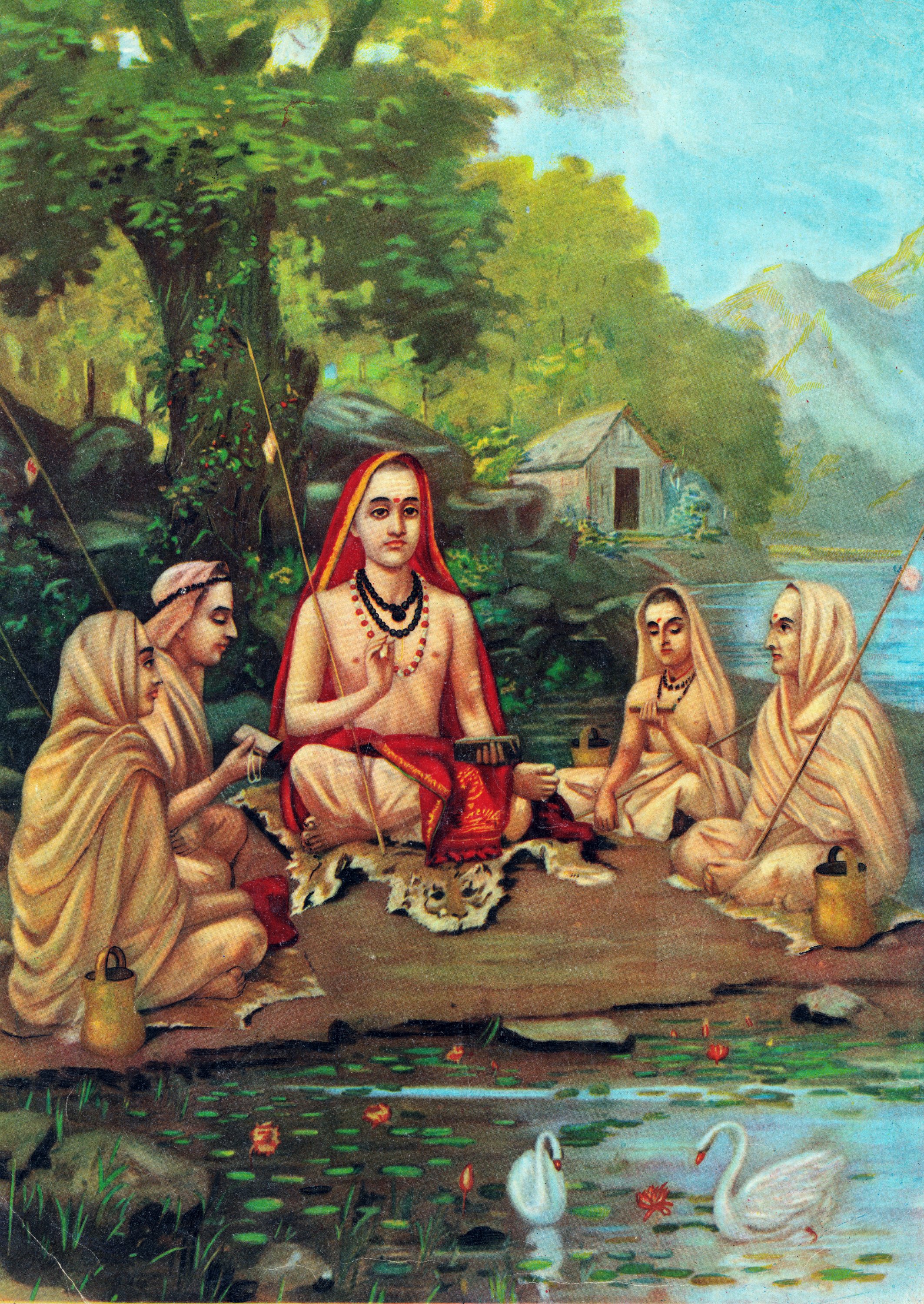
Tag: Mahāvākyas

  • Shankaracharya Misinterpret Vedas Misled, Shiva In Padma Purana?

    Shankaracharya Misinterpret Vedas Misled, Shiva In Padma Purana?

    Not for nothing Dr. Radhakrishnan, former President of India and a Philosopher said that ,

    ‘Indian Philosophy is not a view of Life, but a Way of Life’.

    It is one thing to read,study the Vedas and other Hindu Texts but it is another proposition to understand its soul and ethos.

    Mere Intellectual or Bhakthi approach would not help one to understand the spirit of Hinduism.

    Hinduism should be lived and practiced for years  to understand it in its multifarious aspects.

    Mere abstraction would remain just that, an intellectual Narcissism..

    Mere Bhakthi, or total surrender to God , though highly recommended, is likely to lead one into disappointment as this path is, though seems easy to say, is the toughest to practice.

    One must understand that Hinduism is a personal Religion in the sense that one can practice it the way it suits him, so long it is in conformity with the Vedas.

    As individuals are numerous, so are their mental attitudes.

    Hence Hinduism provides four paths to follow so that people of different mindsets can follow Spirituality.

    They are,

    Karma Yoga, Path of Action,

    Gnana Yoga, Path of Knowledge,

    Raja Yoga, Path of Mental and Physical Discipline and

    Bhakthi Yoga, the Path of total surrender.

    The fact that one is emphasized in the Vedas and other Hindu texts, when they speak of a particular path, does not mean that the other Paths are inferior.

    They are spoken this way so as to instill in the mind the conviction to follow the path that appeals to them and such sayings reinforces the attitude.

    The same logic applies to Nirguna Brahman,Reality without Attributes and Saguna Brahman,Reality with Attributes.

    (for details  please read my article God with names and forms Yes and No)

    This one can understand from the Vedas, Puranas, Ithihasas and the Slokas /Mantras.

    One would, in the same breath, the Vedas talk about Nirguna Brahman and Saguna Brahman.

    One would find the Reality being described as a principle, Nirguna, in the Mahavakyas thus,

    1. prajñānam brahma – “Prajña is Brahman” or “Brahman is Prajña”(Aitareya Upanishad 3.3 of the Rig Veda)
    2. ayam ātmā brahma – “This Self (Atman) is Brahman” (Mandukya Upanishad 1.2 of the Atharva Veda)
    3. tat tvam asi – “Thou art That” (Chandogya Upanishad 6.8.7 of the Sama Veda)
    4. aham brahmāsmi – “I am Brahman”, or “I am Divine” (Brhadaranyaka Upanishad 1.4.10 of the Yajur Veda)

    Then you find in the Narayana Suktha.

    Narayanam mahagyem Viswaathmaanam Parayanam,

    Vishnu Suktha,

    Vishnornukam veeryani pravosam..

    or the Sri Rudram,

    nama sivaya cha, Sivadharaaya Cha,

    where the Individual deities are  praised.

    or look a the Lalitha Sahasranama, where a portion is allotted for worshiping the Devi as Nirguna, the chapter being Nirguna Upasna and another Saguna Upasna where personal deity is worshiped.

    So both options are provided.

    Reading one and discarding the other is not compatible with the Vedas.

    Quoting Vedas in isolation lands one into situations and interpretations that run counter to Vedas themselves, as it has happened in the case of the Mimamsa.

    The Karma Kanda, the portion of the Vedas that deal with duties and performance of Yagas and Yagnyas, was carried to such an extreme that only the Karmas in the form of Yagnyas were followed and the Gnana and Bhakthi were totally omitted..

    And the performance of only Yagnas and sacrifices caused a revulsion among people and this one of the reasons for the raise of Buddhism.

    And many Gods were worshiped in the Yagnyas.

    It took all the Life of Shankaracharya to set matters right and establish the authority of the Vedas, by systematizing  worship into Shanmaha, Six systems of worship.

    And he reestablished the concept of Nirguna Upasna and also provided room for Saguna Upasna.

    Iswara concept found in Patanjali’s yoga Sutra was reinforced by him.

    Such being the case I was shocked to find an observation by Stephen Knapp who has done yeoman service to Hinduism by propagating Sanatana Dharma concept that Shankaracharya misinterpreted the Vedas!

    and

    he quotes Padma Purana and Siva Purana.

    We must point out that some spiritual authorities say that Shankaracharya was an incarnation of Lord Shiva who had been ordered by the Supreme Lord to cheat the atheists. The Shiva Purana quotes the Supreme Lord as ordering Shiva: “In Kali-yuga mislead the people in general by propounding imaginary meanings from the Vedas [Vedic literature] to bewilder them”:

    dvaparadau yuge bhutva

    kalaya manushadishu

    svagamaih kalpitais tvam ca

    janan mad-vimukhan kuru 1

    The Padma Purana also says that Lord Shiva would descend as a brahmana sannyasi and teach Mayavada philosophy in the verse:

    mayavada ashat shastram prachchanna

    boudhyam uchyate moya ebe godidam

    devi kalou brahmana murtina

    To do this, Shankara gave up the direct method of Vedic knowledge and presented an indirect meaning which actually covered the real goal of Vedanta. This is confirmed in the Padma Purana where Lord Shiva addresses his wife, Parvati:

    shrinu devi pravaksyami

    tamasani yathakramam

    yesham shravana-matrena

    patityam jnaninam api

    apartham shruti-vakyanam

    darshayal loka-garhitam

    karma-svarupa-tyajyatvam

    atra ca pratipadyate

    sarva-karma-paribhramsan

    naiskarmyam tatra cocyate

    paratma-jivayor aikyam

    mayatra pratipadyate

    “My dear wife, hear my explanations of how I have spread ignorance through Mayavada philosophy. Simply by hearing it even an advanced scholar will fall down. In this philosophy which is certainly very inauspicious for people in general, I have misrepresented the real meaning of the Vedas and recommended that one give up all activities in order to achieve freedom from karma. In this Mayavada philosophy I have described the jivatma and Paramatma to be one and the same.” 2

    The Padma Purana, in the quote that follows, describes how Lord Shiva tells his wife, Parvati, that he would appear in Kali-yuga to teach the impersonalistic philosophy, which is impious and merely a covered form of Buddhism. Yet, as explained next, there was a purpose for it.

    mayavadam asac-chastram

    pracchannam bauddham ucyate

    mayaiva kalpitam devi

    kalau brahmana rupini

    brahmanas caparam rupam

    nirgunam vaksyate maya

    sarvasvam jagato’py asya

    mohanartham kalau yuge

    vedante tu maha-shastre

    mayavadam avaidikam

    mayaiva vaksyate devi

    jagatam nasha-karanat

    “The Mayavada philosophy is impious. It is covered Buddhism. My dear Parvati, in the form of a brahmana in Kali-yuga I teach this imagined Mayavada philosophy. In order to cheat the atheists I mislead them by describing the Supreme Lord to be without any personal form or qualities.”

    Herein, Lord Shiva himself points out that to believe God has no form is not accurate and is equal to atheism. Even though this Mayavada philosophy was not good for pious people to hear because it would sway them toward an impersonalistic viewpoint, we should note that Shankara’s philosophy was just right for the time and circumstance. The Buddhists, who had spread throughout India and neglected the Vedas, believed in neither a soul nor a God and that, ultimately, the essence of everything is the nothingness or void wherein lies nirvana, freedom from all suffering. So considering how the Buddhists had followed a philosophy of what would generally be considered atheism for hundreds of years and would never have accepted a viewpoint which advocated a supreme personal God, Shankara’s was the only philosophy they would have considered. It was like a compromise between atheism and theism, but Shankara used portions of Vedic knowledge as the basis of his arguments. In this way, as Shankara traveled throughout India his arguments prevailed. Thus, Buddhism bowed and Vedic culture was brought back to prominence. Therefore, his purpose was accomplished, so much so that his Sariraka-bhasya is considered the definitive rendition of Vedanta even to the present day.’

    Totally wrong interpretation.

    If Bhaja Govindam is quoted to buttress the view that Shankaracharya was really only after

    Bhakthi to Vishnu, what about his nirvana Shatgam ,Manisha Panchakam, Soundarya Lahari,Kanakadhara Sthavam,Subrahmanya Bhujanga,Ganesha Pancharatnam?

    Shankaracharya should be studie in full an no in bits.

    And if proof is needed that there are interpolations in the Puranas, Padma Purana and Shiva Purana, this is it.

    This accusation against Shankaracharya is not new.

    He was also called a Pseudo-Buddhist for His Advaita!

    If Shankaracharya was misquoting the Vedas, then how come the Mahavakyas I have quoted above speak of Nirguna Brahmana and not Saguna Brahman, Reality without Attributes?

    ‘AUM
    That supreme Brahman is infinite, and this conditioned Brahman is infinite.
    The infinite proceeds from infinite.
    Then through knowledge, realizing the infinitude of the infinite, it remains as infinite alone-

    Mundaka Upanishad.

    Great indeed are the devas who have sprung out of Brahman.-Atarva Veda.

    ‘satyam jnanam anantam brahman
    “Brahman is of the nature of truth, knowledge and infinity” -Taittriya Upanishad.

    Reference and citation.

    http://www.stephen-knapp.com/complete_review_of_vedic_literature.htm

    Images credit.

    https://ribhuv.wordpress.com/tag/shankaracharya/

  • No Advaita Visishtadvaita in Vedas Why

    If one studies, not merely reads, the Veda, one will know that there is no specific school of thought or ‘ism’


    One will find worship of nature in its Glory, starting from Water,(Mantra Pushpam),Fire (Agni Suktham,Rige Veda),Earth(Bhoomi Suktham)


    Vedas.Image,jpg.
    Vedas. Image source. http://www.trinetra.org.uk/#/vedas-what-are-they/4561706759


    On Time, Rathri Suktham,Kala Suktham,Ushas Suktham,


    On individual forces of nature, Surya Suktham,


    On Values, Samanasasya Suktham.


    On Gods,


    Vishnu Suktham,


    Sree Suktham,


    Durga Suktham.


    On the  world and on Monotheistic approach,


    Purusha Suktham,


    Narayana Sukham


    There is no specific system of worship or specific God promote as it were.


    Why?


    Hinduism is not founded by any one.


    Vedas express Truth as experienced by the Rishis and the Manta grasped by them from the Ether.


    As Lord Krishna puts it in the Bhagavad Gita, Reality or God reveals itself according to the disposition of the worshiper.


    Reality however remains One,.


    So on a cursory reading of the Vedas might give the impression that there are many Gods in mentioned in the Vedas.


    As experiencing Godhead is intimately personal, Vedas knew that thee is no Universal Solution to the seeker.


    One realizes God hood by His self enquiry and this depends on his tendencies or Vasanas,


    So, much like a Super market, Vedas contain what ever that has been grasped for selection by the Individual.


    That’s all.


    That is the reason why do not promote one God.


    Then why is it in the Veda Mantras on finds that Vishnu is the first God, in  NarayanaSuktham, Vishnu Suktham, Shiva in Sri Rudram, Lakshmi in Sree

    Suktham and Durga in Durga Suktham?


    In philosophy it is called ‘Henotheiism’- the practice of praising one God to the exclusion of the others.


    This has a Psychological element built into it,


    You will not agree that what you do or follow is not the best among the available.


    This reinforces faith and helps you spiritually.


    Similarly there is no specific leaning towards Advaita,Visishtadvaita or Dwaita as such in the Vedas.


    This is has come into being only after the commentators and the three Great Acharyas, Sankaracharya, Ramanuja and Madhwa,


    They did not say anything new or what is not said in the Vedas.


    Each interpreted the Mahavakyas of the Vedas from their stand point.


    And they found supporting arguments for their approach from the Vedas.


    Vedas , being an Ocean, it would provide you source for your approach.


    Therein lies its greatness,


    One more point one must bear in mind the time when these Achayas founded their Doctrines.


    Sankararacharaya came after Buddha, whose Buddhism promoted Nihilism or Sunya Vada.


    It is not practical to restore the Vedas with so many Gods as it were,for one without understanding, to have faith in the Vedas.


    From one Sankara said not Two Advaita, it is easy for one who had been saying that there is nothing to believe that there not two, Advaita


    Then came Ramanuja who established Qualified Non Dualism,not Dualism, Visishta Adavaita.


    Then Madhwa came along and founded Dwaita, Dualism.


    In essence there is no difference as far as the origin of these systems go.


    The difference lies in interpretations.


    Anticipating some bigots of Hinduism , there are slokas of Shiva by Vishnu and By Shiv of Vishnu.


    Read my post on these.


    Only those who do not understand the Vedas and Indian Philosophy would promote either Shaivisma or Vaishnavism.


    Ekam Sat, Vipra Bahuta Vadanti’


    The Truth is One,.


    The learned, Vipra(this is actually a dig at the so-called Scholars, Krishna uses this term and Pandita in the same sense in the Bhagavad Gita)


    Say It is many.


    Sivoham.


    Krishnarappnamasthu.


    Enhanced by Zemanta
  • Eighteen Principles ,One Verse Nirvana Shatakam Adi Sankara

    Eighteen Principles ,One Verse Nirvana Shatakam Adi Sankara

    Adi Sankaracarya wrote the Nirvana Shatakam.

    This is also called as Atma Shatakam.

    He explains the Non Duality of Reality in these  Six Verses.

    The essence of the Vedas are found in three Mahavaakyas(Great Revelations)

    They are,

    ‘Aham Brahmasmi’ (Brhadaranyaka Upanishad 1.4.10 of the Yajur Veda)

    tat tvam asi – “Thou art That” (Chandogya Upanishad 6.8.7 of the Sama Veda)
    prajñānam brahma – “Prajñānam is Brahman”  or “Brahman is Prajñānam” (Aitareya Upanishad 3.3 of the Rig Veda)

    The Core meaning is That There is One Reality and We Are a part of it,nay we are It.

    ( note , one sloka each from each Veda: Atharva also has one)

    I shall be posting blogs on each of them.

    The interpretations of the three Acharyas differ, resulting in the three main systems of Indian Thought.

    They are.

    Advaita of Adi Sankara, Non Dualism, Monism,

    Visishtadvaitam- of Ramanuja, Qualified Monism and

    Dwaidha of Madwacharya, Dualism.

    Shankaracharya, in these verse, not only gives us the essence of the Vedas, but also explains the Evolution of the Universe through the Eighteen Principles.

    The World , to be known, has two elements or two things.

    The Observer and The Observed.

    We are the Observers and all other things are the ‘Observed’

    On our side, The Observer, we have the following .

    The five sense organs,Eyes,Ears, Nose, Mouth and Skin (body, tactile)-5

    Five acts of perception, seeing,tasting etc.(Eyes register Image, they do not experience; to explain  one may have eyes but can not see;the act of seeing is different from ‘seeing’) -5

    Mind(the activity of the Brain),-1

    Buddhi, distinguishing faculty, differentiating between The Right and The Wrong)-1

    Ahanagara, the feeling of ‘I’, Mine”-1

    The Five elements,Earth,Water,Fire,Air and Ether-5

    Total 18

    The Sloka.

    Nirvana Shatkam 1
    Nirvana Shatkam 1

    Mano-Buddhy-Ahangkaara Cittaani Naaham
    Na Ca Shrotra-Jihve Na Ca Ghraanna-Netre |
    Na Ca Vyoma Bhuumir-Na Tejo Na Vaayuh
    Cid-Aananda-Ruupah Shivo[a-A]ham Shivo[a-A]ham ||1||

    Meaning:
    1.1: Neither am I the Mind nor Intelligence or Ego,
    1.2: Neither am I the organs of Hearing (Ears), nor that of Tasting (Tongue), Smelling (Nose) or Seeing (Eyes),
    1.3: Neither am I the Sky, nor the Earth, Neither the Fire nor the Air,
    1.4: I am the Ever Pure Blissful Consciousness; I am Shiva, I am Shiva,

    This constitutes the elements for(of) the Observer.

    What about the ‘Observed?’

    Explanation in the next post along with Samkhya explanation for these principles, for Samkya is a heterodox system which does not believe in the Vedas