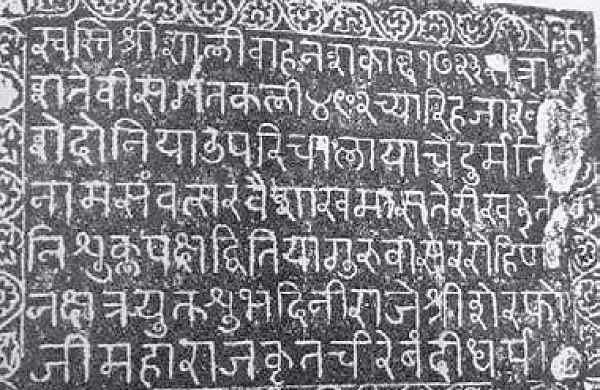
Tag: Copperplates evidence

  • Epigraphs Copperplates Legal,Not Archeological Records

    Epigraphs Copperplates Legal,Not Archeological Records

    It is with consummate ease with which Indian historical records are dismissed with Elan, in the guise of a research paper by a Scholar .I am providing excerpts from the research paper that is supposed to research on Copperplates and Epigraphs of India.

    Abstract: Indian copper-plate grants, initially issued by ruling kings from the third
    century CE onwards and increasingly by private individuals as time passed, are very
    specific documents, as they are kept by the grant beneficiaries as title-deeds. They are
    usually treated as inscriptions due to them being made of such hard material. How-
    ever if the main character of an inscription is its being publicly displayed, copper-
    plate grants are not inscriptions, as they were often found buried for safety’s sake.
    Based on South Indian materials, it is argued here that Indian copper-plate grants are
    neither inscriptions (i.e. publicly displayed writings on temple walls, steles, rocks,
    etc.) nor documents or archival records (i.e. private or state records on palm leaf), but
    are situated at the ‘hinge’ between these two categories, as revealed by their format,
    content and purpose.
    Among the many issues raised by the nature of archival records, I will address here
    only a selection. How, by whom and for which purposes are administrative, legal,
    archival records produced? Is there any observable difference between archives, in-
    scriptions and literary manuscripts concerning materials, formats, and producers?
    Where are archives stored? Are there other objects stored together with the records?
    Which practices are involved inside the archive, how and by whom are they used?
    I will deal with these issues by focussing on Indian copper-plate grants, in par-
    ticular South Indian examples of the first millennium CE and the beginning of the
    second, which show that the copper-plate grants’ content and format are similar to
    that of palm-leaf account books. Still, Indian copper-plate grants are traditionally
    treated as inscriptions because of the durability of the material. But are they? And if
    not, what are they? Documents? My argument is that copper-plate grants, i.e. charters
    of donation inscribed on copper so as to serve as permanent title-deeds, are a peculiar
    type of documents to be situated at the intersection between inscriptions and archives
    for several reasons, which, I hope, will be clear at the end of this essay……..

    Conclusions
    Indian copper-plate grants in general and many other examples of texts engraved
    on metal do not comply to what is a restrictive definition of inscriptions as ex-
    posed or publicly displayed texts, as they were usually kept privately and some-
    times buried. There is further the fact that texts (or parts of texts) found engraved
    on copper are also recorded on other supports such as the palm leaf or paper of
    account books, which fall in the category of archival records since they are ad-
    ministrative documents, or the stone of temple-walls and steles, which fall in the
    category of inscriptions since they are public records. The same text could thus
    be materially instantiated for different reasons: account keeping (archives), pub-
    lic information, proclamation and personal display (inscriptions), securing fu-
    ture rights (copper plates).
    But one question remains: why take so much effort in placing at the begin-
    ning of copper-plate grants lengthy eulogies of kings, if these documents were
    not meant in the first place to be read? The answer might be that there were oc-
    casions when the plates had a ‘public life,’ when read, possibly at the time they
    were delivered to the grantees with a kind of ritual reception or at the time they
    were produced in case of legal dispute. Anyhow, if we are to keep the general
    label copper-plate inscriptions, we should hasten to add that, due to their value
    as title-deeds, these, especially grants, are not usual inscriptions in spite of their
    enduring support, nor usual state archives, but rather belong to an intermediate
    category, for which the best label would simply be copper-plate grants.
    Acknowledgements:
    Many thanks to Arlo Griffiths for providing me excellent pictures of North Indian copper-plate
    grants and of the Pātagaṇḍigūḍem plates, for polishing my English and for offering many sug-
    gestions. I am also indebted to R. Balasubrahmanyam for the permission to photograph copper
    plates in the collections of the Chennai Government Museum and to R.K. Tewari …. Citation.

    ‘To cite this version:
    Emmanuel Francis. Indian Copper-Plate Grants: Inscriptions or Documents?. Alessandro Bausi;
    Christian Brockmann; Michael Friedrich; Sabine Kienitz. Manuscripts and Archives: Comparative
    Views on Record-Keeping, De Gruyter, pp.387-418, 2018, ff10.1515/9783110541397-014ff. ffhalshs-
    01892990ff. https://halshs.archives-ouvertes.fr/halshs-01892990