Tag: Avatar

  • Yajneshwara Is The First Avatar of Vishnu

    The ten Avatars of Vishnu are as under,though there are minor variations in some Puranas to this list.

    The list, according to Vishnu Purana.

    Matsya,Koorma,Varaha,Nrusimha,Vamana,Rama,Parashurama,Krishna,Balarama and Kalki.

    Vishnu's Discus.
    Vishnu’s Discus.gif

    Of these, the first four were in the first yuga,Satya Yuga Sandhi.

    Of these four, Matsya is taken as the first Avatar of Vishnu.

    The Matsya cautioned Manu of the impending Great Flood , asked him to meditate and move away.

    By that time Manu had a family and had a son,though adopted, name Yagnya.

    This is an Avatar of Vishnu as he is the personification of Yagnya,Sacrifice.

    He is Yagnya,head of Yagnya,cause of Yagnya,carrier of Yagnya offering.

    ‘Yagyo Yagya-Patir-Yajva Yagyango Yagya-Vahanah

    Yagyabhrud Yagyakrud Yagyi Yagyabhrug Yagyasadhanah
    Yagyanantakrud Yagyaguhyam Annam Annada Eva Cha

    _Vishnu Sahasranama.

    ‘Vishnu has been equated to Yajna (“sacrifice”) as early as in the Vedas. The commenter on the Vedas – Sayana describes Vishnu as the lord of Yajna or the sacrificer himself.Even the Bhagvad Gita associates Vishnu to Yajna (sacrifice). Performing sacrifices is considered to equivalent to pleasing Vishnu.The Vishnu Sahasranama (“Thousand names of Vishnu”) also relates Yajna as a name of Vishnu.

    Yajneshwara (“Lord of Yajna”) is mentioned as an avatar of the Hindu god Vishnu in the Bhagavata Purana. As Yajna, Vishnu is the embodiment of the Hindu sacrifice ritual or Yajna.He was also the Indra (king of the gods) of the Svayambhuva Manvantara, era of Svayambhuva Manu.

    Yajna is the son of Prajapati Ruci and Akuti, the daughter of Svayambhuva Manu – the first Manu (progenitor of mankind).During the period of Svayambhuva Manu (Svayambhuva Manvantara), there was no qualified Indra, the post of the king of Svarga (Heaven) and king of gods. So, Vishnu incarnated as Yajna and held the post of Indra.

    Vishnu Purana tells that Yajna had a twin sister named Dakshina (“donation”). Later, Yajna married Dakshina and had twelve sons. These twelve Devas (gods) are collectively called the Yāmas ( https://en.m.wikipedia.org/wiki/Yajna_(avatar)


    Despite of the fact that Âkûti had brothers, she was handed over to the great sage Ruci on the condition that the king would get the resultant son. This was settled with the support of religious rites and the consent of his wife.


    Ruci, the most powerful great sage who was entrusted with the procreation, in his supreme concentration begot a pair of children by her who were of the greatest spiritual and brahminical strength.


    The very powerful son the daughter bore was taken to the home of the very happy Svâyambhuva Manu, while Dakshinâ was kept by Ruci.’

    1. Yagna and Dakshina got married subsequently and had 12 sons known as Tushita demigods in Swayambu manu’s time (Tosha, Pratosha, Santosha, Bhadra, Sânti, Idaspati, Idhma, Kavi, Vibhu, Svahna, Sudeva and Rocana) Yagna the Indra then. And Marichi head of sages
    2. Source.
    3. http://vipasana-vidushika.blogspot.in/2013/04/families-of-manu-kardama-prajapathi-and.html

    It is yet another pointer to Sanatana Dharma being present in the south much earlier to Vedic period.

    The philosophical explanation of Yagnya follows in another article.

    I have noticed that the name Yagnyanarayanan is present in South India , among Brahmins.

    As this Avatar preceded Matsya, which took place after Manu had a family,Yagneswara is the first Avatar of Vishnu.
     

  • Womb The Home Garbha Griha Temple Sanctum

    Womb The Home Garbha Griha Temple Sanctum

    One is born from a woman, ends up in Earth.

    Hinduism accords the respect these deserve.

    A woman is called Gruha Lakshmi, one who brings Prosperity to Home.

    Tamil calls her Illal, one who owns/rules the Home.

    Lord Balaji In Garbha Graha, Tirupati.jpg
    Lord Balaji In Garbha Graha, Tirupati.

    Similarly Earth is given the respect it deserves for it supports from Birth to Death.

    Earth is eulogized as Mother and there are Vedic Sukthas in praise of the Earth, Bho Suktham.

    There is Neela Suktham, Neela is considered to be the consort of Lord Vishnu.

    Such being the case, there is no wonder in Hinduism calling the Sanctum Sanctorum of a Temple as Garbha Gruha, Gharbha meaning The Womb and Gruha, the Home.

    Tamil calls The Gharbhagriha as Karuvarai, meaning ‘where the Foetus stays’

    One’s first Home is the womb.

    A Hindu temple consists of an inner sanctum, thegarbha griha or womb-chamber, where the primary idol or deity is housed along with Purusa. The garbhagriha is crowned by a tower-like Shikhara, also called the Vimana. The architecture includes an ambulatory for parikrama(circumambulation), a congregation hall, and sometimes an antechamber and porch.

    The Hindu temple architecture reflects a synthesis of arts, the ideals of dharma, beliefs, values and the way of life cherished under Hinduism. It is a link between man, deities, and the Universal Purusa in a sacred space.

    In ancient Indian texts, a temple is a place for Tirtha – pilgrimage.It is a sacred site whose ambience and design attempts to symbolically condense the ideal tenets of Hindu way of life. All the cosmic elements that create and celebrate life in Hindu pantheon, are present in a Hindu temple – from fire to water, from images of nature to deities, from the feminine to the masculine, from kama to artha, from the fleeting sounds and incense smells to Purusha – the eternal nothingness yet universality – is part of a Hindu temple architecture.

    ….

    Garbhagriha or Garbha gruha (garbha gṛha) (Sanskrit: गर्भगॄह) is the sanctum sanctorum, the innermost sanctum of a Hindu templewhere resides the murti (idol or icon) of the primary deity of the temple. Literally the word means “womb chamber”, from the Sanskritwords garbha for womb and griha for house. Only ‘priests’ (pujari) are allowed to enter this chamber.

    Although the term is often associated with Hindu temples, it is also found in Jain and Buddhist temples…

    In temples with a spire or vimana, this chamber is placed directly underneath it, and the two of them form the main vertical axis of the temple. These together may be understood to represent the axis of the world through Mount Meru. The garbha griham is usually also on the main horizontal axis of the temple which generally is an east-west axis. In those temples where there is also a cross-axis, the garbha gṛha is generally at their intersection.

    Generally the garbhagriha is a windowless and sparsely lit chamber, intentionally created thus to focus the devotee’s mind on the tangible form of the divine within it. Entrance to the garbha grha may be restricted to priests who perform the services there…

    In the Dravida style, the garbhagriha took the form of a miniature vimana with other features exclusive to southern Indian temple architecture such as the inner wall together with the outer wall creating a pradakshina around the garbhagriha. The entrance is highly decorated. The inner garbhagriha or shrine became a separate structure, more elaborately adorned over time.

    More often garbhagriha is square and sits on a plinth, its location calculated to be a point of total equilibrium and harmony as it is representative of a microcosm of the Universe. In the centre is placed the image of the deity.

    But sometimes, for the temples of feminine deities, the garbagriha is rectangular. For example in the temple of Varahi Deula in Chaurasi.

    The present structure of most of these temples is a two-storeyed vimana with a square garbhagriha and a surrounding circumambulatory path, an ardha-mandapa and a narrower maha-mandapa.

    https://en.wikipedia.org/wiki/Garbhagriha

    https://en.wikipedia.org/wiki/Hindu_temple_architecture

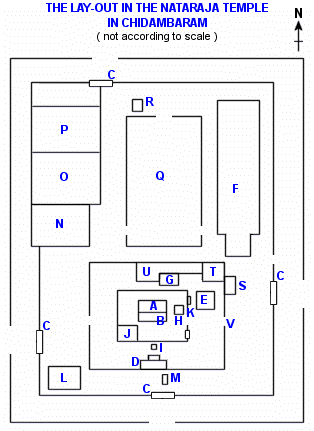
    Natarja ,  Chidambaram Plan Image Credit.  http://natarjatemplechidambaram.blogspot.in/

  • Saraswati Is Benzaiten Japanese God Of Eloquence

    Yet another evidence that Sanatana Dharma existed throughout the world , later carried to various parts,modified to suit the local customs.

    That those customs were also similar to those followed by Sanatana Dharma.

    Goddess Saraswati.jpg
    Saraswati,Goddess of Learning in Hinduism


    Benzaiten (, ) is the Japanese name of the goddess Saraswati; there was an important river in ancient India of this name (see Vedic Saraswati River). Worship of Benzaiten arrived in Japan during the 6th through 8th centuries, mainly via the Chinese translations of theSutra of Golden Light“, which has a section devoted to her. She is also mentioned in the Lotus Sutra.

    Her Sanskrit name isSarasvatî Devî“, which meansflowing water“, and so Benzaiten is the goddess of everything that flows: water, words (and knowledge, by extension), speech, eloquence, and music. The characters used initially to write her name, readBiancaitianin Chinese andBensaitenin Japanese (辯才天), reflected her role as the goddess of eloquence. Because the Sutra of Golden Light promised protection of the state, in Japan she became a protectordeity, at first of the state and then of people. Lastly, she became one of the Seven Gods of Fortune, and the SinoJapanese characters used to write her name changed to 弁財天 (Benzaiten), which reflects her role in bestowing monetary fortune. Sometimes she is called Benten, although this name refers to the goddess Lakshmi.

    Statue of Benzaiten with a torii on her head.jpg
    Hogonji in Nagahama, Shiga prefecture, Japan. Statue of Benzaiten with a torii on her head

    In the RigVeda (6.61.7) Sarasvati is credited with killing the threeheaded Vritra, also known as Ahi (“snake“). This is probably one of the sources of Sarasvati/Benzaitens close association with snakes and dragons in Japan. She is enshrined on the Island of Enoshima in Sagami Bay, about 50 kilometers south of Tokyo, and numerous other locations throughout Japan; and she and a fiveheaded dragon are the central figures of the Enoshima Engi, a history of the shrines on Enoshima written by the Japanese Buddhist monk Kokei (皇慶) in AD 1047. According to Kokei, Benzaiten is the third daughter of the dragonking of Munetsuchi (無熱池; literallylake without heat“), known in Sanskrit as Anavatapta, the lake lying at the center of the world according to an ancient Buddhistcosmological view.


    Citation.

    http://en.wikipedia.org/wiki/Benzaiten

  • Shiva Divine Acts  64 Thiruvilayadal List

    Shiva Divine Acts 64 Thiruvilayadal List

    As I indicated in my earlier posts, the essential difference between an Avatar of Shiva and Vishnu lies in the fact ,in the case of Shiva, He does not stay in a Womb, called Ayonijaha (though this epithet  is used for Vishnu in the Vishnu Sahasranama, I do not recall any instance where Vishnu seems to have appeared  from nowhere and disappeared), in the case of Vishnu He is born as Humans in a womb, undergoes the trials and tribulations of  a Human Being.

    Play of Shiva, Murals in Madutai Meenakshi Temple.jpg
    64 Thiruvilayadal,Sacred Play of Shiva, Murals in Madutai Meenakshi Temple.

    Probably an Avatar is different from Leela, an Avatar is the coming down of God, Avatara means ‘coming down’,whereas Leela can be translated loosely as ‘play,playful’.

    Lord Shiva’s Leelas where He had appeared, done His job and disappeared are mentioned in the Tamil Classics, more vividly in the Thiruvilayadal Purana by Paranjothi Munivar, 6th Century AD.

    These Avatars, Leelas of Shiva are 64 in number.

    These have taken place in Madurai, Tamil Nadu.

    These Avatars are called the Avatars of Somasundara,an amsa of Shiva, and the husband of Meenakshi, an avatar of Goddess Parvati.

    Meenakshi Sunadareswarar is in the Madurai Meenakshi Temple.

    Other than in the Tamil Classics, Shiva Purana and passing references to some of the instances narrated in the Thiruvilayadal Purana, in the other Puranas,I am unable to find references to these in the Sanskrit works.

    One can not brush these aside as figment of Tamil Imagination either as cross references abound Tamil and they are generally trust worthy of facts and there are temple inscriptions which check out with other Historical facts.

    The history of the Tamil Kings mentioned in these instances check out .

    Considering the fact that the ancestor of Lord Rama migrated from Dravida, there seems to be something I am missing here.

    Please refer my Post Rama’s ancestor from Dravida

    I am searching.

    Some of these instances seem to be prehistoric and may relate to Thenmadurai, where the First Tamil Sangam was held Thenmadurai was swallowed by a Tsunami.

    Please read my posts on Tamil Sangam dates.

    Readers may send in their inputs with source on this issue.

    The 64 instances where Lord Shiva appeared are listed below.

    You may read the instances at the link.

    Citation.

    http://www.shaivam.org/english/sen_thiruvil.htm

    Thiruvilaiyadal puranam in English
    Sports No. kANtam Sports of God (thiruviLaiyAdal)
    0. ThiruvilaiyadalPuranam – Introduction
    1. Maduraik kANtam The removal of the crime of indra
    2. The removal of the curse on the white elephant
    3. Discovery of the god to mortals; Building the town of madura; and reign of the first king
    4. Incarnation of minatchi, the goddess of the temple
    5. Marriage of minatchi with siva by the name of sundaresvara
    6. God’s dance in the silver hall
    7. The insatiable dwarf kundotharan
    8. Ganga, at the command of the god, produced the river vaigai
    9. The god brought the seven seas together into one place
    10. Recalling malayadhwaja from the dead, and translation of kanjana-malai
    11. The incarnation of subramanyan in the form of ukkira-pandian
    12. The god sundaresvarar gets his son married and furnishes him with three weapons
    13. Varunan is compelled to retire by the casting of the spear
    14. Ukkira-pandian strikes off indran’s crown
    15. Ukkira-pandian struck mount meru and thence obtained wealth
    16. The god explained the inner meaning of the vedas
    17. The god provided jewels for the crown
    18. Varuna sending the sea to try the god’s power; The latter called four clouds to absorb the sea
    19. kUdal kANtam Varuna sending much rain, the god protected the place by a covering of clouds
    20. Sundaresar condescended to assume the form of a religious ascetic
    21. The sittar gave sugarcane to the stone-elephant
    22. The god killed the elephant which was born from the fire Of a sacrifice made by the chamanals (or jains)
    23. The god on account of gauri, became an old man, a young man, and a child
    24. Natarajar the dancing god altered his attitude, In the silver temple, at the request of the king
    25. The god relieved an innocent person who feared the avenger of blood
    26. The removing of the great crime
    27. The god punished the guilty disciple, by killing him
    28. The destroying of the striped serpent sent by the chamanals (jains)
    29. The god’s nandi conquers the cow sent by the chamanals
    30. The god came with a great army, on account Of savundra samuntan general of the pandian
    31. The god gave an exhaustless purse to the pandian
    32. The god came and sold bracelets to women of the merchant caste
    33. The god taught the eight great meditations
    34. The god opened north gate, and showed the Temple to the chera king, closing the gate afterwards With the bullock seal
    35. The god preserved the pandian’s army by the Miraculous appearance of a booth for giving away water
    36. The performance of alchemy by the god
    37. On the chera king making war, both he and The pandian fell into the lotus tank, from which The pandian was rescued
    38. The god gave a stock of paddy to a vellalan
    39. The god, coming as the maternal uncle of a merchant, settled a dispute
    40. The cure of varaguna pandian, and showing him the world of siva
    41. The god sold wood, and overcame the minstrel, named yemanathen in song
    42. The god gave to his votary, pattiren, A mandate, addressed to the chera king, requiring money
    43. The god gave to the minstrel pattiren, a golden board to sit upon
    44. The god, in the guise of a musician, Decided a contest in singing between two female performers, In the presence of the king
    45. The god nourished certain motherless young pigs, And endowed them partially with the human form
    46. The god made the twelve pigs ministers of state to the pandian king
    47. The god gave instruction to the little black bird
    48. The god gave paradise to the heron, And ordained that the lotus tank should produce no Living creature
    49. thiruAlavAyk kANtam The god showed the boundaries of the town after the place had been destroyed by a flood
    50. The god conquered the soren king, who came To make war against the pandian, which was done by arrows Having the name of sundaresvaren written on them
    51. The god gave a bench to the college of poets; And mingling with them contributed to the improvement of The tamil language
    52. The god gave to terami a purse of gold
    53. The god rescued nakkiran from the tank
    54. The god by means of agastyar taught narkiran purity of grammar
    55. When the bench of learned brahmins were disagreed concerning the merits of different books, the god, by means of A dumb child, settled the difference
    56. The pandian having treated idei-kaden with neglect, The god was pleased to remove and dwell at avada-mathurai
    57. The god came with a net as a fisherrman, And removed the sentence denounced on parvati
    58. The god gave instruction to a person belonging to vathavur
    59. The god turned jackels into horses on behalf Of manickavasagar, who had been instructed Bythe gurumurthi
    60. The god turned the horses into jackals, And being displeased at the subsequent treatment of Manickavasagan, made the river vaigai overflow
    61. The god came to carry mud as a cooly, And the sacred body was struck with a cane
    62. Sambantar, cured kun pandian of his fever
    63. The impalement of the jains
    64. The god called a vanni tree, a lingam, and a well, From tirupurambiyam to bear witness to a marriage
  • Parallel Multi Universe In Hinduism Astronomy

    Parallel Multi Universe In Hinduism Astronomy

    Hinduism is the first religion o have formed  a Cyclic Theroy of Time, that is Time runs in cycles,


    The Four Yugas, Aeons, Krutha, Tretha,Dwapara and Kali repeat themselves without end.


    One approach to establishing the Multi verses is from the angle of the Atomic structure.

    Vishnu with Multi Verse.jpg
    Vishnu with Multi Verse.


    Please refer my posts under Multiverses.


    The other is to find it at the Macro level.


    The description of the Universe in the Hindu Puranas are quite detailed and they explain that there are many worlds with beings, that they intermingled, fought with each other.


    Please refer my post Aliens in Ramayana, Mahabharata,Hinduism.


    The description of the Constellations and their shifting movements  as explained in the Hindu system is validated by modern Astronomy.


    Our Pole Star shifts and so all the other stars with respect to our Sun.


    The Universe contains billions of Stars and they their Planetary Systems.


    Just as our Stars shift position in relation to our Sun, the billion Stars of the Universe shift.


    The term Adhitya refers to Sun in Hinduism.


    There are twelve Adhityas and Vishnu one among them.


    He , as I explained in my post ‘Vishnu once in 6480 years, Astronomy Precession  Equinox,’ emerges once in 6480 years with the changing Great Year, Yuga.


    The Devi Mahatmiya describes that the Devi takes the Trinity of Brahma, Vishnu and Rudra around the Universe and shows them numerous Brahmas, Visnus and Shivas at work, before reaching Chintamani Gruha of the Devi.


    Please read my post on Chintamani Gruha.


    Now these countless Suns, having their own planets follow their own Laws, some  physical laws are the same as ours,


    People existing there travel among them, including the Earth.


    As the Physical laws there are different so is the definition of Life.


    The composition of Life there may be different from ours, they mayor need not have the basis Hydrogen,helium or Carbon as the building block of Life.


    May be they might not need Amino Acids.


    I am providing an excerpt.


    The idea of a physical multiverse came later to physics than it did to religion and philosophy. The Hindu religion has ancient concepts that are similar. The term itself was, apparently, first applied by a psychologist, rather than a physicist.

    Concepts of a multiverse are evident in the cyclical infinite worlds of ancient Hindu cosmology. In this viewpoint, our world is one of an infinite number of distinct worlds, each governed by its own gods on their own cycles of creation and destruction.

    The word multiverse was originated by American psychologist William James in 1895 (the word “moral” is excluded from some citations of this passage):

    “Visible nature is all plasticity and indifference, a [moral] multiverse, as one might call it, and not a [moral] universe.”

    The phrase rose in prominence throughout the 20th century, when it was used regularly in science fiction and fantasy, notably in the work of author Michael Moorcock (though some sources attribute the word to the earlier work of author and philosopher John Cowper Powys in the 1950s). It is now a common phrase within these genres.

    According to MIT cosmologist Max Tegmark, there are four levels of parallel universes:

    • Level 1: An infinite universe that, by the laws of probability, must contain another copy of Earth somewhere

    • Level 2: Other distant regions of space with different physical parameters, but the same basic laws

    • Level 3: Other universes where each possibility that can exist does exist, as described by the many worlds interpretation (MWI) of quantum physics

    • Level 4: Entirely distinct universes that may not even be connected to ours in any meaningful way and very likely have entirely different fundamental physical laws

    Tegmark’s approach is one of the few attempts to comprehensively categorize the concepts of parallel universes in a scientific (or, as some see it, pseudoscientific) context. The full text of Tegmark’s 2003 paper on this topic is available at his MIT website, for those who don’t believe that these concepts are scientific. (They may not be scientific, but at least they’re unscientific musings by a scientist.)


    Citation.


    http://www.dummies.com/how-to/content/string-theory-parallel-universes-and-the-multivers.html