Tag: astronomy

  • Dating Mahabharat,Bhagavad Gita By Astronomy.Texts

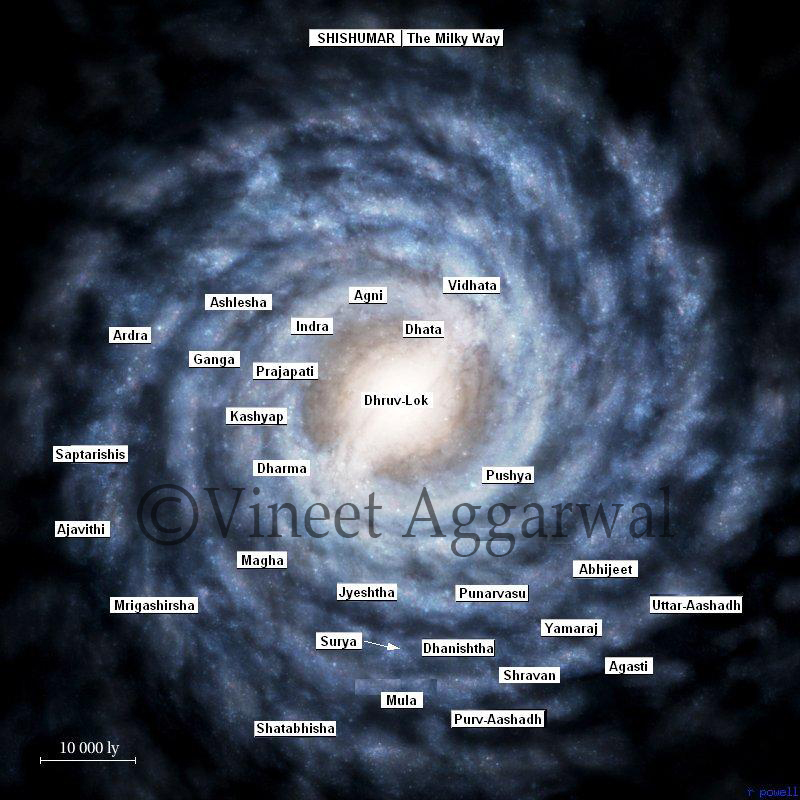
    Mahabharata Sky Map.
    Sky During the Mahabharata War.

    The date of Mahabharata is often debated.

    However it may be noted that it has been accepted as a Fact of History and not a legend.

    People who deny that the Mahabharata is History and based on facts are those who deny because they find  the impossibility of some of the feats and Physiognomy of the characters in the Epic .

    I will posting on this.

    Now based on the internal evidence which abounds in The Mahabharata and external references to the Mahabharata fix the date somewhere between

    3129 BCJ and 2559 BCJ.

    This wide gap between the Dates is due to our present of Time,

    Please read my posts on Time filed under Time,Astrophysics( Read my posts on Ravana’s date,Ram’s Date,Places traveled by Lord Rama)

    Evidence for this conclusion.

    1.External Evidence based on references to Mahabharata by other Works.

    Aryabhata, is a famous early astronomer with contributions to science, whose estimate of p, and the time of moon revolution around the earth are so accurate, that his works are being extensively researched. Aryabhata(476-550 AD) stated that Kaliyuga started 3600 years before, when he was 23 years old, making the start as 3102 BC [Aryabhateeya ref-1]). It would date Mahabharata war to around circa 3130-3140 BCJ.

    Surya Siddhanta [Ref 2], a document evolved from roughly same period, states that sun was 54 degrees away from vernal equinox when Kaliyuga started on a new moon day, corresponding to February 17/18, 3102 BCJ, at Ujjain (75deg47minE 23deg 15min N).

    Varaha Mihira (circa 560 AD), another famous astronomer, stated that 2526 years before start of Saka count (either Shalivahana saka starting in 79 AD orVikrama Saka starting in 57 BC) [Brihat Samhita Ref-3].

    When Saptarishis (ursa major) was near Magha Yudhistira was king 2526 years before Sakatime

    Presently, traditional Sanatana Dharma followers consider that Kaliyuga started at 3102 BCJ, when Sri Krishna passed away, and that Mahabharata war occurred in 3138 BCJ. Millennium year 2000 AD is Kali 5102.”

    Internal Evidence in The Mahabharata.

    The Bhishma Parva and Udyoga Parva(specific chapters of Mahabharata) provide considerable astronomical/astrological descriptions and omens as the Mahabharatawar was approaching. It describes a period of draught, with many planetary positions. Then there is this clear reference to pair of eclipses occurring on 13th day as shown below.

    Fourteenth day, Fifteenth day and in past sixteenth day, but I have never known the Amavasya(New Moon day) to occur on the thirteenth day. Lunar eclipse followed by solar eclipse on thirteenth day is in a single lunar month etc…

    This reference to Thirteen day eclipse pair appears to be a unique astronomical observation. 

    Mahabharata text also refers to retrograde motions of planets prior to war and provides their location with reference to 27/28 Vedic star locations. Mahabharata Drona Parva also refers toJayadhratha’s killing during a dark episode on 13th day of the war, which some consider as another short solar eclipse.

    This document is basically concerned with analysis of all eclipses visible at Kurukshethra(Location where Mahabharata war took place, north of New Delhi, Longitude 76 deg 49 min East, Latitude 29 deg 59 Min North) from 3300 BC to about Buddha-Mahavira-Parshvanaathatime of about 700BC. Analysis of the time between successive eclipses, specifically time between end of one and beginning of other has been made, with a view to look at astronomical feasibility of back-to-back eclipses in 13 days, using modern astronomical computer software.

    Another major issue of how did observers of the period define and determine period between eclipses when no clocks existed, has been addressed.

    Eclipses

    Lunar eclipse occurs when Earth’s shadow falls on the Moon. There are about 150 lunar eclipses per century. Lunar eclipses can occur only at full moon, and can be either total or partial. Further they can be umbral and or penumbral. Total lunar eclipses can last up to 2 hours, while partial lunar eclipses can last up to 4 hours. Any observer on dark face of earth can see when lunar eclipse when it occurs. During period 3500BC to 700 BC, nearly 4350 lunar eclipses have probably occurred. A good fraction of these would have been visible inKurukshethra [ref-6].

    Solar Eclipse occurs when Moon’s shadow falls on earth observer. About 240 solar eclipses occur every century. During period 3500BC to 700 BC, nearly 6960 Solar Eclipses have occurred. Solar can occur only at new moon. Solar eclipses may be total or annular. Total solar eclipses can last up to about 8 minutes, and partial solar eclipses can last up to 115minutes. The shadow of moon has a limited size of few thousand miles falling on nearly 8000-mile diameter earth. Hence, solar eclipses can be seen only in a limited range of longitude-latitude where the shadow falls. Elsewhere, even though sun is visible, eclipse will not be seen.

    Eclipse evaluating computational software and its validation in present context
    Astronomical calculations have been greatly improved since past 30 years, particularly with considerable amount of trajectory work conducted in Moon and other scientific projects. High accuracy computer models and software have been developed. These are validated against databases from US Naval Observatory‘s Interactive computer Ephemeris, and Jet Propulsion Laboratory in California. One such code is LodeStar Pro copy righted by Wayne C Annala in 1994 [Ref- 7]. The Lodestar Pro was checked for historical eclipses of 1000-2500 BC from clay tablet records of Mesopotamia area presently available with British Museum. Wayne Mitchell has analyzed this data [Ref-8]. Lodestar Pro provided excellent match with ref-8.

    Eclipses at Kurukshethra

    During the period of our interest, 3500BC to 700 BC, nearly 4350 Lunar Eclipses and 6960 solar eclipses have occurred on earth. Of these nearly 673 solar and lunar eclipses occurred in pairs of time gap of about nominal 15 days corresponding to roughly half lunar month. We need to search amongst these 673 for eclipse pairs visible in Kurukshethra, which occurred in ‘Thirteen’ days.

    A very detailed scan of all the visible lunar and solar eclipses for every year from 3300BC to 700 BC was made on the Lodestar software for Kurukshethra location. These are tabulated and plotted. Maximum eclipse time gap (end of one eclipse and beginning of next eclipse for naked eye observers) was found to be about 379 hours while the minimum was about 332 hours. A plot of time gap between back-to-back eclipses versus eclipse pair number is shown below. (This time corresponds to maximum to maximum – not end of one to beginning of next as in the future table).

    Julian Calendar.
    Julian Calendar from 412 BC

    It is easy for us, in present time, to precisely analyze the eclipse times based on a 24 hour per day time clock. However many thousand years ago, such a time evaluation would clearly be irrelevant. Hence the count of the day and time had to be based on clear, natural and unambiguous events such as sunset to sunset or sunrise to sun rise. Hence in all the analyses, presented below, the time of relevant sun rise or sun set is indicated such that the eclipse beginning and end can be evaluated with reference to the sun rise or sun set. In modern day definition, the period from sunrise to next sunrise is never 24 hours except on equinox day. On all other days, the time will be either less than 24 hours (when day light time is shrinking) and more than 24 hours (when day light time is increasing). For people of ancient times, sunset-to-sunset or sunrise-to-sunrise would be the logical definition of a day. Using this definition, it is possible to determine whether an eclipse pair occurred in ‘Thirteen days’.

    Kurukshethra eclipses and some planetary retrograde motions

    The table below shows six pairs of eclipses, which can be analyzed further to determine whether Mahabharata war and events could occur then.

    Six eclipse pairs visible at Kurukshethra occurring in less than or near 14 days
    Events in red not visible due to sun rise (Lunar) or sun set (Solar)
    Year BC Eclipse Julian day Initial con Max End Sunrise Sunset end/start date.

    Follow the Link for The Table.

    After serious analysis of all the eclipses, six eclipse pairs from 3129 BCJ, 2599 BCJ, 2056 BCJ, 1853 BCJ, 1708 BCJ and 1397 BCJ clearly are the best candidates for Mahabharata war year from ‘thirteen day’ eclipse pairs view point. There are others that have low obscurity for solar eclipse, or have dominant penumbral lunar eclipse content and hence do not constitute strong candidates for the Mahabharata war.

    One typical eclipse pair of the six is illustrated using Lodestar Pro views of the relevant sunset/sunrise periods. The light/day transition is clearly shown in all the eclipse, which would form the only method of determining that the eclipses occurred in less than fourteen days, which has to be called thirteen-day eclipses. Planets Sani (Saturn) and Brihaspati (Jupiter),Shukra (Venus) in retrograde motion are illustrated for period around the eclipse pairs.

    Other Researches place the date at There are astrological, natural, geographical, physical, inscriptional and scriptural evidences that unquestionably establish the date of Mahabharat war as 3139 BC and the beginning of kaliyug as 3102 BC.

    http://www.thevedicfoundation.org/bhartiya_history/mahabharat.htm

    http://www.boloji.com/index.cfm?md=Content&sd=Articles&ArticleID=1052

    Sources.


    The dynasty of Surya Vansh of Kaushal (Ayodhya) ends with Sumitra (Bhagwatam 9/12/16); the dynasty of Chandra Vansh of Hastinapur ends with Chemak (Bhagwatam 9/22/44, 45); and the dynasties of the kingdom of Magadh flourished up to the Gupt dynasty (80’s BC).
    The kingdom of Hastinapur, after Chemak, was constantly ruled by the people who took over the throne. An ancient book describing the date-wise chronology of all the kings of Hastinapur (Indraprasth or Delhi) from Yudhishthir up to Vikramaditya was found by the proprietors of the fortnightly magazine of Nathdwara (Rajasthan) called “Harishchandra Chandrika and Mohan Chandrika” in about 1872 AD. The proprietor of the magazine printed the entire description in two of its issues (called kiran) 19 and 20 of 1882.
  • Cosmic Dawn Universe Photo Essay


    Cosmic Dawn, Looks Like Vishnu's Conch
    Cosmic Dawn, Looks Like Vishnu’s Conch


    From Hubble Telescope.
    From Hubble Telescope.

    COSMIC DAWN IN A NUTSHELL

    Cosmologists have shown that the Universe began in a hot, dense, and featureless state about 13.7 billion years ago. The Universe we observe today, however, is rich with structures such as galaxies, the product of billions of years of expansion, cooling, and gravity.

    The era between 380,000 and 100 million years after “the Big Bang” is called the cosmic dark ages; a time before the first stars formed to light up the Universe. Between 100 million to 1 billion years after the Big Bang, primordial gas collapsed gravitationally into galaxies, where it cooled and compressed enough to form the first stars, ending the dark ages. Light from these first galaxies ripped apart (“re-ionized”) and heated hydrogen atoms in the inter-galactic gas that filled the Universe. This “feedback” impacted future galaxy and star formation and left observable imprints which astronomers are just now beginning to detect. Understanding this epoch of reionization and first light is a key goal in Cosmology and Astrophysics.

    http://www.as.utexas.edu/~gfigm/fri/nutshell.html


    Cosmic Dawn
    Cosmic Dawn


    Credit: H. Ford (JHU/STScI), the Faint Object Spectrograph IDT, and NASA
    Credit: H. Ford (JHU/STScI), the Faint Object Spectrograph IDT, and NASA
    Image Credit: European Space Agency & NASA Acknowledgment: E. Olszewski (University of Arizona)
    Image Credit: European Space Agency & NASA Acknowledgment: E. Olszewski (University of Arizona)


  • Black Holes Photo Essay

    Blackhole
    X-Ray SpexCredit: NASA Marshall CenterBlack holes are some of the universe’s most enigmatic and mysterious objects. Take a tour of some of the most famous ones in the cosmos. This image of the Cygnus X-1 binary star system is one of the first two focused high-energy X-ray images of any astronomer
    Blackhole
    I’m Forever Blowing BubblesCredit: Gallo et al., Westerbork radio telescopeThe cross marks the location of the black hole Cygnus X-1 in this radio image. The bright region to the left (east) of the black hole is a dense cloud of gas existing in the space between the stars, the interstellar medium.
    Blackhole
    Here Comes the Warm JetsCredit: ESO/L. Calçada Combining observations done with ESO’s Very Large Telescope and NASA’s Chandra X-ray telescope, astronomers have uncovered the most powerful pair of jets ever seen from a stellar black hole. The black hole blows a huge bubble of hot gas, 1000 light-years
    Blackhole.
    Radio WavesCredit: NASA/JPL-CaltechThis artist’s concept shows a galaxy with a supermassive black hole at its core. The black hole is shooting out jets of radio waves. New research led by theoretical astrophysicist David Garofalo of NASA’s Jet Propulsion Laboratory in Pasadena,
    Blackhole
    Eat to the BeatCredit: Felipe Esquivel ReedArtist’s schematic impression of the distortion of space-time by a supermassive black hole at the center of a galaxy. The black hole will swallow dark matter at a rate which depends on its mass and on the amount of dark matter around it.
    Blackhole
    Portrait of the Quasar as a Young Black HoleCredit: NASA/JPL-CaltechIllustration of a young black hole, such as the two distant dust-free quasars spotted recently by the Spitzer Space Telescope.
    Blackhole
    Beware of the BlobCredit: NASA/CXC/M.WeissThis illustration shows what one of the galaxies inside a blob might look like, with the spiral arms of the galaxy in yellow and white, and two-sided outflow powered by the supermassive black hole buried inside shown in bright yellow.
    Blackhole
    Our Strange UniverseCredit: SRON
    Blackhole
    Eject, Eject!Credit: NASA/HubbleIn a Hubble picture, a red circle indicates an object in a distant galaxy that could be an ejected black hole.

    http://www.space.com/31-black-holes-universe.html

  • Connecticut Aurora Shooting Identical Moon Phase Analysis.

    I came across an article posting the phases of the Moon on the day of the shooting spree at Aurora on July 20th and Newtown  on December  14 th.

    Here are the Visuals.

    Phases of the Moon and Shootings
    Aurora Shootings July 20th
    Moon Phases
    Newtown Shooting December 14th Moon Phase

    You may note the identical images for the day.

    Is there a correlation between Human Behavior and the Phases of the Moon?

    Psychotic activity peaks during the Full and New Moon.

    At the University of Miami, psychologist Arnold Lieber and his colleagues decided to test the old belief of full-moon ?lunacy? which most scientists had written off as an old wives? tale. The researchers collected data on homicide in Dade County (Miami) over a period of 15 years ? 1,887 murders, to be exact. When they matched the incidence of homicide with the phases of the moon, they found, much to their surprise, that the two rose and fell together, almost infallibly, for the entire 15 years! As the full or the new moon approached, the murder rate rose sharply; it distinctly declined during the first and last quarters of the moon.

    To find out whether this was just a statistical fluke, the researchers repeated the experiment using murder data from Cuyahoga County in Ohio (Cleveland). Again, the statistics showed that more murders do indeed occur at the full and new moons.

    Dr. Lieber and his colleagues shouldn?t have been so surprised. An earlier report by the American Institute of Medical Climatology to the Philadelphia Police Department entitled ?The Effect of the Full Moon on Human Behavior? found similar results. That report showed that the full moon marks a monthly peak in various kinds of psychotically oriented crimes such as murder, arson, dangerous driving, and kleptomania. People do seem to get a little bit crazier about that time of the month.

    That?s something most police and hospital workers have known for a long time. Indeed, back in eighteenth-century England, a murderer could plead ?lunacy? if the crime was committed during the full moon and get a lighter sentence as a result. Scientists, however, like to have a hard physical model to explain their discoveries, and so far there isn?t a fully accepted one. Dr. Lieber speculates that perhaps the human body, which, like the surface of the earth, is composed of almost 80 percent water, experiences some kind of ?biological tides? that affect the emotions. When a person is already on psychologically shaky ground, such a biological tide can push him or her over the edge.

    BLOODY MOON

    Crimes and violence aren?t the only things affected by the 29+ day full moon cycle. In the Journal of the Florida Medical Association, Dr. Edson J. Andrews writes that in a study of 1,000 tonsillectomies, 82 percent of postoperative bleeding crises occurred nearer the full than the new moon ? despite the fact that fewer operations were performed at that time! Clearly, the full moon is a dangerous time for surgery, and the dissemination of this knowledge should result in planning operations for the new moon.

    http://innerself.com/content/self-help/personal-growth/astrology/moonlunar/4462-full-moon-a-human-behavior.html

    Phases of the Moon are said to affect the bleeding of women during menstrual cycle and patients are reported to bleed more if Surgeries are performed.

    Read from Wiki.

    Scientific research on the theory

    Some studies seem to offer limited support for lunar effects, but most fail to show any relationship between the phase of the moon and abnormal behaviour,[16] and meta-analyses have revealed that apparently significant results are likely to be statistical anomalies rather than indicative of a real effect.[17] In general, apparent positive findings have tended to be inconclusive, contradicted by other studies, or shown to be the result of statistical errors. For example, one study found a statistically significant correlation between lunar phase and hospital admissions due to gastrointestinal bleeding, but researchers acknowledged that the wide variation in the number of admissions throughout the lunar cycle limited the interpretation of the results.[18] Two other studies found evidence that those with mental disorders generally exhibit periods of increased violent or aggressive episodes during the full moon,[19][20] but a more recent study found no such correlation.[21] An analysis of mental-health data found a significant effect of moon phase, but only on schizophrenic patients.[22] Nor are such effects necessarily related directly to the behaviour of the moon. A study into epilepsy found a significant negative correlation between the mean number of seizures and the fraction of the moon illuminated by the sun, but this correlation disappeared when the local clarity of the night sky was controlled for, suggesting that it was the brightness of the night that influenced the occurrence of epileptic seizures.[23]

    A reported correlation between moon phase and the number of homicides in Dade County was found, through later analysis, not to be supported by the data and to have been the result of inappropriate and misleading statistical procedures.[17]

    Three studies carried out between 1959 and 1973 reported a 1 percent increase in births in New York following a full moon. However, a 1957 analysis of 9,551 births in Danville, PA, found no correlation between birth rate and the phase of the moon,[24] and a 2001 analysis of 70,000,000 birth records from the National Center for Health Statistics revealed no correlation between an increased birth rate and the full moon phase.[25]

    A fifteen month study in Jacksonville, Florida revealed no lunar effect on crime or hospital room admittance.[26]

    A meta-analysis of thirty-seven studies that examined relationships between the moon’s four phases and human behavior revealed no significant correlation. The authors found that, of twenty-three studies that had claimed to show correlation, nearly half contained at least one statistical error.[17]


    Enhanced by Zemanta
  • Planet With No Star Video

    We have been taught that a Planet rotates around a Star and that is what makes the Planet stable by maintaining it to stay in equilibrium; it is the reason for Seasons , Day and Night.

    Now Astronomers have found a Rogue Planet with No Star to orbit.

    Planet With No Star_jpg.
    Planet With No Star

    “Astronomers using ESO’s Very Large Telescope and the Canada-France-Hawaii Telescope have identified a body that is very probably a planet wandering through space without a parent star. This is the most exciting free-floating planet candidate so far and the closest such object to the Solar System at a distance of about 100 light-years. Its comparative proximity, and the absence of a bright star very close to it, has allowed the team to study its atmosphere in great detail. This object also gives astronomers a preview of the exoplanets that future instruments aim to image around stars other than the Sun.

    Free-floating planets are planetary-mass objects that roam through space without any ties to a star. Possible examples of such objects have been found before [1], but without knowing their ages, it was not possible for astronomers to know whether they were really planets or brown dwarfs — “failed” stars that lack the bulk to trigger the reactions that make stars shine.

    But astronomers have now discovered an object, labelled CFBDSIR2149 [2], that seems to be part of a nearby stream of young stars known as the AB Doradus Moving Group. The researchers found the object in observations from the Canada-France-Hawaii Telescope and harnessed the power of ESO’s Very Large Telescope to examine its properties [3].

    The AB Doradus Moving Group is the closest such group to the Solar System. Its stars drift through space together and are thought to have formed at the same time. If the object is associated with this moving group — and hence it is a young object — it is possible to deduce much more about it, including its temperature, mass, and what its atmosphere is made of [4]. There remains a small probability that the association with the moving group is by chance.

    The link between the new object and the moving group is the vital clue that allows astronomers to find the age of the newly discovered object [5]. This is the first isolated planetary mass object ever identified in a moving group, and the association with this group makes it the most interesting free-floating planet candidate identified so far. ”

    http://www.eso.org/public/news/eso1245/

    While scientists have found objects they believe might be sunless planets in the past, they couldn’t say for certain whether such celestial objects were planets or brown dwarves (which are effectively failed stars). CFBDSIR2149 is the most conclusive such object yet, since it isn’t located anywhere near a bright star as far as the researchers can tell.

    According to the researchers, this object is quite massive—it has 4 to 7 times the mass of Jupiter—and at 430 degrees Celsius (about 806 degrees Fahrenheit), it’s very warm (the ESO didn’t explain why CFBDSIR2149 may be so toasty, though). Also, they say, this maybe-planet is young in astronomical terms, at between 50 and 120 million years of age.'(techhive.com)

    Rogue Alien Planet Found With No Star! Nibiru, Planet X? 2012 HD

    Enhanced by Zemanta