Tag: Allahabad

  • Vishnu Resides In Ganga Magha Purnima


    Magha Purnima, the Full Moon day in January-February, is a religious festival, when Pious activities are engaged in with specific emphasis on taking bath in the River Ganges.


    Embed from Getty Images


    Maghi, is the month during which the famous Kumbh Mela and the annual Magh Mela takes place at Sangam in Prayag or Allahabad.

    Vishwamitra performed the ritual bath during the Kumbh Mela on a Magh Purnima in 2382 BCE. Magh Purnima is an important bathing date during the Kumbh Mela and the Magh Mela.
    Thepposava, Madurai during Magha Purnima.gif
    Float Festival, Madurai.

    Magha Purnima 2015- 3 ,February, Tuesday.

    Timings.

    Purnima Tithi Begins = 02:31 on 3/Feb/2015
    Purnima Tithi Ends = 04:38 on 4/Feb/2015


    Excception,

    When Ganga is not accessible, because of any reason, one may bathe in any other holy stream, river, tank or pond, Moreover, Gangajal is kept almost in all the Hindu homes. Some of it may be poured into ordinary well water, and then used for bathing.

    On this day a fast is observed and charities are done.

    Early in the morning, after ablutions, the dead ancestors are offered libations, and the poor are given dakshina , one which can afford.

    Magh Purnima is an auspicious day for performing Sathyanarayna Puja.

    Lord Vishnu resides in river Ganga during Magh month and even a touch of this water takes a person to Heaven.

    ( Brahma vaivartha Purana)

    According to other Puranas, Lord Vishnu is impressed by charities  on this day

    It is believed that Lord Vishnu resides in Kshir Sagar during this month and river Ganga is a form of Kshir Sagar.

    A dip in the sea at Kanyakumari and Rameshwaram also has high religious value.

    Similarly, a bath in the Pushkar Lake in Rajasthan is also regarded as equally auspicious. In Madras at Kumbakonam, there are shrines of Nageshwara and Sarangpani near which there is a large tank in which devotees can take a dip on this holy day.

    It is believed that the water of the sacred Ganga flows into this tank on this auspicious day.

    On Magh Purnima, the ‘float’ festival is celebrated at Madurai in Tamil Nadu. On this day, the ornately decorated idols and images of Lord Sundeshwara and Meenakshi are mounted on the floats and are taken to Mariamman Teppakulam Sarovar which is a large sacred tank in Madurai. The procession is accompanied by music and chanting devotional songs.

    Magh Purnima is the birthday of King Tirumala Nayak who constructed the Mariamman Teppakulam which is a few kilometres to the East of Madurai. –

    There is a special significance of this day in Buddhism as well. It is believed that Gautam Buddha announced his impending death on this day. There are religious ceremonies held at Viharas, prayers are dedicated to the Buddha. Religious flags are hoisted on all the monasteries at dawn and sacred verses are chanted from the Tripitaka. –


    According to astrology, Magh Purnima occurs when Moon is in Cancer and Sun is in Capricorn sign.

    Taking bath in the Ganges on Magh Purnima relieves a person from all problems related to the Sun and the Moon.

  • Hinduism Kings Gods In King List Sumeria

    Hinduism Kings Gods In King List Sumeria

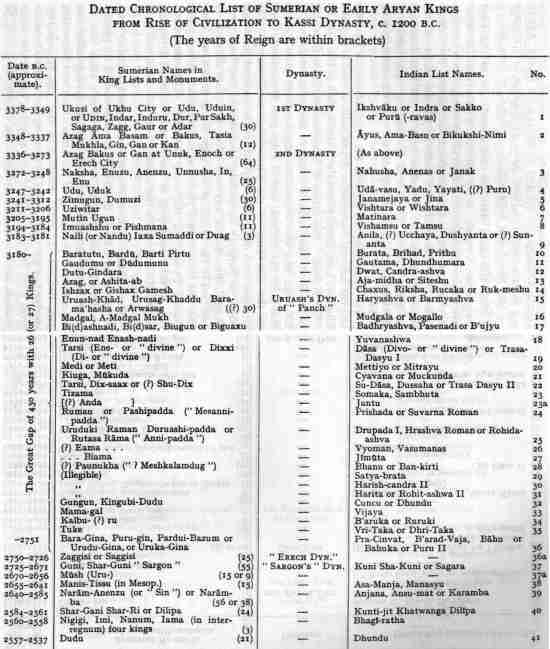
    I have posted an article that Lord Rama and Bharata’s names are found in the Kings List of Sumerians chronicling their Kings.


    Not only Rama and Bharata, but the names of other Hindu Puranic figures find a place in the Kings List.


    The Names found are,

    Sumerian Kings, Chronological order,Kings List.jpg
    Sumerian Kings, Chronological order,Kings List.


    Indra,Pururavas,Dasaratha,Parashurama,Satyavrata,Iksvahu,Kakusha,Janaka,Vasishta, Janamejaya,Dushyanta(Father of Bharata,after whom India is named as Bharatavarsha),Rishis Gautama,Dundhu,,Muchukunda,Drupada,Harischandra,Sagara,Bhagiratha, Lava, Kusha(Rama’s sons),Aja and Raghu(Rama’s ancestors),Pundarika,


    Curious enough ‘ all of them belong to Solar Dynasty mentioned in Puranas.


    “Waddell’s primary chronology was compiled from various Sumerian king lists, Egyptian list of pharaohs, the Bhagavata Purana, Mahabharata, Rigveda and numerous Indus Valley Civilization seals and other monuments and relics and sources, some of which he had deciphered himself.[2] It was entitled “Dated Chronological List of Sumerian or Early Aryan Kings from the Rise of Civilization to the Kassi Dynasty” and documented an alleged list of world emperors as follows:


    Citation.

    en.wikipedia.org/wiki/Waddell’s_chronology

    Image Credit.

    http://www.goldenageproject.org.uk/chronological_sumerian_early_aryan_kings.php


    No. Names in Sumerian King Lists and monuments Date BCE
    (approximate)
    Indian list names
    1 Ukusi of Ukhu City or Udu, Uduin, or Odin, Indar, Induru,
    Dur, Pur, Sakh, Sagaga, Zagg, Gaur, or Adar
    First Sumerian Dynasty
    3378–3349 BCE
    Ikshvāku or Indra or Sakko or Pururavas
    2 Azag Ama Basam or Bakus, Tasia, Mukhla, Gin, Gan or Kan or Nimmirud 3348–3337 BCE Ayus, Ama-Basu or Bikukshi-Nimi
    Azag Bakus or Gan at Unuk, Enoch or Erech City 3336–3273 BCE As Above
    3 Naksha, Enuzu, Anenzu, Unnusha, In, Enu Second Sumerian Dynasty
    3272–3248 BCE
    Nahusha, Anenas or Janak
    4 Udu, Uduk 3247–3242 BCE Udā-vasu, Yadu, Yayati, (?) King Puru
    5 Zimugun, Dumuzi 3241–3312 BCE Janamejaya or Jina
    6 Uziwitar 3211–3206 BCE Vishtara or Wishtara
    7 Mutin Ugun 3205–3195 BCE Matinara
    8 Imuashshu or Pishmana 3194–3184 BCE Vishamsu or Tamsu
    9 Naili (or Nandu) Iaxa Sumaddi or Duag 3183–3181 BCE Anila (?) Ucchaya, Dushyanta or (?) Sunanta
    10
    11
    12
    13
    14
    1516
    17
    18

    19
    20
    21
    22
    23
    24

    25
    26
    27
    28
    29
    30
    31
    32
    33
    34
    35

    36

    Baratutu, Bardū, Barti Pirtu
    Gaudumu or Dūdumunu
    Dutu-Gindara
    Azag, or Ashita-ab
    Ishzax or Gishax Gamesh
    Uruash-Khād, Urusag-Khaddu,
    Barama’hasha or Arwasag (c. 3100 BCE)
    Magdal, A-Magdal, Mukh
    Bidashnadi, Bidsar, Biugun or Biguaxu
    Enun-nad Enash-nadi
    Tarsi (Ene- or “divine”)
    or Dixxi (Di- or “divine”)
    Medi or Meti
    Kiuga, Mūkuda
    Tarsi, Dix-saax or (?) Shu-Dix
    Tizama or Tizkar, Anda
    Rumau or Pashipadda
    (“Mesanipadda”),
    Uruduki Raman Duruashi-padda or Rutasa Rama
    (“Anni-padda”) (c. 2900 BCE)
    Eama
    Biama
    Paunukha (“?Meshkalamdug”)
    illegible
    illegible
    illegible
    Gungun, Kingubi-Dudu
    Mama-gal
    Kalbu or Kalburu
    Tuke
    Bara-Gina, Puru-gin, Pardu-Bazum
    or Urudu-Gina, or Urukka-Gina
    The Great Gap of 430 years
    with 26 (or 27) KingsUruash’s Dynasty of “Paunch”
    3180–2751 BCE
    Burata, Brihad, Prithu
    Gautama, Dhundhumara
    Dwat, Candra-ashva
    Aja-midha or Siteshu
    Chaxus, Riksha, Rucaka or Ruk-meshu
    Haryashva or BarmyashvaMudgala or Mogallo
    Badhryashya, L’asenadi or B’ujyu
    Yuvanashwa
    Dāsa (Divo- or “divine”) or Trasa Dasyu I
    Mettiyo or Mitrayu
    Cyavana or Muckunda
    Su-Dāsa, Dussaha or Trasa Dasyu II
    Somaka, Sambhuta
    Jantu
    Prishada or Suvarna Roman

    Drupada I, Hrashva Roman
    or Rohidashva
    Vyoman, Vasumanas
    Jimūta
    Bhanu or Ban-kirti
    Satya-brata
    Harish-candra II
    Harita or Rohit-ashwa II
    Cuncu or Dhundu
    Vijaya
    B’aruka or Ruruki
    Vri-Taka or Dhri-Taka
    Pra-Cinvat, B’arad-Vaja, Bahū or Bahuka or
    Puru II

    36a Zaggisi or Saggisi 2750–2726 BCE
    37 Guni, Shar-Guni, Kin or Sargon Sargon’s Dynasty
    2725–2671 BCE
    Kuni Sha-Kuni or Sagara
    37a Mush Uru 2670–2656 BCE
    38 Man-ishtishu or Menes First Egyptian Dynasty
    2655–2641 BCE
    Son of Sargon, Asa-Manja, Manasyu
    39 Naram-sin 2640–2585 BCE Grandson of Sargon, Anjana, Ansu-mat or Karamba
    40 Shar-kali-sharri 2584–2561 BCE Son of Naram-sin, Kunti-jit, Khatawanga, Dilīppa
    Irgigi, Nigigi, Imi, Nanum, Iama (in inter-regnum) four kings 2560-2558 BCE Bhagi-ratha
    41 Dudu 2557-2537 BCE Dhundu
    42 Shūdur-kib 2536-2522 BCE Suhotra II, Shruta Shrutāyas
    43 Uru-Nigin (? Nikin Uru of seal WSC. 390 2nd Erech Dynasty
    2521-2519 BCE
    Nabhin, Nābhāga
    44 Urish-Ginar 2518-2513 BCE Harish-Candra or Ambarisha
    44a Tardu (or Kudda) 2512-2507 BCE (?) RathiTara “great-grandson of Ambarūshu”
    45 Ba-Sha-nini (or -ama) 2506-2502 BCE Sindhu-dhipa, Sanjaya
    Uru-ash (or -an) -uta 2501-2494 BCE
    46 Guti occupation without kings Guti Dynasty
    2493-2452 BCE
    Kusha Dynasty
    Ayunāyus (or ? Duthaliyas, k. of Khatti)
    47 Muruta 2451-2449 BCE Mūrtaya
    In Kishu or Gishu 2448-2443 BCE Kusha
    Irilla Tax (or Warla Gaba) 2442-2437 BCE
    Dug-me or Ug-me 2436-2431 BCE
    48 Eamamesh (or Kashushamama) 2430-2425 BCE Kushāmba or Sarva-Kāma
    Inima Bakies, Baesses, Bakus or Basam 2424-2420 BCE Basu II or Bhaji
    Iziaush 2419-2414 BCE
    49 Iārla Tax or Dax 2413-2399 BCE Su Dāsa II
    Ibate 2398-2396 BCE
    Iārla Gash or Kashushamama (2nd term) 2395-2393 BCE Kushāmba (2nd term)
    Basium, Basam or Bakus (2nd term) 2392- BCE Basu II or Bhaji (2nd term)
    Nikīm or Nigin 2391-2389 BCE
    Lasi-rubum or La-Sirab 2388-2387 BCE Sarva-bhauma
    Irarum 2386-2385 BCE
    Darranūm 2384- BCE
    50 Khāblum or Khab-Kalamu 2383-2382 BCE Kalmāshu-pāda
    Suratāsh Sin or Sarati Gubi Sin 2381-2375 BCE Sruta, Upa-Gupta
    Guda, Iārla Guashda or Gudia 2374-2368 BCE Gādhi
    En-Ridi-Pizir, Pisha Ruddu 2367-2361 BCE Vishva-Ratha (son of Gādhi)
    Tiri-gan 2360- BCE Trishanku
    51 Ashukhamukh or Utukhe-gal 3rd Erech Dynasty
    2360-2353 BCE
    Ashmaka
    52 Uruash-Zikim Third Dynasty of Ur
    2352-2335 BCE
    Uru-Ricika Mūlaka
    Dungi or Duk-gin (Shamu-) 2334-2277 BCE Dagni or Dagni-Jama
    Purash-Sin (“Bur-Sin” 2276-2268 BCE Parashu-Rāma (and his massacre) Dasharatha or (?)
    53 Suash-Sin (“Gimil-Sin”) 2267-2259 BCE Shata-ratha or Sushena Shata-ratha
    54 Il-Ibil-Sin 2258-2233 BCE Il-Ibila or Ilivila
    55 Ishbi-Ashuurra Isin Dynasty
    2332-2200 BCE
    Vishva-saha
    56 Katini-Kat (or Shu-Lilishu 2199-2190 BCE Khatvanga or Dilipa
    57 Itiash-Dakhu 2189-2169 BCE Dirga-bahu
    58 Ishshibash-Dakhu 2163-2149 BCE Raghu
    59 Libiash Ugun 2148-2138 BCE Aja
    60 Dashashi-urash, Muru 2137-2110 BCE Dasha-ratha
    61 Amar-Sin, (“Bur-Sin II”) 2109-2089 BCE Rama or Rama-Chandra
    62 Libi (Insakh) 2088-2084 BCE Lava and Kusha
    Ashurra Iwiti or Urra Iwiti 2083-2076 BCE
    63 Insakh-bani 2075-2052 BCE Atithi or Suhotra IV
    64 Zāmbi (3) Tenirpisha (4) Urdukuga, Sin Mapish (II) 2051- BCE Nishadha
    65 Damiq-ilushu -2007 BCE Nala
    66 Anuha-Mubalit (“Sin Muballit” (20, of which four as emperor) First Babylonian Dynasty
    as emperors
    2023-2004 BCE
    Nabha or Nabhas
    67 Khammu-Rabi or “Great Lotus” 2003-1961 BCE Pundarika or “Great Lotus”
    68 Sāmsui-Uduna 1960-1923 BCE Kshema-Dhanvan
    69 Abieshu’a 1922-1895 BCE Devānīka
    70 Ammi-Satana or Ammi-Ditana 1894-1858 BCE Ruru or (?) Suto-rusta
    71 Ammi-Saraga or Ammi-Suduga 1857-1837 BCE Ahi-nagu
    72 Sāmsu-Satana 1836-1806 BCE Sudhanvan ofr Pariyatra
    73 Sakhari-Bal Sea-Land Dynasty
    1805-1791 BCE
    Sahasra-Bala or Bala (with separate line)
    74 Xatal (“Gandash”) Kassite Dynasty
    1790-1775 BCE
    Sthala or Gaya
    75 Agu-um 1774-1753 BCE Auka or Uktha
    76 Bisuiru (“Kashtiliash”) 1752-1745 BCE Vajra-nābha
    77 Ushigu 1744-1737 BCE Shankha
    78 Abisuttash 1736- BCE Ab’Yutthit-ashva or Dhyushit-ashva
  • Vishnu Cut Devi, Fingers At Prayag Shakti Peeta

    Dev’s fingers fell in Prayag, now called Allahabad.

    It is a shame we now call the place as Allahabad, which has no bearing to our culture.

    Lord Shiva , stricken by grief at the death of His consort, was roaming the skies,with Sat’s body, or what remained of Her Body after she immolated Herself.

    This is the temple where as per the legend Sati’s fingers had fallen.

    Swami Brahmananda(Rakhal), first president of Ramakrishna math, spiritual son and one of the best student of Sri Ramakrishna paramahamsa, saw the goddess here as a small child with three Jatas. Trijata

    It is famously called as Mata ji ka temple (or Lalita ) by the locals. Prayaga means Prakrishta Yaga, that means it is the place where Lord Brahma did a very great Yaga.

    Hence its name became Prayaga.

    Prayaga is considered as one of the Sapta mokshapuras.


    Ths is where the Rivers Ganges, Yamuna and Sarasvati meet, Trveni Sangam

    Madhaveswari Dev, Prayag
    Alopi Devi Prayag.Where Dev’s Fngers Fell

    This place is also called as Theertharaj, that means king of all theerthas.

    How To Reach:

    It is about 130 km distance from Varanasi.

    Taxis are available to travel from Varanasi to Prayaga(Allahabad) or from Prayaga(Allahabad) to Varanasi.
    Allahabad is very big railway junction which is at 6 km distance from Alopi temple: http://indiarailinfo.com/arrivals/455.
    Allahabad airport is at 17 km distance from Alopi mata temple


    Lord Vishnu, unable to bear His Brother In Law suffering with His(Vishnu) sister’s Body, threw His Sudarshan Chakra and the Body , cut into pieces and fell in different pieces of on the ground.

    The Fingers of the Devi fell at Gaya.

    There is no Idol but only a Dholi(wooden).

    Devi is called Madhaveswar Devi 0r Alopi(Disappeared).

    “The origin of the name, Alopi (disappeared) Bagh lies in the Hindu belief that when after the death of his wife Sati, the grieving Lord Shiva travelled through skies with her dead body.

    Lord Vishnu, to relieve him from this agony, threw his Chakra at the corpse, resulting in the fall of various parts of the body at various places in India, which were sanctified by the touch of the Goddess’ body parts and hence were thereby deemed holy places for pilgrimage.

    The last part fell at this location thereby named as “Alopi” (where disappearance was concluded)and the holiest of all.”


    Another Legend.

    Once upon a time in that forest happened to pass a marriage procession.

    Marriage processions, in those days used to be the most vulnerable targets of robbers as they used to return loaded with gold and other riches.

    While deep into the jungle this marriage party found itself surrounded by robbers, robbers after killing all the men and looting the wealth turned to the ‘doli’ or carriage of the bride.

    To their dismay when they unveiled the carriage they found there was no one inside.

    The bride had magically disappeared. The word went around, history became legend and legend became myth.

    A temple came up at the site where this incident had happened and locals started worshiping the bride as “Alopi Devi” or the ‘virgin goddess who had disappeared’.

    However, this story provides no convincing explanation as to why the place would be deemed so holy.

    Ref:

    http://www.srinithyakalyani.org/madhaveswari.html

    Enhanced by Zemanta
  • The North South Indian How they Befriend

    North Indians as South Indians
    North Indians as South Indians Readers correct me but I can’t spot a single South Indian surname in the line-up; let’s not even get into caste. Oh well I can’t help myself so here goes, btw this could be marital or maiden names but Indians remember when you wear your caste names so proudly then don’t complain when it’s called up. Credit.http://www.brownpundits.com/2012/11/16/north-indian-punjabi-sindhi-high-castes-pose-as-chennai-beauties/

    I venture to share some of my thoughts on the way the South Indians mix and react with each other.


    I am making observations based on my  having covered the length and breadth of India over  a period of nearly Thirty nine years.

    I have spent my time, while on business tour, in my Dealer’s Homes, partaken their Hospitality.

    Before proceeding let me add that , by a North Indian, I mean those people whose mother tongue is not Tamil, Malayalam,Telugu or Kannada.

    Some of these people were my business associates, others simple are those whom I met casually, mostly on Trains, Buses, Flights .

    Then again there is this difference, those whom I met in their Native place in the North, and those who were settled in the South.

    I had a dealer in Bellary, C.G.Dass & Co.

    I used to visit the Town once in 45 days ,regularly for a period of over six years.

    Right from the second visit, the dealer’s son, Harish, A Guajarati, would come to my Hotel room, pick me up drive me straight to his Home and make me ear.

    Then we would go out for a picture, only to return to his Home at the night. Some days I have slept in his house.

    One must remember I was just a Salesman, not a big wig to who can grant favours to them.

    And my knowledge of Hindi was and is horrible.

    Tehn I had a Maharashtrian Friend Ashok Kamle in Adoni, Andhra Pradesh.

    This again is a repeat performance of Bellary.

    Another is Vasanth at Belgaum, a Guajarati who would not even allow me to check into a Hotel!

    I had another friend SriKant Hanchate a Maharashtrian at Gulbarga, who would spend the whole day with me.

    On my trips to Delhi, I was forced to stay with my dealer friend, a Punjabi, Harkirat Singh.

    He would not have a No from me!

    He would take me to Hindu pilgrimage spots.

    He had taken me  Hardwar,Rishikesh,Kedarnath and Badrinath.

    And I had a gentleman whom I met on the Train at night en route to Budh Gaya.

    I was on my way, with my wife to Benares,Gaya and Allahabad and the Rajdhani from Delhi was expected to reach Gaya by 3.45 am.

    Around Eight when the Dinner was being served a Young man of about 35, took the Dinner Trays from the Waiter’ laid it out in his aisle berth and made sure me and my wife had water by our side.

    As my wife was allotted an upper berth, he exchanged his berth later one, without my asking!

    I spent some time chatting with him.

    In the morning he woke me up at 3.30 am, helped me out with my baggage, assisted my wife in getting down from the Train

    He fetched us an auto rickshaw, gave directions to the driver, asking him to drop us at the address, telling him that he should  call him as soon as he dropped us and had the driver’s Phone number noted.

    After ten minutes or so when we were reaching the destination the driver received a call from this Youngman who checked whether we had reached safely

    and chatted with me for a couple of minutes.

    Remember it is 4am!

    He is local Cable TV operator from Gaya and a journalist.

    Next morning he sent a man who introduced himself as an Agent and booked us in a Train to Allahabad.

    Wait listed at 300( I never knew WL can run into 300!) I was apprehensive.

    The man was waiting at the Train Compartment before we arrived got us a Confirmed seat.

    Do you that he refused to accept anything more than Rs 20 as his charge!

    I get to meet a lot of my son’s friends who are North Indians working in Bangalore.

    The way they mix and the respect they express, I have not seen.

    No pretensions, no air,

    I tend to believe that by Nature North Indians are very easy-going , with out pretensions and has a tendency to befriend and help people.

    However , during my career, I have found that the North Indians clinging together and try to exclude the South Indians from promotions.

    I do not know which is real.

    Is  that I have been lucky in getting to know these wonderful people?

    I tend to take the view that by nature they ar easy-going, respectful and friendly.

    Alas, the South lags behind in this!

    Enhanced by Zemanta
  • Free Pilgrimage For Senior Citizens IRCTC

    The IRCTC of Government of India’s Railway Travel Services  arm offers plans for Pilgrimage to Senior citizens, who have completed 65 years of Age.

    Government of Rajasthan,Madhya Pradesh and Chattisgarh has finalized plans with free Pilgrimage for Senior Citizens and the Government of Tamil Nadu is finalizing the arrangements.

    Features.

    IRCTC, India
    IRCTC

    1.Should have completed 65 years of age.

    2. Pilgrimage spots as of now.

    For the Hindus.

    Kasi, Gaya, Hardwar, Rishikesh, Allahabad, Somnath, Dwaraka, and Ayodhya.

    For the Christians.

    Goa and

    for the Muslims,it is Ajmer.

    3.One place of pilgrimage can be chosen.

    4.The  Collectors will be selecting the Pilgrims.

    5. Proof of Age and address . Aadhaar, Electoral ID ,Ration Card(any one of these)

    Why Buddhists and Sikhs have been left out?

    Related Articles