I used to remark in a lighter vein that you will find a Church,Nunnery,Seminary,Hospital,School and grave yard very near by or in some cases under the same complex!
Now you find that a brothel has been discovered in a Monastery in Moscow.
Story:
Brothel In Monastery Premises.
Two women were arrested on suspicion of prostitution after seven rooms were found in a building close to Sretensky Monastery where sexual services were offered from 1,750 roubles (£35) per hour.
Father Tikhon, the abbot of the monastery, is said to be a religious counsellor to Mr Putin, who is a confirmed Russian Orthodox believer.
There were conflicting reports over the ownership of the brothel, found in one of a chain of mini-hotels called Podushkin.
Life News, a popular muckraking website with close ties to the police and security services, said the building where the brothel was located on Rozhdestvensky Boulevard had been rented out by the monastery.
However, an attendant at the monastery was quoted as saying: “Some time ago we rented premises for our seminary. The bordello was only found then, when we started to check which rooms had become temporarily ours, and which hadn’t. This establishment had been there for a long time; it belongs to someone and has absolutely no connection to us.
Another source at the monastery told Interfax news agency that monks “had heard that next to us was a hotel offering ‘intimate services’” but it was nothing to do with them.
A video of the alleged brothel showed leather harnesses, chains and whips hanging in a basement and Podushkin’s website advertises rooms in the hotel “fitted out for erotic games”.
Patriarch Kirill, the head of the Russian Orthodox Church took a harsh stance earlier this year when three members of the Pussy Riot feminist opposition group staged a “punk prayer” during which they danced a cancan in Moscow’s main cathedral, Christ the Saviour.
The church leader, who is a close ally of Mr Putin, called the protest blasphemous. The three women were later convicted and sentenced to two years in prison, although one has since been released on appeal.
Critics of the church say its moral posturing is eroded by the behaviour of senior clerics. Patriarch Kirill was pilloried in April for wearing a £20,000 Breguet watch and a priest in Moscow came under scrutiny in August aftercrashing a BMW Z4 roadster with Maltese license plates.
The fact that a commercial car-wash operates underneath Christ the Saviour has also been ridiculed.
On Evangelists who are supposed to have gone ‘beyond lust’?
Or how they look at the lighter side of Life, which is ought to be?
Or the prudish Book Stores who sell Porn Books occupying a Moral High Ground?
The insensitivity of the Evangelists?
Story:
‘A Year of Biblical Womanhood: How a Liberated Woman Found Herself Sitting on Her Roof, Covering Her Head, and Calling Her Husband “Master”’ by Rachel Held Evans.
Just ahead of the book’s release Oct. 30, evangelical author Rachel Held Evans announced that LifeWay Christian Resources had refused to stock her second work, A Year of Biblical Womanhood, which describes her humorous year-long attempt to follow the Bible’s rules for women. LifeWay, which is operated by the Southern Baptist Convention, gave no official reason for the censorship, but it wasn’t difficult to guess. Just a few months earlier, Evans had revealed a tangle with her publisher over the word “vagina,” the inclusion of which they feared would be too offensive for Christian bookstores. Evans had allowed other mild profanities (“damn,” “kick-ass”) to be stripped from her manuscript, but she drew the line at “vagina.” Her publisher, Thomas Nelson, allowed her to keep it in, but their fears proved correct.
Ask almost any evangelical writer, musician, or artist who came of age in the past two decades, and he or she will have a similar story. Thanks to a combination of evangelical prudery and corporate anxiety, popular Christian books, music and films have been part of a totally sterilized landscape. Curse words or mentions of female genitalia weren’t the only things off limits: so was any serious portrayal of evil, suffering, anxiety, or doubt that wasn’t presented in a carefully-calculated formula where good and bad were always clearly distinguishable, where pain was always resolved in redemption and hope.
Countless evangelical artists have chafed at the sanitized version of reality imposed by recording and publishing gatekeepers who seemed to live in fear of the waves of Victorian outrage they imagined would come hurtling their way if a single “damn” slipped through the cracks. (LifeWay immediately pulled the 2009 film version of Michael Lewis’ The Blind Side, a hit with evangelicals, when a lone Florida pastor complained about its vulgar language. Other authors faced questions over “masturbation” and “crapshoot.”) To many Christian writers and musicians, this extreme sensitivity seemed like a capitulation to a few overwrought objectors. But with very few exceptions, evangelical cultural producers had no choice but to surrender their creative vision to the censors and conservatives if they wanted to reach a significant audience.
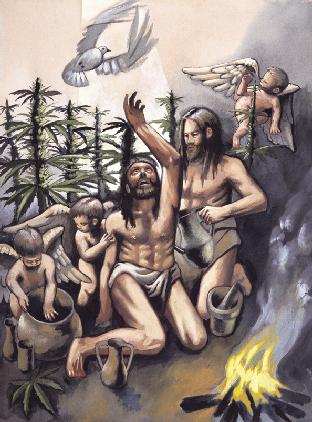
The Guardian,UK reported a news story stating that Jesus Christ was cannabis User and used it to heal .
Jesus was almost certainly a cannabis user and an early proponent of the medicinal properties of the drug, according to a study of scriptural texts published this month. The study suggests that Jesus and his disciples used the drug to carry out miraculous healings.
Seem to be a detailed Study.
Jesus
“The anointing oil used by Jesus and his disciples contained an ingredient called kaneh-bosem which has since been identified as cannabis extract, according to an article by Chris Bennett in the drugs magazine, High Times, entitled Was Jesus a Stoner? The incense used by Jesus in ceremonies also contained a cannabis extract, suggests Mr Bennett, who quotes scholars to back his claims.
“There can be little doubt about a role for cannabis in Judaic religion,” Carl Ruck, professor of classical mythology at Boston University said.
Referring to the existence of cannabis in anointing oils used in ceremonies, he added: “Obviously the easy availability and long-established tradition of cannabis in early Judaism _ would inevitably have included it in the [Christian] mixtures.”
Mr Bennett suggests those anointed with the oils used by Jesus were “literally drenched in this potent mixture _ Although most modern people choose to smoke or eat pot, when its active ingredients are transferred into an oil-based carrier, it can also be absorbed through the skin”.
Quoting the New Testament, Mr Bennett argues that Jesus anointed his disciples with the oil and encouraged them to do the same with other followers. This could have been responsible for healing eye and skin diseases referred to in the Gospels.
“If cannabis was one of the main ingredients of the ancient anointing oil _ and receiving this oil is what made Jesus the Christ and his followers Christians, then persecuting those who use cannabis could be considered anti-Christ,” Mr Bennett concludes.”
‘D The title “Messiah” is much older than Christianity, as all the ancient kings of Israel are referred to as the “Messiah”. “Christos – Anointed One, a title of many Middle-Eastern sacrificial gods: Attis, Adonis, Tammuz, Osiris. . .” 12‘
‘B The “m” is a pronounced plural, and the singular kaneh-bos sounds remarkably similar to the modern cannabis. Although often mistranslated as “calamus”, the word has been translated as “fragrant-cane” in most modern bibles, and specifically designates the fragrant flowering tops of cannabis.’
Some modern “scholars” have claimed that the King James translators mistranslated the Hebrew word “qaneh” (pronounced “Kaw-neh”). They did not. It amazes me how ignorant many of today’s self-professed “scholars” are. You don’t have to be a scholar to understand the truth, all you need is the Holy Spirit of God (John 16:13). These “scholars” claim that in Exodus 30:23, “calamus” was actually “kineboisin” –which is the Hebrew word for cannabis (hemp, or marijuana). Where did this “scholarly” information come from? Suspiciously, there are only a couple sources of this NEW information.
There are a few different claims, but the most recent and weighty was allegedly from the Hebrew University of Jerusalem in 1980. Even more suspicious is the ridiculous claim that a few people have found a NEW truth that theologians and translators have missed for thousands of years. Do you really believe that? If you do, I have some swamp land in Siberia I’d like to sell you.
Allegedly, in 1903, the British physician Dr. Creighton was the first to determine that several references to cannabis can be found in the Old Testament. Interestingly, no one can seem to document this claim. Then again in 1936, etymologist Sara Benetowa (of the Institute of Anthropological Sciences in Warsaw) allegedly discovered the connection between kaneh-bosem in the Old Testament, and the original Semitic Hebrew origins of the word cannabis. Again, where’s the proof of these allegations? Anyone can say anything; but without proof, it is only conjecture at best.
I have a big problem with a few things here. First, are you going to believe a doctor and an etymologist over tens-of thousands of theologians and translators throughout history? Second, there are NO proofs of these claims. Third, there is absolutely nothing in the Bible which permits substance abuse. And fourthly…
The hebrew University in Jerusalem is pro-Homosexual.
“Through his deep love and respect of the Jewish tradition he challenges us all to reread our canonical texts in order to create room for an alternative vision of the religious community.”
More information:
‘As doubtful as the following hypothesis might first seem to the reader, I might as well boldly state my case right from the start: either Jesus used marijuana or he was not the Christ. The very word “Christ”, by the implication of its linguistic origins and true meaning, gives us the most profound evidence that Jesus did in fact use the same herb as his ancient semitic ancestors, and which is still used by people around the world for its enlightening and healing properties.
The Greek title “Christ” is the translation of the Hebrew word Messiah, which in English becomes “The Anointed” D. The Messiah was recognized as such by his being anointed with the holy anointing oil, the use of which was restricted to the instillation of Hebrew priests and kings (See CC#5). If Jesus was not initiated in this fashion then he was not the Christ, and had no official claim to the title.
From the time of Moses until that of the later prophet Samuel, the holy anointing oil was used by the shamanic Levite priesthood to receive the “revelations of the Lord”. At the dawn of the age of Kings, Samuel extended the use of the anointing oil to the Hebraic monarchs by anointing Saul (and later David) as “Messiah-king”. These kings lead their people with the benefit of insights achieved through using the holy anointing oil to become “possessed with the spirit of the Lord.”
“Anointing was common among kings of Israel. It was the sign and symbol of royalty. The word ‘Messiah’ signifies the ‘Anointed One’, and none of the kings of Israel were styled the Messiah unless anointed.”1 The title was clearly only given to those “having the crown of God’s unction upon them” (Leviticus 21:12).
After the fall of the Jewish kingdoms, and the bloody purges following the forged discovery of the Book of theLaw (1 Kings 23), the cannabis holy oil was prohibited as associated with pagan worship. Yet it seems that certain sects retained the topical entheogen, and continued to practice the older religion, silently awaiting the return of a Messiah-king in the line of David.
The ministry of Jesus marked the return of the Jewish Messiah-kings, and thus the re-emergence of the holy oil. Jesus was called the Christ because he violated the Old Testament taboo on the cannabis oil and distributed it freely for initiation rites and to heal the sick and wounded.
Although there is some evidence of Jesus’ use of this Judaic cannabis oil in the traditional New Testament, we get a clearer picture of its importance when we also look at surviving Gnostic documents. The term Gnostic, meaning “knowledge”, refers to a variety of early Christian sects which had extremely different beliefs about both Jesus and his teachings than those which have come down to us through modern Christianity.”
Fundamentalists are of the same Hue, be it Islam or Christianity.
“Eastern religions, yoga, vegetarianism and meditation are just a few of the so-called “hobbies” that may lead to demonic possession, according to a list that was distributed by people posing as a fundamentalist group outside Comic-Con 2012.
I have often maintained that if Jesus Christ were to be reborn, he would not be able to find the Religion he founded!
Such is the behaviour of the professed Christians, Catholics, let me hasten to add lest I may provoke other sects(In a Religion which states that there is no division among them!)
Where is the Germany born Pope?
Delivering message of peace and reconciliation among the Faiths?
Story:
St.Peter’s Basilica
Germany‘s Catholic Church will deny worshippers the right to Holy Communion and religious burials if people do not pay a special church tax.
A newly-enforced German bishops’ decree says anyone failing to pay the tax – an extra 8% of their income tax bill – will no longer be considered a Catholic.
All people in Germany must pay this tax if they want to worship in either Catholic or protestant churches, or Jewish synagogues.
Last year millions of files spanning decades were handed over to criminal investigators by all 27 dioceses of the Catholic Church hierarchy in Germany in a bid to get to the heart of child sex abuse by priests.
It was seen as an attempt to staunch the flow of leavers who made it plain the scandal, and the inability or unwillingness to deal with it, was the reason for their departure.
In 2010, 181,000 people left, an increase of 50 percent on the previous year. Last year 126,000 left.
Over the past twenty years, the number of members of Germany’s Roman Catholic Church has fallen from 28.3 million to 24.6 million or 30.2 percent of the country’s population.
The Catholic Church has seen numbers fall in recent years, particularly in Germany
Many parishioners said they were sickened that offending clergy were often simply moved to new jons where they were free to commit more crimes.
Now comes the new hardline from the church which is also partly in response to a test case that has been griding through the courts and due for a decision by a court in Leipzig on Friday.




You must be logged in to post a comment.