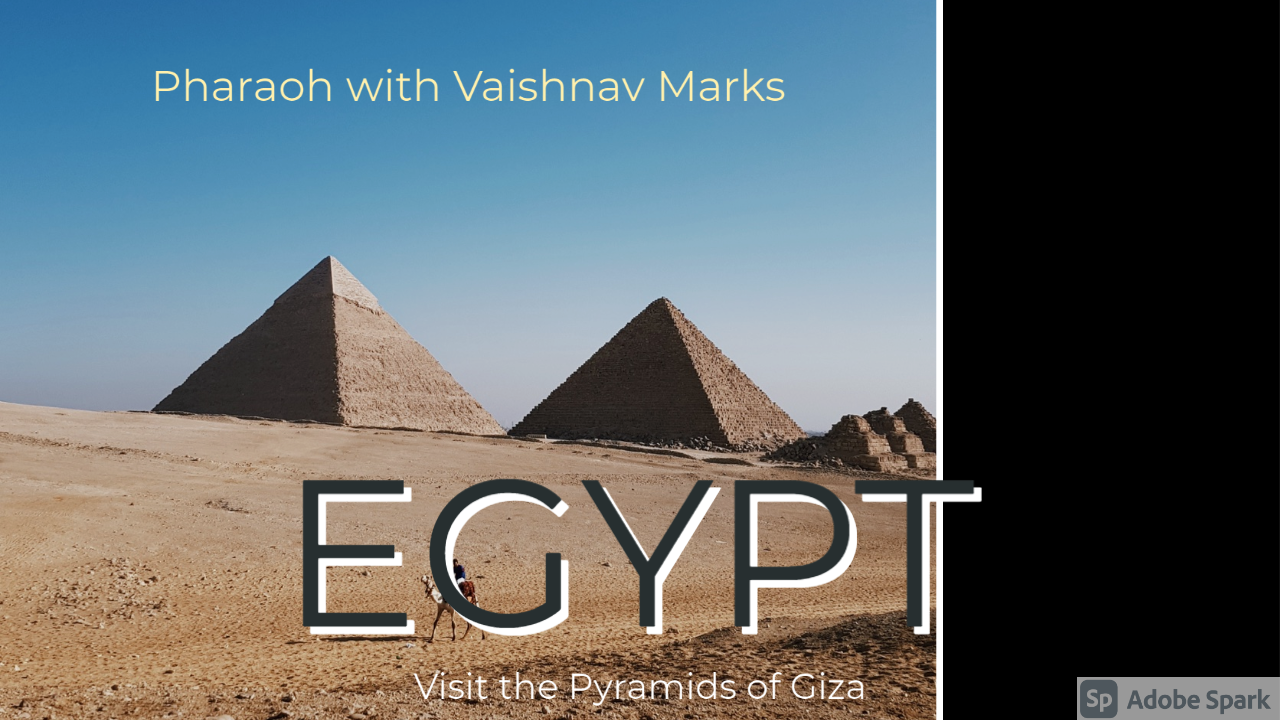
The First Pharaoh of Egypy,Menes is identified as the son of Sagara, Emperor belonging to Surya,Solar Dynasty of India.
Menes ,the First Pharoah of Egypt was Asamanja , the son of Emperor of Sagara.
Sagara was from Kosala Kingdom of India.
One may recall his descendant ,Bhagiratha brought River Ganga to Earth.
Lord Rama belonged to Solar Dynasty and Sagara was his ancestor.
The Kings List of Sumeria and the Kings List of Egypt confirm this.
The reference to Sumeria is found in Indus Valley.
This has been brought out by researcher Waddelll in his Book.
I have provided the link to his work at the close of this article.
He also presents evidence to the effect that the Sumerian Kings List and the Egyptian Kings List confirm that the Sumerians preceded the Egyptians and both these trace their ancestry to Indian Solar Dynasty.
The study is backed by deciphering the Sumerian ,Egyptian and Indus valley Seals,Tablets,Hieroglyphics and archaeology.
And of course, the literature of these three civilizations.
Not surprising at all.
Considering the facts,
Rama,Dasaratha and Bharatha find their names in the Sumerian Kings List.
Akkadian civilization preceded the Sumerian civilization.
And Sage Angirasa founded the Akkadian Empire
Hindu OM is found in Sumrian Prayer
Tamil city found in Sumeria,Akkadian
Naramsin of Akkad.
Tamil city in ancient Syria
Menes,( C 3150 BCE) is the legendary first king of Egypt who is thought to have united Upper and Lower Egypt through conquest and founded both the First Dynasty and the great city of Memphis. His name is known from sources such as Manetho’s Chronology (3rd century BCE), The Turin King List, and the Palermo Stone as well as from some scant archaeological evidence such as ivory engravings. In the early days of Egyptology, Menes was accepted as the first historical king based upon the written records. As time went by, however, and archaeological excavations failed to turn up any evidence of such a king, scholars began to question whether he had actually existed or was, perhaps, a composite figure drawn from the memory of the reigns of other kings.
Source. http://www.ancient.eu/Men
Menes,First Pharoah of Egypt.
But here it is noteworthy, that in the Indian list of kings
given in the Puru version of the Indian Aryan King-
Lists — that is in that version which preserves especially full
details of Menes' dynasty as Manasyu of Gopta — we find that
the immediate successors of Manasyu' s dynasty are Nine kings,
whose names equate to a considerable extent with those of the
Ntne kings forming the Second Dynasty in the lists of Manetho
and the others. And these nine kings were clearly the local
successors of Manasyu's dynasty in Egypt and not in Meso-
potamia, for they are absent in all the main-line lists of
the Early Aryan kings, who, we have found, were kings of
Mesopotamia. 1

In this Indian Puru version of the kings who immediately
succeeded Manasyu's dynasty, is given a string of nine
names of which the holders are described as the " sons " or
descendants of Raudrashwa, a personage who is therein
(MBt. I. 94) called a " brother " of Sargon (or Pra-Vira,
see p. 4) ; and who is stated to have married " the
nymph " Misri-Keshi, whose name Misri is suggestive of
the old name Misr for Egypt. 2 And Sargon's father was,
as we have seen, a Predynastic Pharaoh of Egypt. This
presumes that Raudrashwa was an elder brother of Sargon
and was resident in Egypt. And the fact that he did not
succeed his deposed father in the kingship in Mesopotamia
could be explained by his having died before the reign of
the usurper Zaggisi, i.e. before Sargon had attained manhood
and recovered his father's empire ; for Sargon being a
posthumous son could not have had a younger brother. In
this view therefore, there were resident in Egypt, contem-
porary with and during the reign of Sargon's or Menes'
…
The first clues to these discoveries were gained by my
observation that Menes (as he was called by the Greeks) or
Manj (as he is usually called in his own Egyptian inscriptions) 1
appears in his due chronological position along with his
dynasty in the official king-lists of the Early Aryans from
the first king onwards, as preserved in the ancient Indian
epic chronicles, the Puranas. In the latter he bears the name
of Asa Manja, or " Manja the shooter " in the solar version
of these lists, and Manasyu or Mawas-the-Uniter in the lunar
version. 2 And the great Indian epic, the Maha-Bhaxata, in
supplementing the Purana chronicle account, describes
him as " Manasyu of the line of the Prabhu [Parda or
' Pharaoh '], the royal eye of Gopta [Kopt or Egypt] and
of the four ends of the earth." 3 The Indian epic king-lists
further record that he was the son and successor of the
mighty world-emperor, King Kuni or Sha-Kuni or Sagara,
whom I had fully identified with the Mesopotamian world-
emperor, whose name is variously spelt Kin, Gin, Gani,
Guni, or Shar-Guni, a name which is arbitrarily semitized by
Assyriologists into " Sargon," in order to equate it with
the Hebrew name " Sargon " of the much later notorious
Semitic Assyrian king of that name in the eighth century B.C.
who carried the Jews into exile, and from whom they dis-
tinguish the former as " Sargon-the-Great."

On comparing these Early Aryan king-lists with those of
the Sumerians in Mesopotamia,* I observed that the latter
documents also recorded in the self-same chronological
position the dynasty of King Gin or Guni (" Sargon-the-
Great "), bearing substantially the same names and titles as
in the Indian lists and in exactly the same order ; and that
the names and order from " Sargon's " son Manis onwards
were identical with those of Menes' dynasty of Pharaohs on

1 See later. 2 See pp. ^i. 3 See p. 4 and App. I. 4 Kish Chronicle.


MENES AS SON OF SARGON-THE-GREAT 3


their own Egyptian monuments. Menes or Manj in his
Egyptian inscriptions usually bears the title of " Manj-
the-Warrior," and in the Sumerian king-lists and in his own
inscriptions in Mesopotamia, the son and successor of
" Sargon-the-Great " is styled " Manis-the-Warrior." And
the last king of this dynasty, bearing the same name in both
Sumerian and Egyptian inscriptions, has his name signifi-
cantly written on his own Egyptian inscription by the
self-same Sumerian pictographic signs as in the Sumerian
king-lists and in his own inscriptions as Sumerian emperor
in Mesopotamia.

Further comparison disclosed that Menes' father, " Sargon-
the-Great," along with the latter's father and grandfather
were identical in names and titles with the three Predynastic
Pharaohs who immediately preceded Menes in Egypt ; and
who have left there their records, seals or sealings in
Sumerian script. And these identities are confirmed by their
own Sumerian inscriptions in Egypt, and by their official
seals in their Indus Valley colony, in which most of them
bore also the title of " Pharaoh," and mention Egypt by
name as being within their empire.

Let us now examine the detailed proofs for these identities
of Menes or Manj and his " predynastic " ancestors in
Egypt with those of Manis and his immediate imperial
Sumerian ancestors in their contemporary inscriptions in
Mesopotamia and the Indus Valley and in the Indian epic
records of the Early Aryan kings.

Menes or Manis-Tusu as Manasyu the " Pharaoh
of Gopta " (Egypt) in the Indian Epics

The name of this Aryan king under the form of Manasyu
is found in the lunar version of the Indo-Aryan King-Lists,
and corresponds to the solar form of his name as Asa
Manj as or Asa Manj a in the solar main-line lists in which
he is No. 38 (see Table, p. 151) — the solar lists 1 being the
most complete and in undisturbed chronological order.
And " Sargon " in this Puru version is called Pra-Vira or
" Foremost hero," in which Vlra corresponds to his Sumerian
title of Pir, 2 V being a very late invented letter. 3

1 Lists of the purer Sun-worshippers. 2 WMC. 200. 3 See WAOA. 49 f .
....
The fuller Egyptian form of Menes' name as Manj,
strikingly confirms the literal identity of the Egyptian with
the Sanskrit Manja (or Asa-Manja), the son of the Emperor
Sagara, that is Sargon ; and it equates also phonetically
with the Manis name of Sargon's son in Sumerian — the
affix Tusu meaning, as seen below, " The Warrior." This
fuller Egyptian form of Menes' name is usually disguised by
many English Egyptologists as Mena. But the alphabetic
value of the last letter is rightly rendered by the Berlin
school as J} which is now seen to be its proper value by
our trilingual comparison ; and this is confirmed by the
pictorial form of this Egyptian hieroglyph which pictures a
flowering reed, which I observed was the same sign, form,
sound, and meaning as the Sumerian pictograph of the
flowering reed word-sign with the phonetic value Gi 2 — thus
affording another of the many instances I have demonstrated
of the derivation of the Egyptian hieroglyphs from the
Sumerian pictographs, with the same pictographs, form,
phonetic value and meaning.

....
of the two crowns of Upper and Lower Egypt." Under
his other Indian name as Asa-Manja, or " Manja the
Shooter," is described in the Indian Chronicles, his quarrel
with, and disinheritance by, his father, Sagara (Sargon),
which, we shall find later, appears to relate to his declaration
of independence in Egypt during the lifetime of his father
in Mesopotamia ; and thus explaining why Sargon's younger
son succeeded his father on the Mesopotamian throne and
not Manis-Tusu, his eldest son, who only succeeded later.

Identity of Menes with the Aryan Emperor Manasyu
& Manis-Tusu, son of Sargon, confirmed
Source and Citations. Egyptian civilization and Its Sumerian Origin Real Chronology by Waddelll


You must be logged in to post a comment.