Tag: Myanmar

  • Eleven Thousand Year Hinduism Sri Kshetra Lakshmi City Burma

    Eleven Thousand Year Hinduism Sri Kshetra Lakshmi City Burma

    As I have noted in many of my articles, more I delve. into ancient civilizations, more I find about the antiquity of Indian Culture, Sanatana Dharma and Hinduism.

    When I state Indian culture and dharma it includes Jainism and Buddhism.

    They are considered as part of Hinduism by Sanatana Dharma which calls them as Nastika which term means one who does not believe in the testimony of the Vedas.

    These Religions are accepted as  different schools of Thoughts and are to be respected.

    One of the Greats of Jainism, Arishtanemi was a cousin of Lord Krishna and I have written a detailed article on this.

    Considering the sweep of Sanatana Dharma throughout the world in ancient times which are proved by new archaeological findings, Astronomy dating and confirmation by Cultural affinities, similarities, Etymology of the languages spoken around the world and their roots in Sanskrit and Tamil, accurate descriptions of areas Flora and Fauna in these areas by ancient Indian texts, I am amazed and awestruck at the time line and spread of Hinduism.

    And the ridiculous dating of Hinduism to 5000 years, which the self styled scholars have assigned to Rig Veda, the first and earliest literature known to Man.

    That Rig Veda is the earliest, these scholars grudgingly admit!

    The stretch of Indian history beyond 5000 years have been proved by a million year old Tamil site in Chennai, 20000 old site at Poompuhar, Tamil Nadu, unearthing of pottery with Tamil inscriptions in the middle East the  Hindu artifacts found in Southeast Asia, Middle East, Europe, China, US, Latin America, Central America, Africa, Australia and Russia, not to forget UK, Ireland and Sweden.

    I have written extensively on these with proof.

    Based on these evidences I have questioned the present date assigned to Buddha around 480BC for he could be dated much earlier.

    While writing on ancient civilizations of the world, I have written on Ur, Atlantean, Lemuria and Rama Empire.

    I have covered a part of the series of articles on this subject, intending to write more on them as I got side tracked into writing some thing else.

    This, I consider as a Bane and Blessing of not being a scholar for I write based on what I find to be credible evidence and I have no preset theories to flaunt.

    This is a bane because at times readers lose continuity.

    I have written on the presence of Rig Veda Mandala City in Arkaim, Russia, the City of Port Barzhyn, Russia built by Pradhyumna son of Lord Krishna, Baikal Russia as  Vaikanasa Theertha of Indra.

    Then we have the Kings of Tamil origin in South East Asia.

    We also know that what is now as Bengal in India was inhabited at least 25000 years ago.

    And the Rig Veda was composed in the Arctic and what is now Russia was once the home of Sanatana Dharma Dharma.

    While writing on these I was intrigued by the spread from Arctic to South (fact is before spreading to Arctic Sanatana Dharma was in South Dravida desa before migrating to Arctic because of a Tsunami), the spread of Buddhism from India from Bengal Region to Lanka and south East Asia.

    And there is the enigma of China.

    However I have provided evidence Hinduism was in China before any of organised Religion was present.

    Now part of the jigsaw seems to fall in place.

    That is the Piyu Civilisation in Burma, which is dated  third century BC.

    Archeology proves it was at leat 11000 years old.

    Buddhism was practiced.

    Vishnu was worshiped.

    City in honor of Lakshmi was found, Sri Kshetra.

    Lakshmi is called Sri and Sri Kshetra means Holy City of Lakshmi.

    Eight cities have been found.

    They were built on Mandala design prescribed by the Vedas.

    Buddhism, Thera Buddhism was practised.

    Hinduism preceded Buddhism, hence Hinduism remains are found.

    Read more on this below.

    Shall be writing more on this subject.

    Ancient city Sri Kshetra in Myanmar
    Sri Kshetra City in Burma


    Based on limited archaeological evidence, it is inferred that the earliest cultures existed in Burma as early as 11,000 B.C., mainly in the central dry zone close to the Irrawaddy. Circa 2nd century B.C., the Tibeto-Burman-speaking Pyu began to enter the Irrawaddy valley from present-day Yunnan via Tapain and Shweli rivers. The original home of the Pyu is reconstructed to be Kokonor Lake in present-day Qinghai and Gansu provinces. The Pyu, the earliest inhabitants of Burma of whom records are extant, went on to found settlements throughout the plains region centered around the confluence of the Irrawaddy and Chindwin rivers that has been inhabited since the Paleolithic age. The Pyu realm was longer than wide, stretching from Sri Ksetra in the south to Halin in the north, Binnaka and Maingmaw to the east and probably Ayadawkye to the west. [Source: Wikipedia +]

    The Pyu city states (Burmese: ပျူ မြို့ပြ နိုင်ငံများ) were a group of city-states that existed from c. 2nd century BCE to c. mid-11th century in present-day Upper Burma (Myanmar). The city-states were founded as part of the southward migration by the Tibeto-Burman-speaking Pyu people, the earliest inhabitants of Burma of whom records are extant.[2] The thousand-year period, often referred to as the Pyu millennium, linked the Bronze Age to the beginning of the classical states period when the Pagan Kingdom emerged in the late 9th century…
    The city-states—five major walled cities and several smaller towns have been excavated—were all located in the three main irrigated regions of Upper Burma: the Mu River Valley, the Kyaukse plains and Minbu region, around the confluence of the Irrawaddy and Chindwin Rivers. Part of an overland trade route between China and India, the Pyu realm gradually expanded south. Halin, founded in the 1st century AD at the northern edge of Upper Burma, was the largest and most important city until around the 7th or 8th century when it was superseded by Sri Ksetra (near modern Pyay) at the southern edge. Twice as large as Halin, Sri Ksetra was the largest and most influential Pyu centre.[2]

    Of the 12 walled cities excavated thus far, five are the remains of largest Pyu states: Beikthano, Maingmaw, Binnaka, Halin and Sri Ksetra.
    The Pyu culture was heavily influenced by trade with India, importing Buddhism as well as other cultural, architectural and political concepts, which would have an enduring influence on the Culture of Burma and political organisation.[3] The Pyu calendar, based on the Buddhist calendar, later became the Burmese calendar. Recent scholarship, though yet not settled, suggests that the Pyu script, based on the Indian Brahmi script, may have been the source of the Burmese script used to write the Burmese language.
    The millennium-old civilisation came crashing down in the 9th century when the city-states were destroyed by repeated invasions from the Kingdom of Nanzhao. The Bamar people, who came from Nanzhao, set up a garrison town at Bagan at the confluence of the Irrawaddy and Chindwin Rivers. Pyu settlements remained in Upper Burma for the next three centuries but the Pyu gradually were absorbed into the expanding Pagan Kingdom.
    Sri Ksetra or Thaye Khittaya (သရေခေတ္တရာ [θəjè kʰɪʔtəjà]; lit., “Field of Fortune”[16] or “Field of Glory”[13]), located 8 km southeast of Prome (Pyay) at present-day Hmawza village,[17] was the last and southernmost Pyu capital. The city was founded between the 5th and 7th centuries,[18]:62–63,77although during two of the recent excavations, January to February 2015 and December 2015 to February 2016, led by Janice Stargardt in Yahanda mound at Sri Ksetra, sherds stamped with Buddhist motifs were found, dated from c. 340 +/- 30 CE.[19] and Pyu culture cremation burials around 270 +/- 30 CE.[20]. Sri Ksetra likely overtook Halin as the premier Pyu city by the 7th or 8th century, and retained that status until the Mranma arrived in the 9th century. The city was home to at least two dynasties, and maybe three. The first dynasty, called the Vikrama Dynasty, is believed to have launched the Pyu calendar, which later became the Burmese calendar, on 22 March 638.[2] The second dynasty was founded by King Duttabaung on 25 March 739 (11th waxing of Tagu 101 ME).[21]
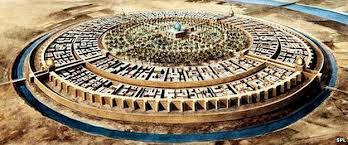
    Sri Ksetra is the largest Pyu site discovered thus far. (Only Beikthano and Sri Ksetra have been extensively excavated. Other important Pyu cities as Maingmaw and Binnaka could yield more artefacts with more extensive excavations.) It occupied a larger area than that of the 11th century Pagan or 19th century Mandalay. Circular in design, Sri Ksetra was more than 13 km in circumference and three to four km across, or about 1400 hectares of occupied area. The city’s brick walls were 4.5 meters high, and had 12 gates with huge devas (deities) guarding the entrances and a pagoda at each of the four corners.[21]
    The culture of Pyu city states was heavily influenced by India. Indian culture was most visible in the southern Pyu realm through which most trade with India was conducted by sea. The names of southernmost cities were in Pali or Sanskrit derived like Sri Ksetra (Thaye Khittaya) and Vishnu (Beikthano). The kings at Sri Ksetra titled themselves as Varmans and Varma. It was not just a southern phenomenon. To varying degrees, northern Pyu cities and towns also became under the sway of Indian culture. The Burmese chronicles claim that the founding kings of Tagaung were descended from no less than the Sakya clan of the Buddha himself.[32][33]
    By the 4th century, most of the Pyu had become predominantly Buddhist, though archaeological finds prove that their pre-Buddhist practices remained firmly entrenched in the following centuries. According to the excavated texts, as well as the Chinese records, the predominant religion of the Pyu was Theravada Buddhism. The Theravada school prevalent in the Pyu realm was probably derived from the Andhra region in southeast India, associated with the famous Theravada Buddhist scholar, Buddhagosa.[32][33] It was the predominant Theravada school in Burma until the late 12th century when Shin Uttarajiva led the realignment with Ceylon’s Mahavihara school.[34]
    The archaeological finds also indicate a widespread presence of Tantric Buddhism, Mahayana Buddhism and Hinduism. Avalokiteśvara (Lokanatha) (called Lawkanat in Burmese; လောကနတ် [lɔ́ka̰ naʔ]), Tara, Manusi Buddhas, Vaiśravaṇa, and Hayagriva, all prominent in Mahayana Buddhism, were very much part of Pyu (and later the Pagan) iconography scene. Various Hindu Brahman iconography ranging from the Hindu trinity, Brahma, Vishnu and Shiva, to Garuda and Lakshmi have been found, especially in Lower Burma.

    Reference and Citation.

    https://en.m.wikipedia.org/wiki/Pyu_city-states?osm=1

  • Sonia Gandhi’s Discussion with Maria Shriver

    Sonia Gandhi, Chairperson, United Progressive ...
    Image via Wikipedia
    
    
    Friday, 04 August 2006, 13:17
    C O N F I D E N T I A L SECTION 01 OF 05 NEW DELHI 005495 
    SIPDIS 
    SIPDIS 
    STATE FOR INR/B 
    EO 12958 DECL: 08/04/2016 
    TAGS PGOV, PREL, PINR, PHUM, SCUL, KWMN, PINS, IN 
    SUBJECT: A GARRULOUS SONIA GANDHI OPENS UP TO MARIA SHRIVER 
    Classified By: Charge Geoff Pyatt for reasons 1.4 (B,D)
    1. (C) Summary: In a relaxed August 3 conversation with California first lady Maria Shriver, Sonia Gandhi revealed a rare glimpse of herself. Usually withdrawn and reserved in public, she spoke at great length and radiated confidence on women’s’ issues and some aspects of her private life. Mrs. Gandhi demonstrated a strong commitment to a progressive left-of-center agenda aimed at combating socially conservative forces bent on oppressing Indian women. However, she was also realistic, revealing an in-depth knowledge of Indian culture, especially the rural/urban divide. At times suppressing her emotions, she spoke about the compulsions of political life, her parents’ objections to her marriage to Rajiv Gandhi and the sacrifices she and her family have made. Her comments and demeanor put the lie to cocktail party suggestions that she courts Manmohan Singh’s job. End Summary.
    Two Dynasties Meet
    ------------------ 
    2. (C) Maria Shriver, California’s first lady and wife of Governor Arnold Schwarzenegger, met with Congress Party President Sonia Gandhi on August 3 as part of her official visit to India. Shriver is in India to discuss her various initiatives on women’s’ affairs and to solicit Indian involvement. She is also laying the groundwork for a proposed trade mission led by Governor Schwarzenegger around February, 2007. After her stay in Delhi, she will go to Dharamshalla to meet the Dalai Lama. In addition to the Gandhi meeting, Shriver met with the head of the National Commission for Women and toured NGO’s involved in women’s’ affairs. Mrs. Gandhi was accompanied by former Cabinet Minister Karan Singh.
    Indian Women Bear a Heavy Burden
    -------------------------------- 
    3. (C) Shriver and Gandhi engaged in an over one hour exchange that was lively and open and covered many issues, both personal and political. Shriver explained that she was concerned with women’s issues, including sexual abuse and exploitation and trafficking. Mrs. Gandhi replied that the situation for women in India is more troubling and traumatic than that in the US and other developed countries, as Indian women must deal with myriad problems not found in the west, such as child labor. In addition, most Indian women live in remote villages with severe “cultural compulsions” that work against women, making it difficult for the GOI to enforce the law. She pointed out that Indian women remain largely uneducated which is a “big problem” for Indian society and makes progress difficult. This compels the GOI to rely on television and radio to reach women with messages aimed at their concerns. Mrs. Gandhi noted that while she had a deep personal interest in women’s’ issues, she “only rarely” gave personal interviews aimed at female audiences.
    And Sonia Bears a Personal Burden
    --------------------------------- 
    4. (C) Without prompting and at her own initiative Mrs. Gandhi then spoke at length about her personal life. She revealed that after her mother in law’s murder Rajiv Gandhi was under intense pressure to take up the political mantle of the Gandhi family, but both Rajiv and Sonia were intensely
    NEW DELHI 00005495 002 OF 005
    personal and had no interest in politics. According to Mrs. Gandhi, she urged her husband repeatedly to avoid politics, but he insisted. After Rajiv Gandhi became Prime Minister, Sonia was determined to avoid the limelight and “kept in the background.” She clarified that she accompanied her husband to official events, but refrained from making political statements. After her husband’s assassination, Mrs. Gandhi withdrew, working only on a charitable foundation established in Rajiv’s memory. In a candid revelation of her personal political stance, Mrs. Gandhi stated that “the right was becoming strong in India and Congress weak,” tipping her hand and “compelling” her to enter politics to protect the Gandhi family legacy. She also revealed that her children were “not keen” about the idea, but eventually told her, “whatever you decide, we will back you.”
    Turning Down the PM Spot
    ------------------------ 
    5. (C) Mrs. Gandhi was reluctant to provide details regarding her decision to turn down the Prime Minister post after the UPA’s surprise 2004 electoral victory, stating that “I am often asked about this, but tell people that I will write a book someday with the whole story.” She would only say that she “felt better” that someone else became PM and “did not regret” her decision. Shriver congratulated Mrs. Gandhi for her resoluteness and described her as “courageous.” Clearly embarrassed by this adulation, Mrs. Gandhi made no response. She elaborated, at Karan Singh’s insistence, saying that she was under lots of pressure, as the “party workers” were “very upset.” They “could not understand” why she, as party President, was not taking up the post, since they had voted for her and won a majority.
    Politics and Women
    ------------------ 
    6. (C) Shriver noted that she chairs a “Women’s Conference” that brings 11,000 women to California to discuss relevant issues, and reinforced the point that “women can change the world.” Shriver invited Mrs. Gandhi to attend next year. She pointed out that last year’s keynote speaker was Sandra Day O’Connor, who spoke about balancing public and private life, and how she left the Supreme Court to look after her ailing husband and spend more time with her children. Shriver emphasized that Justice O’Connor also did not want to enter public life but was “pushed by her husband,” and noted how difficult it is to be a wife and mother and play a public role. Mrs. Gandhi made no commitment to attend.
    Indian Steps to Bring Justice
    ----------------------------- 
    7. (C) Mrs. Gandhi explained the steps that her UPA government had taken and planned to take to help women achieve greater social mobility and rights. She explained that the GOI had instituted a “Panchayati Raj” program under which major decisions regarding the economic development of villages are made by Panchayats (village councils). To ensure female participation, Rajiv Gandhi had “reserved” 33 percent of the positions on the Panchayats for women. Although there were “some complaints” that the women were “manipulated by their husbands,” Mrs. Gandhi asserted that “research had confirmed that women will invariably take the right decisions.” She noted that the UPA now wants to extend the same reservations to Parliament and the Legislative
    NEW DELHI 00005495 003 OF 005
    Assemblies. Mrs. Gandhi confirmed that currently the number of female MPs was “very small,” as “some parties believe that women should not be in power.”
    The Indian Contradiction
    ------------------------ 
    8. (C) Shriver pointed out that her trip had made her aware of the “great contradiction” between a society in which women occupied many leadership positions, including, at times, Prime Minister,” but still were denied many basic rights. Mrs. Gandhi agreed with Shriver, noting that several Indian states had female Chief Ministers, and that an increasing numbers of Indian women are CEOs of major corporations, doctors, and scientists, and “we will keep fighting.” She explained that the situation for women varied from state to state, and that South India was “more progressive” than the North for various historical and cultural reasons, and that, for example, the state of Kerala supplied nurses to much of the Middle East.
    Possible Indian Collaboration

    For transcript in detail click link . http://www.wikileaks.ch/cable/2006/08/06NEWDELHI5495.html

  • China Surrounds India.

    China has been quietly building a pressure area in the NorthEastern part of India,While encouraging Myanmar in its dictatorial ways,it is masterminding naxal/maoist activity in India, which extends from the North Eastern corridor of India, starting from Nagaland,Manipur,West Bengal,Assam,parts of Orissa,Chattisgarh,parts of Bihar,MP,UP,DANDAKAKARANYA,COASTAL BELT OF ANDHRA,EXTENDING TO NORTHERN PART OF TAMIL NADU( DHARMAPURI)Parts of Maharashtra and North Karnatka are also in the ring.

    It is also laying claims to Arunachal pradesh ,which has no link what so ever with China,either geographically or culturally,stating that it does not recognise Mac Mohan Line.And now it is building a bridge across Brahmaputra.It is also controlling Maoists in Nepal.Its anti India rhetoric is shrill now.
    India is being slowly surrounded.
    The Govt. of India has not understood to the gravity of the situation and is pussyfooting with China.The insurgency of Maoists is far more serious and much more difficult to contain than Taliban.This shall become a festering flashpoint in the world map shortly, unless India and world powers wake up.

    STORY.
    While increasingly distrustful of China’s intentions, the government here on Thursday refrained from questioning Beijing’s denial that it
    was engaged in constructing a dam on Brahmaputra which could impact ecology in the northeastern states.

    Story;
    ‘Reacting to a fresh report questioning China’s denial, the MEA here said, “India and China agreed in November 2006 to establish an Expert Level Mechanism to discuss trans-border river issues in an institutional way. Three meetings have been held so far…. The Chinese side has categorically denied that there is a plan to build any such large scale diversion project on the Brahmaputra river.”

    However, it said the government would “ascertain whether there are recent developments that suggest any change in the position conveyed to us by the government of China”.
    http://timesofindia.indiatimes.com/india/India-to-check-if-China-is-building-Brahmaputra-dam/articleshow/5129067.cms