Tag: Lalitha Devi

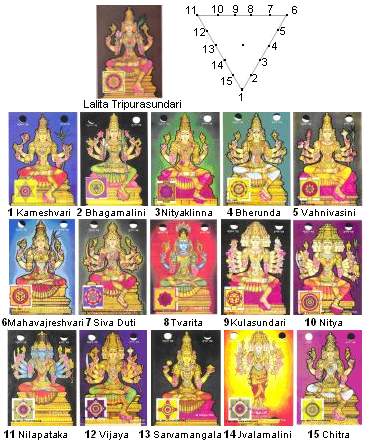
  • Exploring Nithya Devathas in Sri Vidya

    Exploring Nithya Devathas in Sri Vidya

    Bhagani Mehyayanaya Varade Rete Surete Bhagaklinne Klinnadrave Kledaya Dravaya Amoghe Bhagavichche Kshubha Kshobhaya Sarva Sattvan Bhageshwari Aim Blum Jem Blum Bhem Blum Moem Blum Hem Blum Hem Klinne Sarvani Bhagani Me Vashamanaya Streem Hara Blem Hreem Am Bhagamalini Nitya Shreepadukam Pujayami Tarpayami Namah.  https://ramanisblog.in/2023/10/09/nithya-devathas-position-in-sri-chakra-mantras-description/

    Nithya Devathas in Sri Vidya

    Nithya Devathas, often revered within the Sri Vidya tradition, embody various divine forms that are essential for spiritual growth and understanding. The concept of Nithya Devathas emphasizes the importance of worshipping these deities to achieve higher levels of consciousness and fulfillment.

    Importance of Nithya Devathas

    1. Spiritual Connection: Nithya Devathas act as intercessors to unite devotees with the divine. By connecting with these forms, practitioners enhance their spiritual journey.
    2. Energy Flow: Each Nithya Devatha represents unique energies and aspects of the universe, allowing devotees to harness specific vibrations for personal growth and healing.
    3. Ritual Significance: Rituals performed in honor of Nithya Devathas are fundamental in Sri Vidya practices. These rituals are designed to align the practitioner’s energies with the cosmic forces represented by the deities.

    Nithya Devathas in Practice

    • Meditation: Devotees often meditate on the forms of Nithya Devathas to imbibe their qualities and foster profound insight.
    • Chanting: Recitation of specific mantras associated with Nithya Devathas is believed to invoke their blessings, promoting peace and harmony.

    Conclusion

    Understanding and embracing the Nithya Devathas within the framework of Sri Vidya can lead to transformative experiences. They serve not only as spiritual guides but also as powerful symbols of inner strength and devotion.

    Related Articles

  • Devi Upasana Age of Children For Lalitha Pooja

    People would like to know the age of children who are to be worshipped in the form of Devi

    Bhuvaneswari with Bala in Her Lap.

    There are many forms of Devi visualised and mentioned in the third part of the first section of Shrimaddevi Bhagwatham.

    The children should not have attained Puberty.

    They are as follows.

    Two year-old child is called ‘Kumari’. Worshipping them destroys the sorrow and poverty of the devotees and wealth, age, and strength increase.


    A three-year-old girl is called ‘Trimurti’. Their worship fulfills religion, objectives, and work. Moreover, prosperity increases and leads to the betterment of children.


    A four-year-old girl is called ‘Kalyani’. Their worship brings knowledge, victory, kingdom, and happiness.


    A five-year-old girl is called ‘Kalika’. Their worship destroys the enemies.


    A six-year-old girl has been called ‘Chandika’. Their worship brings prosperity and wealth.


    A seven-year-old girl is called ‘Shambhavi’. Their ritual worship ends fights and any disputes.


    An eight-year-old girl is considered to be the form of ‘Durga’. Their worship leads to upliftment and success in spiritual meditation.
    A nine-year-old girl is called ‘Subhadra’. Their worship destroys complex diseases.


    A 10-year-old girl is called ‘Rohini’. Their worship fulfills all the desires in your heart.

    https://news.abplive.com/lifestyle/navratri-2021-kanya-puja-know-the-significance-of-kanya-pujan-according-to-the-girl-s-age-1487478#goog_rewarded

    Another interpretation is as follows.

    Please follow as your Guru advises which to follow.

  • Panchasthavi: Profound Text on Devi and Sri Vidya Experience

    Panchasthavi is a text on Devi which expresses the joy of Devi,Sri Vidya Experience. The Anubhuti of Devi is Indescribable. One has to Experience It. This happens,by Her Divine Grace,hen Sath,Being,IS,Siva is Unified with Consciousness,Chit,Devi. It is Not really a Unification for they have never been separated; they have been as The River and It’s Bed, Word and meaning. It is that our Chith which is tainted , perceives them differently.

    When that ignorance is destroyed and knowledge dawns, Ananda Bliss is the consequence.

    Outpouring of the Experience forms the Panchasthavi.

    Adi Shankaracharya heard the Panchasthavi being changed by a Kashmirii pandit and was influenced and inspired to compose the Soundaryalahari.

    The author of Panchasthavi is not known. However, some research indicates it was Lalla Bhatta of Kashmir. By goings through the lines, one can say definitely that it is not by by Kalidasa as his style is missing.

    Panchasthavi has five parts.

    They are.

    1.Amba Sthava

    https://youtu.be/20dDJ2a2L2o?si=qw3bbXJDXocqtj-nhttps://youtu.be/20dDJ2a2L2o?si=qw3bbXJDXocqtj-n

    https://archive.org/details/panchastavi-vrs-tamil-tr/page/n7/mode/

    2.Laghu Sthava.

    3.Charcha Sthava

    4.Ghata Sthava and

    5.SakakaJananai Sthava.

    Panchasthavi

    Panchasthavi is a profound text dedicated to Devi, expressing the joy of Sri Vidya experience. It emphasizes the indescribable Anubhuti of Devi and the unification of Siva and Devi through her divine grace. The text beautifully describes the consequence of destroying ignorance and attaining knowledge as the bliss of Ananda. It is believed that the outpouring of this experience led to the creation of Panchasthavi.

    The text consists of five parts:

    1. Amba Sthava
    2. Laghu Sthava
    3. Charcha Sthava
    4. Ghata Sthava
    5. SakakaJananai Sthava

    The author of Panchasthavi is not definitively known, but there are indications that it might be attributed to Lalla Bhatta of Kashmir. Although it has been speculated that the renowned poet Kalidasa could be the author, the absence of his distinct style suggests otherwise.

    You can explore the text further by accessing the full content of Panchasthavi here. Additionally, the app Vaidika Vignanam also offers the opportunity to read the full text, providing deeper insights into this profound work.

    ऐंद्रस्येव शरासनस्य दधती मध्येललाटं प्रभांशौक्लीं कांतिमनुष्णगोरिव शिरस्यातन्वती सर्वतः ।एषासौ त्रिपुरा हृदि द्युतिरिवोष्णांशोः सदाहः स्थितात्छिंद्यान्नः सहसा पदैस्त्रिभिरघं ज्योतिर्मयी वाङ्मयी ॥ 1 ॥या मात्रा त्रपुसीलतातनुलसत्तंतूत्थितिस्पर्धिनीवाग्बीजे प्रथमे स्थिता तव सदा तां मन्महे ते वयम् ।शक्तिः कुंडलिनीति विश्वजननव्यापारबद्धोद्यमाःज्ञात्वेत्थं न पुनः स्पृशंति जननीगर्भेऽर्भकत्वं नराः ॥ 2 ॥दृष्ट्वा संभ्रमकारि वस्तु सहसा ऐ ऐ इति व्याहृतंयेनाकूतवशादपीह वरदे बिंदुं विनाप्यक्षरम् ।तस्यापि ध्रुवमेव देवि तरसा जाते तवानुग्रहे– लघु स्तवःRead full text in

    vaidika vignanam app

    Enjoy the Panchasthavi .

    I shall be conducting Panchasthavi Pooja Dakshina Pada,South India as it is not well known here.

    I have stated conducting/conducted Suvasini Pooja in Uthara Padha, North India.

  • How Sri Yantra Was Created

    Sound , language and Self Realization are intricately connected in Hinduism.

    While the Reality is a principle beyond qualities, names and forms God concept has been advocated to ensure that the Mind has an object to concentrate upon in the path to Realization.


    Sri Chakram.jpg
    Sri Chakram.

    Please read my post God has names and forms Yes and No.

    Sound/Vibrations are basis of creation.

    Universe is born of Motion.

    One may never determine which precedes the other, sound or vibration, one may never know.

    The Sri Chakra of Devi.The Devi's Sri Chakra.iamge.jpg
    Sri Chakra

    Consciousness which is beyond Space and Time is linked to sound in effort to realize itself, that is Self.

    While Consciousness  can communicate and commune with Reality at the highest level, at the rudimentary level it communicates through sound and vibrations.

    Realizing this Hinduism has arrived at three levels from here the sound originates in the Human Body.

    From the Mouth, as in A,

    From the Throat, as in U, and

    From the pit of the stomach, as in M.

    Correct sound of these letters may be found when one pronounces the Sanskrit script.

    These primordial sounds of A, U and M are combined and the resultant Sound Om or AUM is the vital basic Mantra of Hinduism.

    No Mantra is complete with out these three sounds.

    In some Mantras these sounds though invisible are embedded in Mantras and stotras by Great Acharyas.

    Soundaryalahari By Adi Shankaracharya contains the 51 Bheejaksharas, the Seed sounds of Devi , they are embedded in the text though it is invisible.

    Each God is assigned specific numbers of letters, called Aksharas,

    Interesting to note that Akshara, loosely translated as Letters means Limitless, therby signifying the power of sound produced by each letter.

    Shiva is assigned five,

    Vishnu Twelve,

    Subrahmanya Six  and

    Devi 15/51.

    These letters when intoned correctly form the Geometrical shape of Yantra.

    OM produces Sri Yantra.

    Please read my article on this.

    How the Devi’s Yantra is produced?

    Ho did it evolve?

    Lalita Devi in Sri Pura.jpg
    Lalita Devi in Sri Pura.

    ‘Formation of the Shri Yantra

    The creation of the Shri Yantra is described in the Yogini Hridaya (Heart of the Yogini Tantra), which still does not exist in an English translation, as far as we are aware. This is said to be the second part of the Vamakeshvara Tantra.

    “From the fivefold Shakti comes creation and from the fourfold Fire dissolution. The sexual union of five Shaktis and four Fires causes the chakra to evolve. O Sinless One! I speak to you of the origin of the chakra.

    “When she, the ultimate Shakti, of her own will (svecchaya) assumed the form of the universe, then the creation of the chakra revealed itself as a pulsating essence. From the void-like vowels with the visarga (:) emerged the bindu, quivering and fully conscious. From this pulsating stream of supreme light emanated the ocean of the cosmos, the very self of the three mothers.

    “The baindava of the chakra has a triple form, dharma, adharma and atma, and matri, meya and prama. The chakra of nine yonis is the great mass of consciousness bliss and is the ninefold chakra and the nine divisions of the mantra.

    “The baindava is placed on a dense flowery mass and is the Chitkala. Similarly, the ambika form of eight lines is the circle of the vowels. The nine triangles quiver forth the effulgent form of 10 lines. The Shakti, together with her surrounding nine blossomed forth the 10 trikonas. The second quivering form of 10 lines has Krodhisha as first of the 10. These four chakras, of the nature of light, create the 14-fold form, the essence of perception.” — Yogini Hridaya, I 6-16.

    At the very heart of the bindu or centre of the Shri Yantra is that which caused it to emanate. This is Kamakala, consisting of the three bindus or potentials. One is red, one is white, and one is mixed. The red bindu is ova, the white bindu semen, and the mixed bindu the union of Shiva-Shakti, the individual as potential Shri Cakra.

    Father and Mother are represented in Shri Vidya by two limbs or aspects of Lalita known as Varahi and Kurukulla. The semen of Varahi, the father-form, gives four alchemical dhatus to the child. The ova of Kurukulla, the mother-form, gives five dhatns to the child. Consciousness enters via orgasm. The three bindus, collectively known as Kamakala (digit of sexual desire), are the root potential of sun, moon and fire. It is like sun and moon coming together in an eclipse, or the seed from which the plant human being grows.

    Varahi’s four alchemical dhatus are known as the four fires. Kurukulla’s alchemical dhatus are known as the five saktis. The combination of these five saktis (downward pointing triangles) and four fires (upward pointing triangles), forms the complex figure in the centre of Shri Cakra.

    Varahi’s four fires are the 12 (3 x 4) sun Kalas, 12 sidereal constellations. Kurukulla’s five triangles are the 15 (5 x 3) Kalas of the moon, 15 lunar days. The complete individual grows within nine months to be born as a Shri Yantra or plant. The flowering of this plant is shown by the 24 petals of the yantra. The above all gives rise to the familiar shape of the Shri Yantra. The yantra is usually arranged in one of two forms. In the Bhuprastara, it is two dimensional and laid flat, usually facing the east, but sometimes the north, depending on the practice. The Meruprastara has the yantra in a pyramidal form. Unless the yantra be decorated with the appropriate bija and other mantras, it is worthless. It is also dead unless it is installed with life and the individual doing the puja is initiated into one of the lines (parampara).
    “The baindava is placed on a dense flowery mass and is the Chitkala. Similarly, the ambika form of eight lines is the circle of the vowels. The nine triangles quiver forth the effulgent form of 10 lines. The Shakti, together with her surrounding nine blossomed forth the 10 trikonas. The second quivering form of 10 lines has Krodhisha as first of the 10. These four chakras, of the nature of light, create the 14-fold form, the essence of perception.” — Yogini Hridaya, I 6-16.
    At the very heart of the bindu or centre of the Shri Yantra is that which caused it to emanate. This is Kamakala, consisting of the three bindus or potentials. One is red, one is white, and one is mixed. The red bindu is ova, the white bindu semen, and the mixed bindu the union of Shiva-Shakti, the individual as potential Shri Cakra.

    Father and Mother are represented in Shri Vidya by two limbs or aspects of Lalita known as Varahi and Kurukulla. The semen of Varahi, the father-form, gives four alchemical dhatus to the child. The ova of Kurukulla, the mother-form, gives five dhatns to the child. Consciousness enters via orgasm. The three bindus, collectively known as Kamakala (digit of sexual desire), are the root potential of sun, moon and fire. It is like sun and moon coming together in an eclipse, or the seed from which the plant human being grows.

    Varahi’s four alchemical dhatus are known as the four fires. Kurukulla’s alchemical dhatus are known as the five saktis. The combination of these five saktis (downward pointing triangles) and four fires (upward pointing triangles), forms the complex figure in the centre of Shri Cakra.

    Varahi’s four fires are the 12 (3 x 4) sun Kalas, 12 sidereal constellations. Kurukulla’s five triangles are the 15 (5 x 3) Kalas of the moon, 15 lunar days. The complete individual grows within nine months to be born as a Shri Yantra or plant. The flowering of this plant is shown by the 24 petals of the yantra. The above all gives rise to the familiar shape of the Shri Yantra. The yantra is usually arranged in one of two forms. In the Bhuprastara, it is two dimensional and laid flat, usually facing the east, but sometimes the north, depending on the practice. The Meruprastara has the yantra in a pyramidal form. Unless the yantra be decorated with the appropriate bija and other mantras, it is worthless. It is also dead unless it is installed with life and the individual doing the puja is initiated into one of the lines (parampara).

    Source of the quote,

    http://www.shivashakti.com/tripura.htm

  • Lalitha Devi Bandasura Home Sunken Beneath Caribbean Google Maps

    Lalitha Devi Bandasura Home Sunken Beneath Caribbean Google Maps


    One of the intriguing aspects of Sanatana Dharma, Hinduism is the places mentioned in them, in the Puranas, Ithihasas,Ramayana and Mahabharata seem to be both allegorical and real(which is verified)

    Mount Meru,Chandra Loka, Dhruva( Pole Star)Agastya ( Canopus Star),Sisumara Chakra,Pancha Kosas,the Five sheaths of Human body)……….

    All these have physical existence

    Please read my Posts on each of these.

    I had a call from a Gentleman from Houston ,Texas,US,who informed me that he had seen images of the Deavatas mentioned in our Texts, when he was cruising in the Caribbean.

    To be more specific around Puerto Rico, Cuba.

    Images flashed by as he was cruising and he felt charged for an instance.

    To the doubting Thomases , let me add that he is a very practical man and is a contractor erecting satellites.

    In a conversation lasting an hour, I was able to see a keen and observant individual with an open mind.

    He did not wish his name to be mentioned.

    He had an interpretation of this phenomena, which he had suggested I do not Publish.

    However I am posting this with my interpretation, with the limited knowledge  I have of Sanatana Dharma Texts.

    1.Co Ordinates. 18°46’40.1″N 67°26’07.4″W.

    Click the Teardrop mark in the Map

    18.789059, -67.434176.

    You will find  ‘No Information available”!

    Here is the Google Map for these co ordinates.


    1.Please go to the Google Map Link in a new window.

    2.Open Satelitte view

    3.On to your Right just above the ter drop icon,notice a monstrous Face.

    And another next to it in Profile as though it is kissing it!

    In both the images Ears Eyes and Noses are visible.

    Now Use the Rotate Icon.

    Rotate clock wise once.

    You see a lot of Figures, appear  to be Human Monstrosities!

    Among these you find a Bedecked Horse!


    Now to Puerto Rico.


    1.Please go to the Google Map Link in a new window.

    2.Open Satelitte view

    3.In the Map,look for the beginning of a Great Wall starting from beneath Fajardo.

    4.It extends to and beyond the British Virgin Islands.

    5.The Wall seems to be a folded mountain Chain.

    6.Zoom the view at your top right hand corner of the wall ending at British islands.

    7.Below Rooselt Roads you find a Fold one finds in the outer wall of a Palace.


    Three refernces come to my mind.

    One is the Moola Sainya of Ravana.

    Another is the place where badasuara was killed b Lalitha Devi.

    Yet another is the Chitamani Gruha of Lalitha Devi!

    There are ancient Vishnu , Shiva temples in Colorado.

    And the US is the Pathala Loka of Hinduism.

    Am looking for more evidence.

    After the annihilation of Bhandasura, Trimurtis called upon the cosmic architect Viswakarmaand the architect of demons Maya, and instructed them
    to construct 16 palaces in 16 kshetras (sacred places) for the residence of Lalita &Shiva KameswaMeruand other gigantic mountains (9) Jalasamudraand
    other oceans (7) –total 16Kshetras.
    The palatial buildings of mother goddess in these kshetras are called Sripura.
    360. Wherever a Sripura is located , its dimensions are like this.
    A.)Mount Meru has 4 peaks,
    One on the eastern side, one on north-west, one on the south-west,
    Each is 100 yojanas tall and 100 yojanas wide these are trimurti worlds,
    .
    In the center of these is the fourth, which is 400 yojanas tall and 400 yojanas wide.
    B.) Sripura is on the Middle peak
    Sripura has metallic compound walls 7 in number they are square-shaped. Eachwall is separated from the next one by one a distance of 7 yojanas.
    1.
    Kalayasa (iron)wall – The perimeter of this wall is 16 thousand yojanas.
    2.
    Kansya (bronze)wall—Between these two is the first chamber. Several trees and gardens are located here.
    Mahakali and Mahakala are the gate keepers.
    Kalachakra is their throne.
    ‘Images of Ganesha have been excavated in plenty in Mexico. This god with the elephant’s trunk is frequently depicted in Mexican manuscripts . Lord Ganesha ‘Ekadant Ganesh’ was found in the temple at Kopan .


    The image of Hanuman called by the name ‘Wilka Huemana’ and measuring 50 feet in height and 12 feet in breadth was found in Guatemala. Similar one was found during an excavation of an Aztec temple in Mexico City and was known as ‘Euhectal’, a wind God, a monkey God.


    In the jungles of Honduras idols sit in Hindu mudra meditation pose .

    The Hindu doctrine of the ages is found on a massive stone monolith popularly known as the Aztec calendar. This amazing piece of stone disc is 12 feet in diameter and weights more than 20 tons.


    A festival called Sita-Ram (Situa – Raimi) was celebrated in Mexico during Nav-Ratri or Dussehra period which has been described on page 5867 in the book ‘Hamsworth History of the World’.  ( read my post0

    Both in Central and South America, there are found Sati cremation, priesthood, gurukul system, yajna, birth, marriage and death ceremonies to some extent similar to the Hindus. When Pizarro killed Peruvian King Atahualpa his 4 wives committed Sati—or self sacrifice.

    Same with Hindu concepts of cataclysm, rebirth, four yugas and the concept of two planets like Rahu and Ketu causing solar eclipse

    AZTEC OF MEXICO is derived from “worshipper of Ashtabhuja or Ashtak ( 8 armed ) ” , the eight armed God- found in Mexican temples.

    https://ramanisblog.in/2015/03/31/asthabuhjaeight-armed-devi-worshiped-in-mexico/

    https://ramanisblog.in/2014/10/26/lalita-devi-tripura-dimensions-description/

    • The information found in the Map is likely o be blocked as geographical anaomalies are blocked by Google.